Vaccine Efficacy

An Imperial College of London study of the efficacy of the various Wuhan Virus vaccines, led by Oliver Watson, indicates that around the world, 20 million lives were saved in the first year of the vaccines’ availability. In the US, according to the study, some 1.9 million lives were saved by the vaccines.

Using data from worldometer‘s Coronavirus Web site, that works out to a bit over 2% additional lives saved given a case (not given an actual infection) in the US, which is a good improvement, especially for those 2%. But it’s also only a 2% improvement, and it comes against an already low mortality rate for the virus, other than for those with serious comorbidities and/or who are older than 85-ish.

And the study doesn’t appear to break out lives saved by health or age category, so the improvement could be even less for those who start out largely healthy and not in geezerdom.

That puts the probability of gain down in the region where it’s also useful to consider the probability of deleterious side effects from the vaccines.

Elites are Talking Again

This time, it’s in the context of the Wuhan Virus and its latest evolution, and the elites are triggered by

The nearly 300 deaths reported daily are again more concentrated among older people, underscoring hazards for the more vulnerable while the overall population appears less at risk.

With oblivious self-importance, Katelyn Jetelina, Assistant Professor Department of Epidemiology, Human Genetics and Environmental Sciences School of Public Health, University of Texas Health Science Center at Houston (such a long title…), pronounced that

It’s really up to us to determine where in this repertoire of things that can kill us we want to place SARS-CoV-2[.]

No, it most assuredly is not. While medical expertise constitutes an important input into an individual’s decision-making, the actual risks regarding things that can kill us—the Wuhan Virus in the present case—are unique to each individual. The perception of this risk is unique to each individual. The response to be taken in light of the actual or perceived risk from the Virus are unique to each individual.

The determination of where in this repertoire of things that can kill us we want to place [Wuhan Virus] belongs to the individual, not the elites.

A Couple of Illustrations

Taken from a Wall Street Journal article otherwise centered on the alleged pitfalls of calling an end to the Wuhan Virus situation. First up:

“We’re in uncharted waters. There’s not a blueprint to say, ‘OK, this is how this politically unfolds, coming out of a pandemic’,” said Cornell Belcher, a Democratic pollster.

Politically unfolds. Not how it unfolds from a health perspective, or from a national benefit perspective, or even from what’s good for a politician’s constituency. No, what matters to the politician is how this unfolds to the benefit of a politician’s personal standing in office or in gaining/retaining office.

And this one, in which the journalism guild is an enthusiastic participant.

For example, some moderate Senate Democrats and most Republicans who voted to end the federal mask mandate last month are now calling on the administration to keep in place Title 42—which is predicated on the idea that the country faces a Covid-19 emergency.

No, Title 42 is a law, long predating the Wuhan Virus situation, that was designed to bar from entry into our nation those wanting to immigrate from nations with their own health emergencies. The press is actively complicit in distorting that law’s invocation as a means of dealing with our own emergency. Title 42 was invoked during the just concluded “emergency” (concluded in fact if not by political recognition) to keep those from nations with major Wuhan Virus outbreaks from coming here and making our own situation worse.

It’s certainly true that some of the invocation was motivated as a means of illegal alien entry control and that some of the invocation was motivated by the existence of our own virus situation. Those, though, were and are secondary to the simple fact that the law is designed, and presently used, to protect us from immigrants and illegal aliens potentially bringing with them disease outbreaks in their countries of origin.

Two Tables

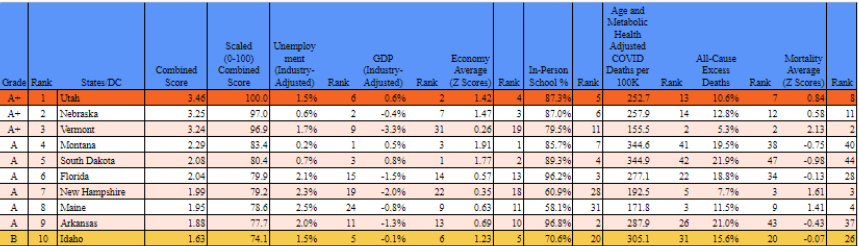
These two are excerpted from Phil Kerpen’s, Stephen Moore’s, and Casey Mulligan’s A FINAL REPORT CARD ON THE STATES’ RESPONSE TO COVID-19, a working paper published through the National Bureau of Economic Research. The first table identifies the 10 States that performed best during the height of the Wuhan Virus situation, as assessed across three variables: the economy, normalized by State industry composition; education, as measured by lost school days; and mortality, normalized by State population age and the prevalence of obesity and diabetes (leading co-morbidities for Covid deaths).

The second table identifies the 10 States that did worst.

States that opened from lockdowns early in the virus situation did better overall and on education and economic measures, and those same States did as well as (Florida vs California, for instance) or better on health outcomes related to lockdowns.

Oddly, those States that did best are Republican-led, and those States that did worst are Progressive-Democrat-led.

Go figure.

Note: right-click on the tables and select Open Link in a New Tab to get a bigger image.

This, Too, Is a Start

To paraphrase an old trope, transgenders are people, too. Whether gender dysphoria is truly the case in particular individuals, or it’s a sham claim by some boys and young men in order to gain access to girls’ and women’s sports competition (or just their locker rooms), or it’s the manufacture of woke “schooling,” transgenders, those victimized by that pseudo-schooling, even the cheaters, need a place to compete.

Just not a place where males transgendered into women compete against women. Nor should women transgendered into men be competing against men, but given the nature of transgendering, that’s not a problem.

Men and women, boys and girls, start out with the facts of biology: an XX set of chromosomes or an XY set. That beginning, at the egg-sperm uniting stage and throughout subsequent development, confers on the male stronger, heavier bones, and stronger and heavier muscles. The different origin and development paths also impart permanently different hormone sets and bodily outcomes from those differing hormones. And that’s just the start. No amount of hormone therapy, no amount of testosterone withholding—or adding, in the case of girls transgendering into boys—changes those inherent physical advantages that born-boys have over born-girls. Not even the differing hip and shoulder structures change post-transgendering. The physical advantage is permanent.

Lia Thomas, via the recently concluded season of NCAA swimming, provides a canonical example. Her performance advantage was heavily illustrated both by her margins of victory in the women’s competitions and by the level of his performance when competing as a man the prior years.

And so we have the Utah legislature enacting, over Governor Spencer Cox’ (R) veto, a bill banning transgender competition in Utah’s schools. Cox had said he’d tried to do what I feel is the right thing regardless of the consequences. His veto letter centered on his concern that ensuing lawsuits

will likely bankrupt the Utah High School Athletic Association and result in millions of dollars in legal fees for local school districts with no state protection….

His four-page veto letter listed other concerns centered mostly on the process by which the bill was amended (several times) and then enacted.

Cox’ fiscal concern is valid, if somewhat overblown—a firmly zealous early defense would forestall further lawsuits and mitigate their total costs.

Still, the legislature’s move is—can be—only a start. Transgenders do need a place, a means, by which they can participate in sports. Now it’s time to set up a Title IX athletics program for transgender athletes so they can compete against their peers, and women can go back to competing against their peers.