
An Old Dead Guy’s View of National Debt

On this, the 80th day shy of the 215th year since George Washington’s Farewell Address, an anniversary made notable by our present astronomical and exploding national debt, I thought I’d post what that old dead guy had to say about national borrowing and national debt.

The short version is, “Don’t do it, and don’t have it.”  Following are his specific words.

As a very important source of strength and security, cherish public credit.  One method of preserving it is to use it as sparingly as possible: avoiding occasions of expence by cultivating peace, but remembering also that timely disbursements to prepare for danger frequently prevent much greater disbursements to repel it; avoiding likewise the accumulation of debt, not only by shunning occasions of expence, but by vigorous exertions in time of Peace to discharge the Debts which unavoidable wars may have occasioned, not ungenerously throwing upon posterity the burthen which we ourselves ought to bear.  The execution of these maxims belongs to your Representatives, but it is necessary that public opinion should cooperate.  To facilitate to them the performance of their duty, it is essential that you should practically bear in mind, that towards the payment of debts there must be Revenue; that to have Revenue there must be taxes; that no taxes can be devised which are not more or less inconvenient and unpleasant; that the intrinsic embarrassment inseperable from the selection of the proper objects (which is always a choice of difficulties) ought to be a decisive motive for a candid construction of the Conduct of the Government in making it, and for a spirit of acquiescence in the measures for obtaining Revenue which the public exigencies may at any time dictate.

Notice that bit about taxation, too.  Taxes are for paying down the national debt and for the common defence, not for frivolous spending.  But again, the overriding imperative this Founder laid out is that our nation’s debts should be kept small by keeping spending small, and those debts should be paid by the generation that incurred them—not visited on our children’s children.

We citizens bear an additional responsibility in this, too: not to make frivolous demands on government to do for us that which we should—and can—do for ourselves.

Á propos is this remark by David Ricardo in response to Great Britain’s decision to print fiat money in an effort to increase funding for their war against Napoleon (one of those “unavoidable wars” to which Washington would have been referring, and not too far removed in time from Washington’s address):

Why should the mere increase of money have any other effect than to lower its value?  How would it cause any increase in the production of commodities? ….

Money cannot call forth goods, —but goods can call forth money…[.]
The Progressive Endgame

What Progressives don’t understand—won’t accept—is that, as Eric Falkenstein wrote

People get most of their pleasure, and meaning, being useful to others, which includes inspiring the admiration or happiness of others by one’s actions. Every time I make my daughter squeal with delight makes me thankful to be alive, because I know she really loves me, and I work to provide her with things and habits that will make her prosper, and hope that at some point after I’m gone she will remember me with sincere gratitude.

This made especially in the actual community interactions of individuals.  Progressives are only willing to help their fellows by government diktat, not directly with their personal resources.  I’ve written elsewhere about who donates to charity, for instance, but it bears repeating: Conservatives donate 3.5% to 4.5% of their incomes; Liberals just 1.25% to 1.5%.  And further,

A healthy wage is a strong correlate with one’s usefulness to non-family members, especially if you work in field without a lot of regulation.

Adam Smith understood this.  John Locke and our Founders understood this.  The “invisible hand” and the existence of a social compact both are founded on the not-so-enlightened self-interest—the greed—of the individuals participating in the commerce and in the formation of the social compact.  Free commerce, and the republican government over which the compact members are sovereign, are what lead to the greatest material and moral prosperity of the individuals involved.  The first is self-evident.  The second derives from that material prosperity: being useful to others, indeed, satisfying our duty to others (which involves such mundane things as honoring our commitments, here to provide our mutual support to defend and preserve our—and our fellows’—individual and several inalienable Rights, to help those less fortunate than ourselves, and so on) is enormously facilitated by personal prosperity (which, just incidentally, also creates community prosperity): we have more wherewithal with which to satisfy our individual obligations (which are, don’t forget, individual, not collective).

Falkenstein concludes

[Eric Hoffer considered that] intellectuals found free societies a threat because such societies didn’t need mandarins directing them, and if not flattered would help incite the masses to some sort of revolution.  A man is likely to mind his own business when it is worth minding, and so those unhappy with their own meaningless affairs will focus on minding other people’s business.  Hoffer noted one must not merely provide for those without meaning in their lives, but provide against them, because in a democracy and market economy their preferences will have power.  Those who see their lives as inferior and wasted crave equality and fraternity more than they do freedom, and this can cause a Republic to fall to a democracy, and ultimately a tyranny.

Thus,

In other words, Hoffer describes the essence of the Liberal [I say Progressive—ed.] desire to micromanage society into perfect equality at the expense of liberty.  A coalition of intellectuals and the underclass, both of whom feel unappreciated.  We haven’t figured out a good outlet for these do-gooders, or a good way for those without a purpose to find life rewarding, so they continue to plague us with their plans and angst.

When the Shoe’s on the Other Foot

Progressives spent $741 million on their 2008 Presidential campaign, and President Obama announced a goal of $1 billion for his spending on the current campaign.  Candidate John McCain spent all of $228 million on his.

Today the Republicans are competing on even ground—even leading the Progressives in some areas—in campaign funding, while Obama’s $1 billion goal is at risk.

The Progressives’ response?  They’ve petitioned the Federal Election Commission with a formal complaint, demanding that the Republican donors to those SuperPACs that don’t side with the Obama camp be revealed; in particular, they’ve complained out the Crossroads GPS SuperPAC.

Never mind that Crossroads, and the other SuperPACS, is organized under a section of the tax code that allows it, and all SuperPACS—conservative and liberal—to keep its funding sources private.

Robert Bauer, a lawyer for the Democratic National Committee, wrote in the complaint to the FEC, in all seriousness

There has never been any doubt about its true purpose: to elect candidates of its choice to the presidency and Congress.  Crossroads has tried to shield its donors—wealthy individuals, and corporations who may be pursuing special interest agendas that are not in the national interest.

They make this complaint even though there’s no requirement for donors to SuperPACs to lose their anonymity.  Never mind what the law says.  The law is what Progressives say it is, as Obama has already made clear in another matter.  Never mind what the national interest is.  The national interest is whatever the DNC says it is.

That this is simply a dishonest attempt to stifle campaign donations by the wrong side (in the manner of the KeepingGOPHonest Web site, among others), and so to stifle the political speech of those who are saying things of which the Progressives disapprove.  That there is no legitimacy at all to this beef is demonstrated by the Progressives’ decision to file their “complaint” first with a newspaper (The New York Times) and only after that with the Federal Election Commission.

Oh, yeah—the Progressives have Priorities USA, which is organized under the same tax code section as is Crossroads.  And whose donors are carefully kept secret, as is entirely appropriate under the law.  But Priorities isn’t having the same fund-raising success as Crossroads.

It’s no fair the other side is doing well—we’re supposed to win, dammit!

Food Stamps and Poverty

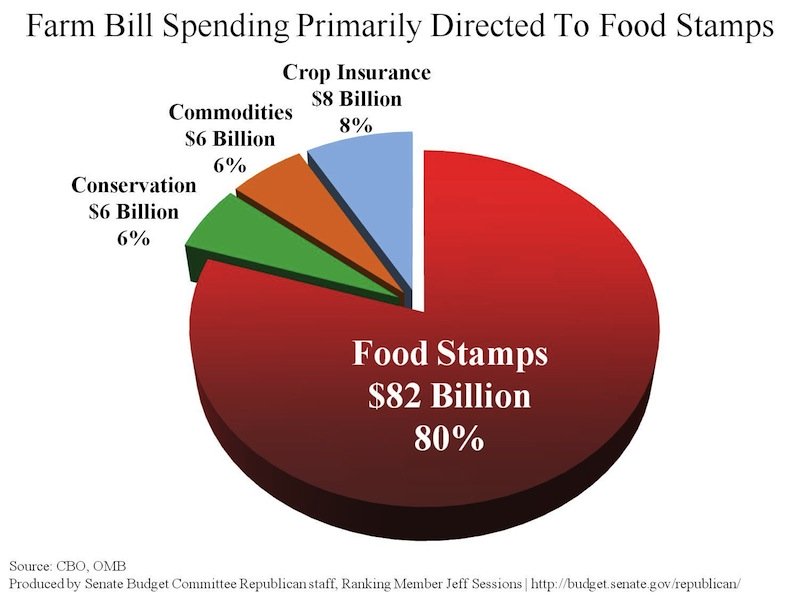
John Hinderaker, at Power Line, notes that the Progressives in the Senate have voted down even a modest (some might say trivial) reduction in Federal spending on food stamps—using your tax money.  (Note, by the way, that 100% of the spending on food stamps is by the Feds; no state spends one red cent of state monies on these.)  The offered reductions were in the form of three  amendments, two put forward by Jeff Sessions (R, AL):

  • establish a federal asset test to ensure that food stamps aren’t going to families that may not have an income but have tens of thousands of dollars in savings or may even live in a million-dollar home
  • prevent states from waiving federal eligibility requirements for the program
  • eliminate the bonuses that the federal government now pays to states that deliberately swell the ranks of food stamp recipients.

The spending mandated by the Farm Bill to which these amendments were to be attached is shockingly weighted, as this graph shows: There are a couple of other aspects of this Progressive demand to spend your money on their food stamps.  Forty-six million Americans currently live below the poverty line as a result of President Obama’s failed economic and social welfare policies.  Thirty-nine states have no limits at all on the fiscal well-being of a family in determining that family’s eligibility for food stamps—anyone who applies qualifies—and twenty-eight states have limits that are more than 130% above the Federal Poverty Guideline (which differs in a trivial way from the Federal Poverty Threshold that the Census Bureau uses to determine the number of Americans living in poverty).

Of those 39 states (the full list can be seen in Table 1 of the Congressional Research Service’s “The Supplemental Nutrition Assistance Program: Categorical Eligibility“), California, Illinois, and New York alone account for 70.5 million Americans.

Under Federal law, which the Progressives have refused to alter in any meaningful way, vastly more Americans are eligible for food stamps than are actually living in poverty.  Food stamps no longer are a program to help the needy; they’re a program to get and keep Americans dependent on a Progressive-run government for their welfare.  They’re a Progressive Incumbency Welfare program.

Student Subsidies and the Federal Government

I’ve written before about the failure of subsidies, their feel-good and superficial benefits notwithstanding.  The student subsidy that is a Pell Grant is a case in point.

Jenna Robinson and Duke Cheston, of the Pope Center for Higher Education, reported a bit ago on the growing excesses of the Pell Grant program (the full report can be read here or here).  The program consumed some $36 billion in the 2009-2010 academic year, half the Department of Education’s budget.  This also is—surprise—the Federal government’s largest education expenseinvestment.

Here’s what’s been done over the last several years, of which those $36 billion are only the latest, with/to a program that began life 30 years ago as a well-intensioned program to help the poor go to college.

  • In the 2009-2010 academic year, 60% of all college students received a grant—9.6 million students.  Between 2008 and 2010, the number of Pell recipients increased by almost 50%, roughly doubling taxpayer cost (this is a government charity, not a private one).
  • The maximum grant was raised to $5,550 beginning 2011 from 2008’s $4,731 per year.  This further encourages creative accounting: a 2009 study by Christina Chang Wei and Laura Horn (“A Profile of Successful Pell Grant Recipients: Time to Bachelor’s Degree and Early Graduate School Enrollment”) found that 60% of Pell Grant recipients were “financially independent” of their parents, compared with 34% of non-recipients.  Being “financially independent” means the parents’ finances have no bearing on student need or eligibility.
  • Better-off students often take their large Pell Grants and go to more expensive schools.  In that 2009-2010 academic year, 20% of Pell grantees from families making over $60,000 (so much for “financially independent”) went to schools that cost $30,000 or more per year with the aid of those Pell Grants.  Students from lower income families, without that wealthier base underlying their own grants, attended those higher-cost schools at a significantly lower rate—13%.  (By itself, this should be no big deal; people should go where they can afford to go with their money.  But this isn’t their money, it’s our taxpayer money—and our charity should help folks get by, and get a leg up, not help them live large.)

What did we gain from this…government largesse?  The usual subsidy distortions, but no improvement in academic performance or ultimate success.

  • An apparent increase in college enrollment by poor students—from 46% in 1970 to 59% in 2009, but
  • Poor actual performance, at least comparatively: graduation rates were lower for students who received Pell Grants than for those who didn’t.

And, as the WSJ points out, in the manner of all subsidies

  • Pell Grants contribute to the ever-rising tuition spiral: colleges and universities learned long ago how to capture that extra cash, and they adjust their price schedules accordingly.

Hmm….