Collapse of the Euro?

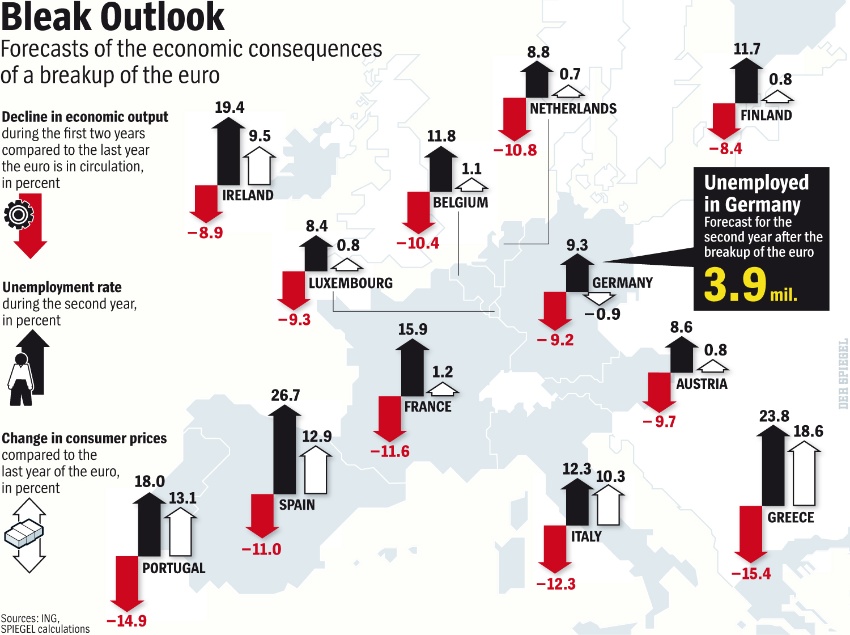
Much is being made of the impending collapse of the euro, and of the disaster this would represent for Europe.  Indeed, a graph published by Spiegel Online can look frightening:

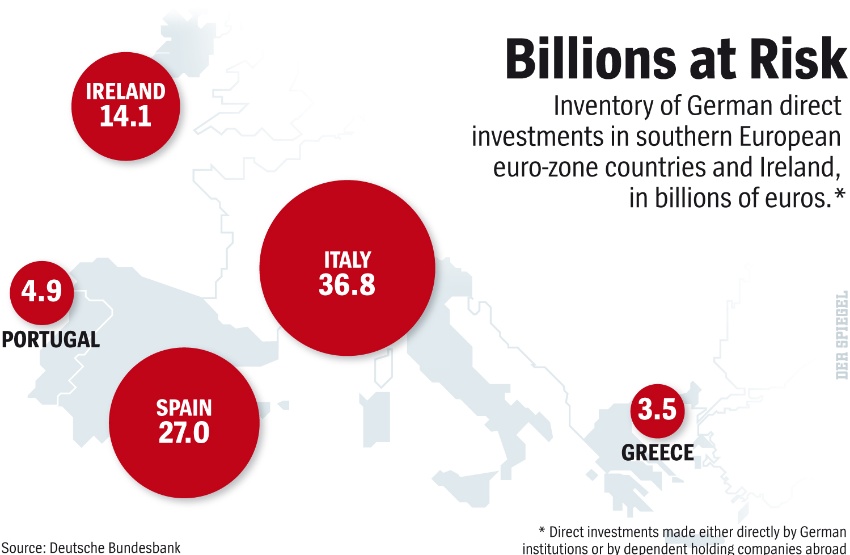
The risk to Germany in particular?  Much is made about the money Germany and Germans have in some of the PIIGS, as the graph below indicates.

But against the German 2011 GDP of €2.57 trillion, this totals to less than 4%.  That will sting, but not much.

As I’ve written before, a breakup would be near-term disruptive.  But what happens after those two years of the first graph above?  There needn’t be a disorderly collapse.  Even this short term disruption (pop quiz: what are the current inflation and unemployment rates in the PIIGS?), the stronger economies will recover, and do so faster without the albatross of the profligate spend-and-borrowers dragging on their wallets.  Furthermore, it’s not too late to realign into a small collection of smaller common currency regions, each with free trade agreements with the others.  Within each smaller currency region, there would be a far larger opportunity for social, political, purpose-of-money homogeneity, and so a far greater chance of success.

The single alternative of every nation for itself with its old currency back is simply the other half of a false dichotomy presented by Spiegel Online—and by Europe’s politicians, who have a personal interest in the continuation of the current, failing, structure.

A Town Understands Frivolous Costs

In at least one town, it costs up to $30k to add extra police, fire, and so on for a Presidential visit.  Those hosting towns generally suck up and pay those costs when the President comes a-calling on official business, but who pays when it’s a purely campaign visit?

Durham, NH, says the President’s campaign team should pony up.  The city government’s press release said

Community leaders do not believe that costs associated with the campaign should be borne by local taxpayers.

And Town Manager Todd Selig added

Community leaders have taken the position that the campaign, regardless of party affiliation, should absorb the added local public safety costs rather than local taxpayers.

A carefully anonymous Obama campaign official told CBSBoston,

The campaign will follow all rules and pay for the portion of travel that relates to political events, as has been true for previous incumbent presidential candidates.

Frankly, this just sounds like more Obama weasel words to put another fund-raiser on the taxpayer’s nickel.  Entirely.

It’s moot for now, though:  Selig said on Sunday that an anonymous donor—who Selig says insists that the town is doing the right thing by declining to pay for a campaign stop—has donated $20k to the town for the incremental costs related to the President’s campaign stop.

Hope and Change

The last 3½ years have seen a lot of this slogan.  While the hope—for the better—waned long ago, President Obama has, in fact, achieved quite a lot in the way of change.  Here are some of those changes:

He got Obamacare rammed through, albeit in the dark of night in a wholly, cynically, partisan manner, and he did it without a single Progressive (or Republican, come to that) congressman actually reading the bill prior to voting on it—some proud in their ignorance.  This bill achieves quite a lot: it lets children extend their childhoods and parental dependencies to their 26th year, by staying on mumsy’s and popsy’s health insurance policies.  It adds to the Federal deficit with its trillion-dollar costs.  It lets you, taxpayers, pay for coverage for an additional 20+ million health insurees.  It nationalizes the health care and health insurance industries.

He got Dodd-Frank rammed through in the same manner and with the same level of Congressional ignorance.  And pride of ignorance.  This bill also achieves quite a lot.  It creates a fourth branch of government in the Consumer Financial Protection Bureau and the Financial Stability Oversight Council.  These two agencies are wholly unaccountable to the Congress—and so to us—are not under control of the President, and at least the CFPB’s budget comes, on demand, from the Federal Reserve System.  Yet these two will, single-handedly and without oversight, determine whether financial institutions will be allowed to do business (vis., extend loans or credit of any sort—even at your corner mom and pop grocery store) and the conditions under which they will be allowed to do so.

He’s achieved a trillion-dollar cut in our defense capacity at a time of rising PRC aggressiveness, a soon-to-be-nuclear-armed Iran, and an expansive, grasping Russia.  This includes a shrinking Navy, a gutted Army, and an Air Force with little capacity for anything other than looking pretty in fly-bys.

In an apparent nod to an earlier Secretary of State, Henry Stimson, he’s leaking every cyber-warfare and counter-terrorism secret we used to have to the news outlets.  Apparently, if we have no secrets, other gentlemen have no need to resist the temptation to read ours.  Or he subscribes to the theory that if we tell our enemies everything we have, we don’t need to spend our resources trying to figure out what they know about us (another savings!).  Or both.

He’s instructed his DoD to desist using unpleasant interrogation techniques.  And, since he believes our enemies have no knowledge of anything that’s of intelligence value at all, he’s instituted a program of killing them rather than capturing them and having to figure out how to hold them and question them.  And he brags about personally selecting, by name, the ones that are to be assassinated—a Roman circus thumbs down from the Emperor.

No, Obama has wrought enormous change.  Just all of it has been destructive of our great nation.

We need to fix this.

Another Out of Control Regulation

This regulation began as a Bush the Younger administration’s EPA attempt to work on an environmental problem now known to be non-existent.  Unfortunately, it’s being continued under an Obama administration EPA for no reason other than a cynical exercise in governmental power for the sake of that power.

The regulation in question is the EPA’s requirement that oil refiners mix into their refined fuels millions of gallons of a cellulosic ethanol, even though that additive does not exist.  This has the refiners in a quandary because the EPA is intent on fining them heavily for their failure to use this ghost chemical.

Tom Pyle of the Institute of Energy Research points out that

None, not one drop of cellulosic ethanol has been produced commercially. It’s a phantom fuel.  It doesn’t exist in the market place.

He goes on

Why would [the EPA] ask them to blend any at all if it doesn’t exist?  Because they know that they can squeeze some extra dollars out of them.

On the other hand, the EPA does have the authority to relax the requirement, and apparently they’re in the process of that.  The cellulosic ethanol blending requirement is, supposedly, being reduced by 98%.  Thus, in the end, the refiners only need to use 2% of this non-existent additive compared to their original requirement.  There’s a break.  Charles Drevna, representing refiners, has the right of this.

[The EPA is] forcing us to use a product that doesn’t exist; they might as well tell us to use unicorns.

He added

We’ve had to go to the courts and litigate this thing is because [the EPA] just turned a blind eye to us[.]

They have to because that mandate, the potential per centage reduction notwithstanding, just gets larger and larger: 500 million gallons of cellulosic ethanol this year, 3 billion in 2015, and 16 billion in 2022.  Never mind that nobody is making this stuff.

It shouldn’t have come to this.

Federal Overreach

As C Boyden Gray and Jim R Purcell note in a recent Wall Street Journal op-ed, the Dodd-Frank Wall Street Reform and Consumer Protection Act of 2010 is an especially egregious example, an Act that arrogates vast power to the Federal government and then concentrates it in the Executive Branch.

As they note,

Dodd-Frank created both the Financial Stability Oversight Council and the Consumer Financial Protection Bureau, giving each agency effectively unlimited power. The FSOC can declare a financial firm “systemically important”—that is, too big to fail—based on “any” “risk-related factors” that it “deems appropriate.” And the CFPB can punish even responsible lenders who in good faith offer loans that the bureau later deems to be “unfair,” “deceptive” or “abusive.”

Demonstrating just how far this overreach is intended to go, the illegally appointed head of the CFPB, Richard Cordray, has instructed Congress that it is “probably not useful” to define in advance what an “abusive” lending practice is.  No, he’s just going to use his enormous, and unconstrained, his enforcement powers to retroactively punish lenders based on his carefully ex post definition of the “facts and circumstances” of each of their cases.  Nice company you got there.  Be too bad if something was to happen to it.

That this overreach is deliberate is demonstrated by the Act’s cynical elimination of any pretense of control by any branch of the government over these two Executive Branch bureaucracies, and the Act’s cancelation of even the most ephemeral separation of the three branch’s powers.

The CFPB is not subject to Congress’s “power of the purse,” which James Madison knew to be Congress’s “most complete and effectual weapon.”  Instead, Dodd-Frank lets the CFPB claim more than $400 million from the Federal Reserve each year and prohibits Congress from even reviewing that budget.  The president’s control over the CFPB is limited because by law he can remove the agency’s director only under strictly limited circumstances.  Finally, Dodd-Frank limits the courts’ review of CFPB’s legal interpretations.

And

The FSOC is similarly free from checks and balances.  For example, when the Council—a working group of the Treasury secretary, Federal Reserve chairman, comptroller of the currency, and other unelected regulators—anoints a financial institution as too big to fail, the courts are prohibited from even reviewing whether the regulators properly interpreted the applicable laws.

And that illegal appointment?  Cordray was given a recess appointment while the Senate was in session.

So much for the Constitution, that document that’s more than 100 years old and hard to understand.  So much for the Rule of Law.

RTWT.