Fun Facts with Taxes

Some of this is old hat, but it’s worth reviewing, and some of this is relatively new.  All courtesy of Ari Fleischer in a recent Wall Street Journal piece.

[T]he only group in America paying at least a “fair share” is the top 20%—people who make more than $74,000. For everyone else, the tax code is a bargain.

This figure shows the rest of that breakout—who earns and who pays:

Note that: 60% of the income-receiving population, those bottom 3 quintiles, are just that—receiving, while paying far less in taxes.

Additionally, the trend is toward greater concentration of tax payments into fewer earners—greater unfairness.  The CBO’s “The Distribution of Household Income and Federal Taxes, 2008 and 2009” report makes this plain.

In 1979, the top 20% made 44.9% of the nation’s income and paid 55.3% of all federal taxes.  By 2009, the top 20% had risen to 50.8% of the nation’s income while their share of federal taxes paid had risen further, to 67.9%.

That’s a 13% increase in income and a 23% increase in federal tax “share.”  Meanwhile,

In 1979, the bottom 20% paid 2.1% of the federal taxes.  In 2009, their share of taxes has shrunk to 0.3%.

In 1979, middle-income earners ($34,900 to $50,100) paid 13.6% of all federal taxes.  In 2009 they paid 9.4%.

Hmm….

On the Cost of Tax Breaks

Here’s one more argument for a flat, no deduction, credit, subsidy, etc tax code.  Using the structure as a social or economic engineering tool just doesn’t work.

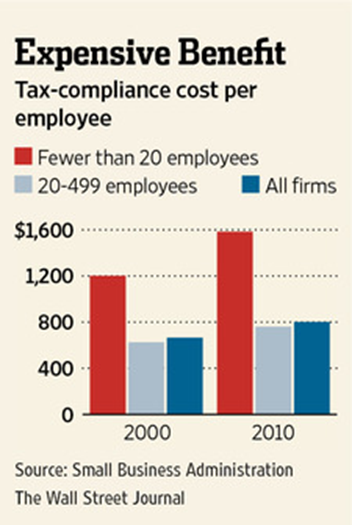
From John D McKinnon’s article in The Wall Street Journal at the above link comes this figure, showing the cost of meeting the requirements for getting Federal tax breaks generally, broken out by company size.

John Raine, CEO of Raine Inc., an Indiana manufacturer of belts and holsters for the military and other customers has an all too typical position about these “breaks.”

I usually avoid these targeted tax incentives, because it costs so much just to be compliant that it’s not worth messing with.  I can’t run a business based on what area the federal government is trying to juice.

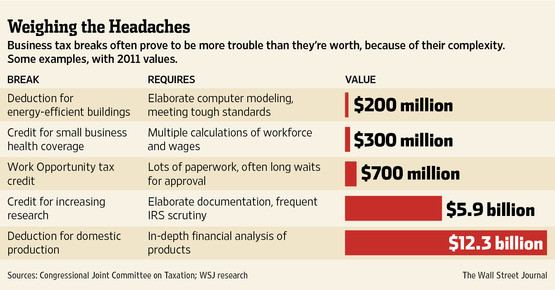
The Federal Work Opportunity credit is another example, and it, too, has a typical response.  The Work Opportunity credit was designed to reward companies for hiring people from any of a number of disadvantaged categories of workers—welfare and food stamp recipients, youths seeking summer jobs, ex-felons, and the like.  The credit is worth up to $2,400 per employee, and for businesses hiring unemployed veterans, it can be worth as much as $9,600 per.

The credit is too much trouble to collect, though.  It requires extensive paperwork for each claimed worker, and incredibly, the paperwork can take a year or more to process.  Assistant Professor of Economics at the University of Florida, Sarah Hamersma, has estimated that the credit is taken for only 20%-35% of all eligible workers.

McKinnon reports

JJ Pledger, Chief Financial Officer for the Twisted Root gourmet burger chain in the Dallas-Fort Worth area, said he spent the better part of a day last year trying to figure out how his company could obtain the credit.  Mr Pledger, a CPA, knew the credit likely would be available for a number of his company’s 200 or so annual hires.  But the more he read, “it seemed like the documentation of the tax credit could be really hard to administer,” he recalled.  One concern was all the personal information needed from job applicants. “So I put it on the back burner….

There are other examples in McKinnon’s article.

Compliance costs for US businesses and individuals have reached 1% of GDP, roughly $150 billion last year.  Out of 1.78 million US corporate tax returns, only about 20,000—just above 1%—claimed any of three dozen main business tax credits, the IRS estimates.  This figure illustrates another aspect of the costs of these “breaks.”

It’s just too hard a thing to do to collect these, never mind the value.

I’ll say it again: flat tax.  No deduction, no subsidy, no credit, no nothing.  Say what your top line income was.  Pay 10% of that.  Be done with it, and all on Governor Rick Perry’s postcard.

Defense Cuts on the Stump

President Obama, speaking before the VFW the other day, had some interesting words to say about defense, and cuts to our defense capability that are looming.  Naturally, I have a few words to say about what he said.

People in Congress ought to be able to come together and agree on a plan, a balanced approach that reduces the deficit and keeps our military strong[.]

Indeed.  When are the President and his fellow Progressives in the Senate going to get out of the way of a bipartisan solution and allow one, instead of throwing our nation’s security away on his demand to raise taxes on his disfavored group of Americans?  After all, it’s Obama’s demand that taxes be raised, rather than spending be cut elsewhere—like in our bloated entitlement programs—that’s standing in the way of salvaging our defense establishment.

And there are a number of Republicans in Congress who don’t want you to know that most of them voted for these cuts. Now they’re trying to wriggle out of what they agreed to.

Nah—they’ve made no bones about this.  Obama held a gun to their heads and forced the idiocy of sequestration during the debt ceiling “negotiations” when he threatened to destroy our economy if he couldn’t get his tax increases, even to the point of cynically blowing up an agreement that had been reached—including revenue increases, if not tax rate bumps—with his last-minute (literally) demand for an additional $1 trillion increase in taxes.

Instead of making tough choices to reduce the deficit, they’d rather protect tax cuts for some of the wealthiest Americans, even if it risks big cuts in our military.

Again, indeed.  Instead of making tough choices to reduce the deficit, Obama is ready to impose destructive cuts on our military in order to get his taxes on his disfavored Americans, and I’ve got to tell you, Mr Obama, I disagree.

As we look ahead to the challenges that we face as a nation and the leadership that’s required, you don’t just have my words, you have my deeds.

President Obama’s deeds are especially frightening.  His “deeds” include the idle chit-chat that’s allowing Iran to get nuclear weapons.  His “deeds” include the idle chit-chat that’s allowing the Syrian boss Assad to butcher his own citizens—19,000 of his fellow Syrians—and to move his chemical weapons arsenal and prepare it for use against surviving Syrians dissidents.  His deeds include surrendering to Russian demands and throwing Poland and the Czech Republic into the teeth of the Bear and cancelling a plan to build missile defense installations in those two countries.  His deeds include surrendering American foreign policy to the veto authority of Russia and The People’s Republic of China, especially vis-à-vis Iran and northern Korea.

His deeds include his claimed end to a war in Iraq that was already won and done, with only a SOFA to facilitate American troop presence for training to be negotiated.  Without any American presence—Obama’s crowning achievement here—Iraq is falling apart under terrorist attacks and secular and religious strife, and al Qaeda is resurgent.

His deeds include winding down the war in Afghanistan with an announced withdrawal schedule and nothing left behind.  He’s snatching defeat from the jaws of victory, as the Taliban are still in the field and effective, while the Afghan army is neither.

House Armed Services Committee Chairman, Buck McKeon (R, CA) has the right of it:

President Obama played no small part in setting the time bomb that is sequestration.  Indeed, automatic defense cuts were included in the Budget Control Act at his insistence.  Now he owes our troops his best efforts to defuse the cuts.  Ultimatums from the campaign trail are not enough.

The challenges we face as a nation are legion, the future is near, and the leadership Obama has demonstrated and the deeds he’s done, make change imperative.

A Bit More on Free Speech

Indiana University Southeast has a rather appalling view of the First Amendment.  One aspect of it, as Maegan Vazquez notes in a recent Fox News article is

One stipulation in the code requires that students may only “express opinions” within a free speech zone….

Yet, according to the Indiana University system’s overarching code,

In accordance with the state and federal Constitution and university policy, the university recognizes the rights of all students to engage in discussion, to express thoughts and opinions, and to assemble, speak, write, publish or invite speakers on any subject without university interference or fear of university disciplinary action.

What the IUS’ code says on the matter is this:

  • Persons wishing to express their opinions, distribute materials or assemble on campus in accordance with the state and federal constitution in relation to their right to free speech, must submit an Application to Schedule Facilities form. … This Application should be submitted at least five (5) days prior to the event. Approval must be granted before an event can take place.

and

  • … The free speech area on campus is customarily in the McCullough Plaza. However, other locations which do not disrupt functions of the university may be identified by the Director of Campus Life in consultation with University Police.
  • … Materials may not be posted on campus other than the designated kiosk in the Commons.

Notice that.  IUS presumes to demand an academic week’s advance notice before an expression of opinion—a demonstration, a protest—can be conducted.  To be sure those wishing to express an opinion can appeal the decision, but only to an IUS agency—they’re forced to ask the university to overrule itself.

The university, in a statement to Fox News actually said the following with a straight face:

[The guidelines] were intended to provide some guidance on the issue so that those wishing to gather and express an opinion could do so without endangering people or property.  The guidelines also were intended to protect the rights of all students to have unfettered access to educational activities on campus (in other words, the exercise of free speech rights should not result in blocking access to buildings or disrupting classes or campus events).

Here is the university cynically ignoring the myriad of state and Federal law that already governs “endangering people or property.”  Instead, IUS wishes to engage in prior restraint: restrict legitimate activity on the idle speculation that nefarious results might—might—ensue.

Here, too, is the university cynically ignoring the fact that no small part of free political speech—that 1st Amendment bit that’s part of that confusing, older than 100 years scrap of paper that isn’t binding on anybody, anyway—is attention-getting disruptions.  They’re also ignoring that such disruptions contribute to the credibility—or its lack—of the protest message.  By insisting on controlling for themselves political speech, they’re also insisting that their non-protesting students are too stupid to draw their own conclusions about the message of the protest (which makes me wonder on what all those students are spending their college money, to be getting such shoddy teaching in critical thinking).

Associate Professor of Political Science and Dean of the School of Social Sciences at IUS, Joseph Wert, says with equal seriousness,

We have to regulate other groups who come from off campus. Some come and preach a lot of hate. We just can’t have them wandering around campus with bullhorns over here….  Governments have the right to restrict the time and place of these things….  If they were regulating content–I’d have a problem with that[.]

Let me see if I understand this.  In order to control the behavior of those with no affiliation with the university who enter the campus from outside, the good Professor actually thinks it’s necessary to regulate the speech of university students.  Never mind that the university—like all colleges and universities—have the authority to restrict access by outsiders, and to restrict the behaviors of those outsiders allowed onto campus, without at all touching student activity.

Then there’s this: when the university restricts the time and location of speech, it is perforce, regulating its content—by permitting it to be spoken at all, or not, except at a time and place of university choosing.

In the end, what we have is a university restricting even individual peaceful expressions of opinion to a specific location of the university’s choosing, at a time of its choosing.  Even simple flyers expressing free opinions are permissible only in a designated location—too small to accommodate everyone’s flyers.   Everywhere else on campus, it’s not legal under IUS’ Code to express a differing opinion.  Not at all.  Not anywhere.   Never mind that this is a direct contradiction of the Indiana University system’s governing Code.

As the Senior Vice President of the Foundation for Individual Rights in Education, Robert Shibley, put it,

[The University is] teaching [college students] that they’re not equipped to live in a free society.

The Penn State Fiasco

I had some words about this earlier.  Now the sports authorities have weighed in.

The NCAA has penalized Penn State with the following primary sanctions:

  • fined Penn State $60 million
  • erased all of Head Coach Joe Paterno’s wins from 1998-2011
  • banned Penn State from the postseason for four years
  • permitted current and incoming football players to transfer to and immediately compete at another school (this permission runs for the entire college careers of current players.  Normally, players can transfer at any time, but they must sit out a year at their new school, with that year counting toward their 4-year eligibility)
  • capped football scholarships at 20 below the normal limit for four years (this is a roughly 25% reduction in scholarships)
  • placed the Penn State football program on probation for five years

The Big 10 has added (while reserving the possibility of adding further penalties) a ban on sharing in post season (bowl) revenues for four years, with an expected cost to Penn State of $13 billion.

On the whole, I agree with these.  A ban on football altogether for a year—the so-called death penalty—would have punished the player-students, who had nothing to do with their coaches’, Athletic Department, or University leadership failures.

However, I would have preferred additional sanctions: 100% termination of the remaining football coaching staff who were on the payroll last November; 100% termination of all Athletic Director staff associated in any way with the Penn State football function (including athletics, financial support functions, player recruitment (beyond the football coaching staff’s involvement), alumni relations as these apply to Penn State football, and so on); and termination of the Penn State University President, Vice President, and Chief of Operations, and their operational (as opposed to administrative) staffs—just clean house altogether.

Whether or not these people had anything directly to do with Sandusky’s behavior, their oversight was wholly inadequate: Sandusky could not have gone on as long as he did, nor could the cover-up of Sandusky’s behavior have gone on as long as it did, without a significant fraction of these staffs functionally condoning the behavior and cover-up through their own inaction.  Just generally require a wholesale house-cleaning.