Customer Choice

New Mexico’s Progressive-Democrat Governor Michelle Lujan Grisham has gotten to be enacted rules mandating battery cars and trucks in New Mexico.

Starting in calendar year 2026, 43% of all new passenger cars and light-duty trucks shipped to New Mexico auto dealerships by national auto manufacturers must be zero emission vehicles. Similarly, beginning in calendar year 2026, 15% of all new commercial heavy-duty trucks shipped to New Mexico auto dealerships by national auto manufacturers must be zero emission vehicles. These percentages gradually increase over time.

“Increase over time:” by 2031, those 43% rise to 82%. By 2034, the minima for Ford F-250, Ford F-450, and tractor-trailer type trucks rise to 55%, 75%, and 40%, respectively.

Disingenuously, Lujan Grisham says regarding those limits on choice,

The adoption of these rules is a victory for customer choice….

That’s the Progressive-Democrat’s definition of customer choice: the State taking on the burden of choosing, thereby relieving its subjects citizens of that burden.

No. I decline to use Lujan Grisham’s Newspeak Dictionary. I’ll stay with American English dictionaries and their definitions of “customer choice:” us ordinary Americans acting on our own selections.

That choice is clear, too, for the good citizens of New Mexico, who’ve already made theirs: less than 1% of the 650,000 vehicles registered in New Mexico, despite tax credits, are EVs. Those good citizens do, however, need to select better at the next ballot box.
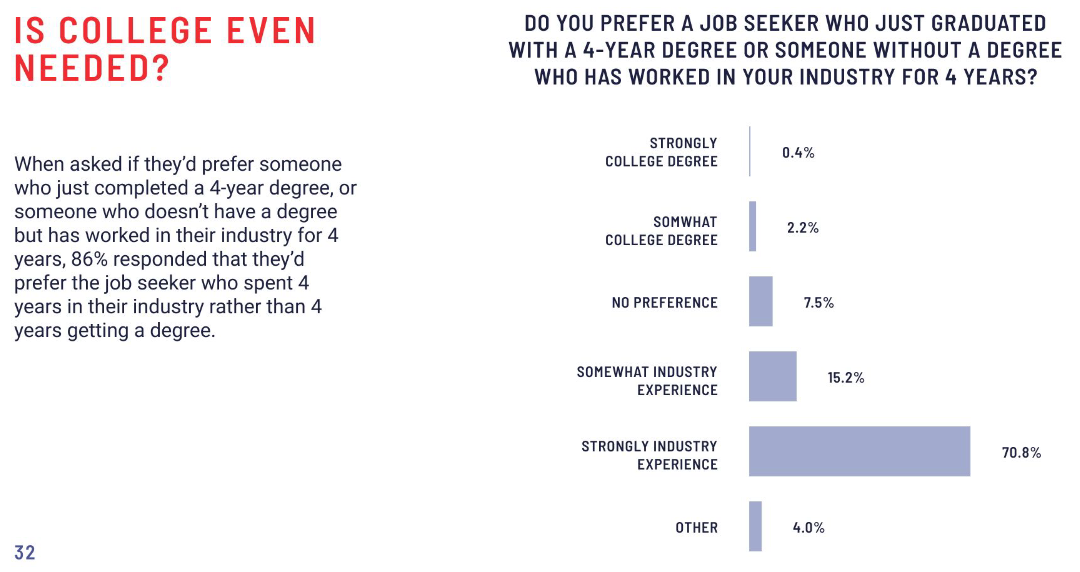
91%

That’s the outcome of a Freedom Economy Index survey of 70,000 small businesses, of whom 905 responded, producing a survey with a 3% margin of error and a 95% confidence interval for the outcome.

And having delayed the lede, here is that outcome.

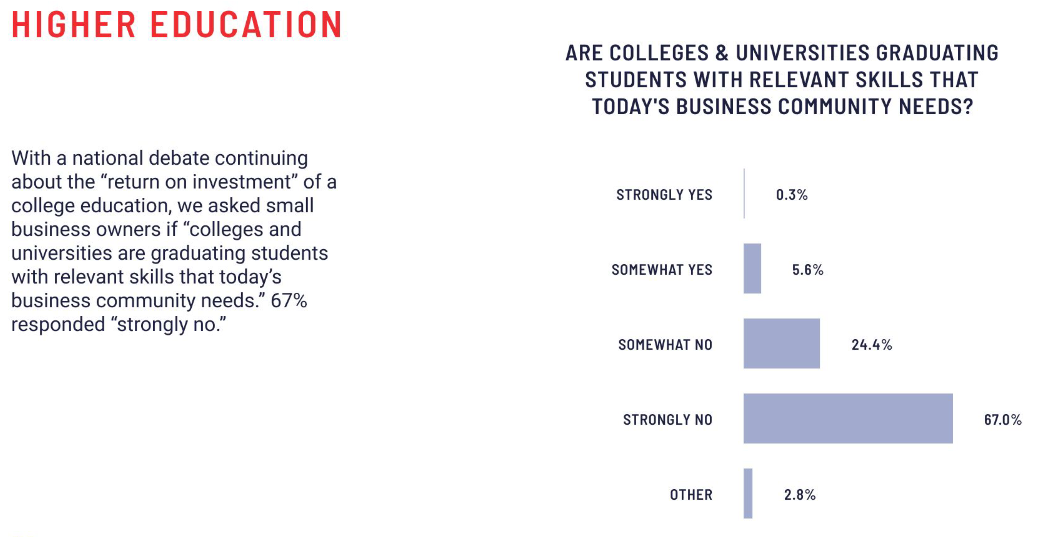
Fully two-thirds of the respondents think college graduates have educations that are useless to business needs, and another quarter of them think those graduates don’t have very useful educations. Here are some of the comments from respondents, which the survey reported verbatim:

  • The Talent shortage will just get worse because high schools and colleges produce no talent.
  • The skills should be taught in highschool [sic].
  • A good work ethic would be a good place to start!
  • They don’t show up to an interview, and work is too hard, 9-5 is such a struggle.

And this:

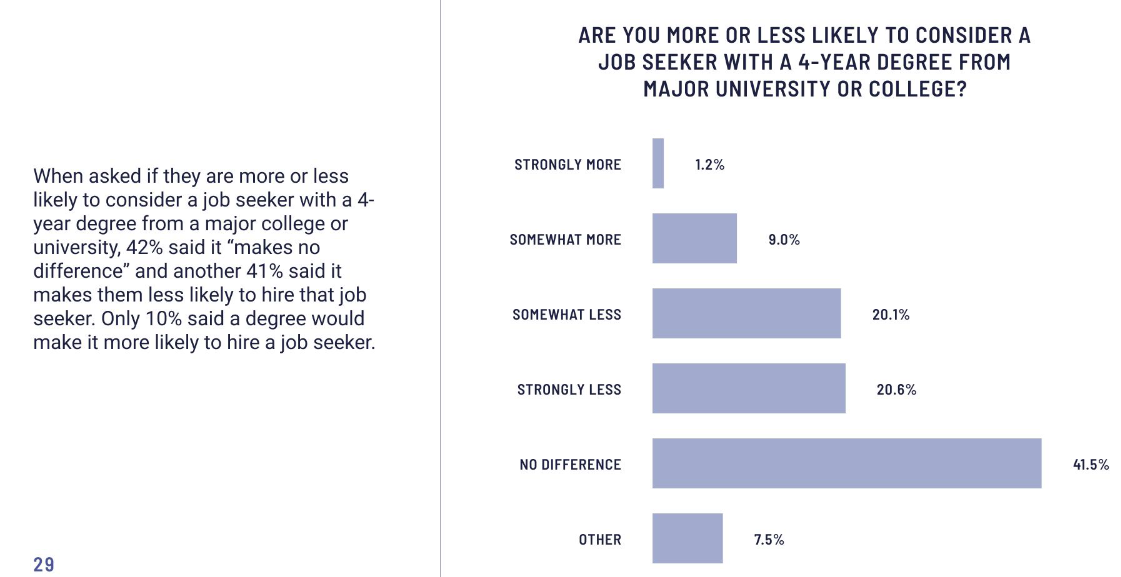
Four-fifths of the respondents’ positions range from don’t care about hiring a graduate of a “major” school to strongly less likely to hire such a one. Some more verbatim comments:

  • I found that graduates with the aforementioned scholastic achievements typically have an incompatible ideology with my business culture.
  • We would hire someone with hands-on experience over someone that read about it in a book.
  • I only care about skills. If you ain’t got the skills you ain’t got a job.

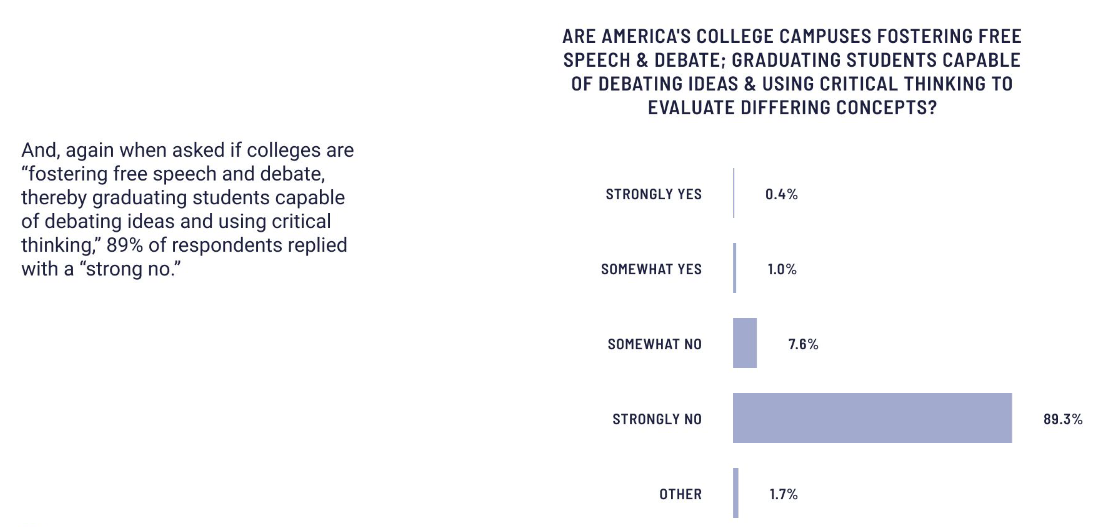
And these two, which pretty much speak for themselves:

Businesses—small businesses, anyway—are catching on to the utter failure that is our current generation of colleges and universities.

The survey itself covers a broad range of items of concern to the small business community; it’s well worth reading in its entirety.

Just How Infirm?

Just how physically infirm do Progressive-Democrat President Joe Biden’s advisors think he is?

People close to the president have discussed having him walk shorter distances while on camera. They’ve also advocated, at times, trading in formal shoes for more comfortable ones—both to make his stride seem less stiff, but also to reduce the risk of falls.

Or maybe switch to shoes that actually fit him? Or—the horror—sneakers, which are enormously comfortable, and who cares what he has on his feet, anyway? Except sneakers tend to have soles that grip the floor or the ground much better than the smooth leather soles of those evil formal shoes, and those grippier soles might be a bigger tripping hazard.

Alternatively, should Biden pull a Buttigieg and hitch a ride to within short walking distance, and then dismount/get out and walk a few steps for the cameras?

Maybe he should ride a bicycle to the podium—he’s checked out on dismounting from bicycles, isn’t he?

Or maybe he should just sit in a wheel chair and power himself to within a short distance from the podium. Texas Republican Governor Greg Abbott has no trouble doing that. Except Abbott goes all the way to the podium and speaks from there.

On the other hand, other staffers have indicated, anonymously, that Biden should go on offense regarding his age. The problem with that is that Biden is no Ronald Reagan. On the alternative other hand, they could simply acknowledge the Biden gait: it’s stiff because old men get stiff legs, or it’s stiff related to foot injuries he incurred cavorting with his dogs a few years ago, or both. And neither of those have anything to do with his mental acuity. But his staffers don’t have that level of mental acuity themselves.

So It Should Be with General Infrastructure

The subheadline outlines part of the problem:

Companies often need to show progress to get government cash but struggle without it

In the body of the Wall Street Journal article at the link is this:

Some of the companies are in Catch-22 situations. Washington won’t issue them loans until they raise outside money and move ahead with projects.

It’s true enough that big, established companies are better able to game the situation. It’s also true that high interest rates—especially after an extended period of no- to low rates—and inflation have hurt, but these only emphasize my point in this post.

It isn’t just “clean” energy: the problem is both broader and more narrowly defined.

What needs to happen regarding Federal funds transfers needs to happen all across the infrastructure terrain, whether the transfers are to individual businesses or to States more generally. Contracts must be let and particular projects must have a minimum of six months of concrete, publicly measurable progress before any taxpayer money can be transferred to the individual business executing the project.

Regarding States in particular, any taxpayer money must be sent directly to the business carrying out the State-identified infrastructure project (and only after the business has satisfied the above criterion), and the State must have already transferred State taxpayer funds to the particular business. Finally, before any Federal taxpayer funds can flow, the business must have a minimum of six months of concrete, publicly measurable progress with the State’s taxpayer money before any Federal taxpayer money can flow to the business.

Sent directly to the business: it’s important, too, that Federal funds entirely bypass the State and go directly to the business in question. Even in honest circumstances, the State’s middlemen siphon off entirely too much of the Federal taxpayer’s money.

They’re Confessing Their Crimes

They’re really quite blatant about it, too.

A ransomware gang claimed this past week that it broke into the systems of the fintech platform MeridianLink. The breach has been reported to regulators.
The company didn’t report it, as new rules will require them to do. The hackers did.

AlphV (or Black Cat, depending on who’s speaking for the gang) aren’t the only criminal hackers to do this sort of thing. Other hackers are joining in on telling the cops of their deeds, as a means of pressuring the victims to pay up. Or their security failures will be made public.

Aside from only cowards meekly surrender and functionally if not legally aiding and abetting the criminals by paying, and the situation is straightforwardly enough greatly mitigated by those companies getting serious about their IT security, a separate question exists.

These criminals have all confessed their crimes. Where are the regulators? Where is DoJ? Certainly, it’s hard to identify the members of these criminal organizations, but hard means possible. In the meantime, these crime syndicates can themselves be traced back and their accesses to the Internet hindered severely, if not outright blocked. And their identities publicly disclosed.