That’s Not Your Money

Echoing Progressive-Democratic Party Presidential candidate and New York Mayor Bill de Blasio’s claim that there’s plenty of money, it’s just in the wrong hands, more Progressive-Democrat Presidential candidates are moving toward taxing the mere existence of that money.

For the richest Americans, Democrats want to shift toward taxing their wealth….

After all,

At the end of 2017, US households had $3.8 trillion in unrealized gains in stocks and investment funds, plus more in real estate, private businesses, and artwork[.]

Gimme that money, say the Progressive-Democrats. You didn’t earn that. And besides, whether you did or not is irrelevant. We have better uses because just shut up.

Senator Ron Wyden (D, OR) has given the game away.

The whole tax system is stacked in favor of the tax-avoidance crowd[.]

Because it’s government’s money, not private money.  Never mind that were tax rates not so usuriously high, no one would have to work hard to pay the minimum the law requires (honest efforts that guys like Wyden, in wide-eyed innocence, call “tax avoidance”).

Aside: the article opens with this:

The income tax is the Swiss Army Knife of the US tax system, an all-purpose policy tool for raising revenue, rewarding and punishing activities, and redistributing money between rich and poor.

Which is what I’ve been saying, along with many others, all along. Our tax code is for social engineering not so much for raising revenue for Constitutional purposes.  And that’s a fatal flaw.

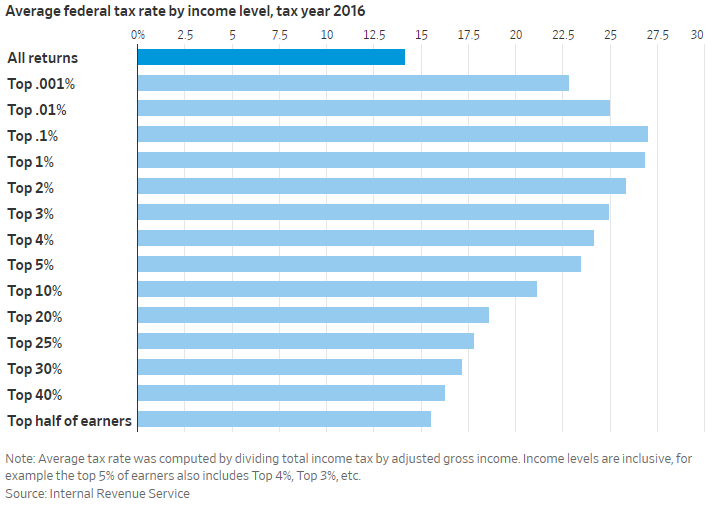
Second aside: Progressive-Democrats ignore how much more taxes the Evil Rich pay than the rest of us, as illustrated by this graph from the same article. It’s never going to be enough because you’re still talking—shut up, I said.

An Economic Misunderstanding

The Congressional Budget Office said Wednesday that the two-year budget deal will increase our annual deficits significantly over the next ten years.  That puts a premium on Republicans regaining the majority in the House, retaining/expanding its majority in the Senate, and retaining the White House, with an emphasis on Conservative Republicans in that mix.  That’s for another post, though.

What…triggered…me was this bit at the end of the article CBO Director Phillip Swagel:

The nation’s fiscal outlook is challenging. To put it on a sustainable course, lawmakers will have to make significant changes to tax and spending policies—making revenues larger than they would be under current law, reducing spending below projected accounts, or adopting some combination of those approaches.

Close, but no cigar—not even an ersatz vaping cigar (do they make these?).  To get onto a sustainable course, the only change to tax policy is to continue reducing the rates: make the individual income tax rates permanent, then move onto a course to (permanent) low flat tax rate on all income, regardless of source. Add to that elimination corporate income taxes altogether; it’s corporations’ customers who pay the bulk of those taxes, anyway, in the form of higher prices.

Then cut spending to levels below the resulting revenues, with an emphasis on cutting non-defense spending.  It’s time the government stopped misspending us citizens’ money.  It’s also time the government stopped competing in the economy for products, services, and resources to produce those products and services.

With more money left in our hands, and with less competition from Government driving up our prices, the private economy will truly take off—increasing along the way revenues to the government from that greatly increased economic activity.

That increased economic activity and revenue to Government will have an additional mid-term salutary effect, if politicians are sensible and don’t lose their nerve.  The increased revenue could ease the pain of transitioning our Social Security and Medicare programs to privately done facilities, getting Government further out of our personal economic and health lives.

The increased economic activity also would redound to the States’ collected revenues—facilitating over the same mid-term a conversion of Federal Medicaid transfers to block grants to the States on an annual declining balance to zero schedule.

A Brief Question

…briefly answered.  Greg Ip, in his column on a putative currency war inflicted on us by the EU asked it.  He opened his piece with this:

When Federal Reserve policy makers gather in Washington this week [a couple days ago] to weigh cutting interest rates, a big part of their decision will already have been made—in Frankfurt.

Then he asked

How should the US protect its economy against possible threats from European economies?

The answer renders his opener irrelevant.  We best protect our economy—against far more than merely “possible threats from European economies”—with lower/no business taxes, minimal regulation, and better products freely traded. These are what underpin a long-term, fundamentally sound economy. Anything else is just glorified yield chasing and short-term machinations that no government, however loosely it is central-plan oriented, can hope to manage.

The Fed has no role in this; it needs only to set its benchmark rates to levels historically consistent with 2% inflation (its target inflation rate) and then sit down and be quiet.

Tax and Spent Progressive-Democrats

In spades.  They’re in a race to bankrupt us.  Or, as The Wall Street Journal put it,

The Democratic presidential primary is turning into a bidding war.

Senator and Progressive-Democratic Party Presidential candidate Elizabeth Warren (D, MA) has broken out of the starting gate with an offer of forgiveness of $640 billion in student debt for our votes.

Senator and Progressive-Democratic Party Presidential candidate Bernie Sanders (I, VT), though, has caught her at the first turn: he’s offering $1.6 trillion (yes, that’s with a ‘t’) in canceled student debt plus tuition-free “public” colleges.

And both, and their fellow horse racers, are offering tens of trillions more dollars on their Green New Deal variants, health care for all variants, government jobs guarantee variants, social security for all variants, and on and on.

Free stuff for all, and all they want is our votes.  And the destruction of our economy and our wallets.

Not an Iron Curtain

But it is intended to be a chain-link fence.  It’s not intended to keep folks out, though, but like its Big Brother, it is intended to “encourage” folks to stay in.

Connecticut has expanded its mansion tax on homes.  Here’s how it works.  On sale, Connecticut taxmen will exact from the seller a 2.25% tax on the value of the sale that exceeds $2.5 million.  This is an increase from the already existing “conveyance tax” of 1.25%, but it adds a fillip: if the seller stays in the State for a suitably long time after the sale (“suitable” being defined by the State’s politicians), he’ll get the money back as a tax credit.  If he leaves Connecticut for greener and friendlier pastures too soon to suit those politicians, too bad—he loses those 2.25%.

Governor Ned Lamont (D) made the nature of his chain-link fence explicit. He said that the tax is a

penalty when people whose homes are valued over $2.5 million sell their homes and leave the state.

There’s also a related question: with Connecticut making it so hard to leave, why would anyone want to go there in the first place?

It’s not all bad, though.  The center of Connecticut is only 35 miles from Massachusetts and only 55 miles from Rhode Island and New York.  To the extent there are jobs at all in Connecticut, those are easy commutes, as any Angelino, Metroplex resident, or New Jersey-ite knows.