
They Don’t Get It

Jim Tankersley of the National Journal is talking about the just concluded Iowa Caucus.

…what Republicans have on their hands now, and will likely have until the party rallies around a nominee to face President Obama, is another chapter in a longstanding struggle among ideological factions within their party—factions including social conservatives, libertarians, business leaders, and the GOP political establishment.

Perhaps the starkest divide came on the question of what caucus-goers were looking for most in a presidential candidate.

This is a typical misunderstanding of the dynamic.  Rather than the Democratic Party’s demand that its members strictly accept the party line handed down by its leadership, conflicts among Republicans in their primaries constitute a microcosm of democracy in action.  This is simply the open debate through which the party arrives at its position, for good or ill, with no fear of the public listening in.  In fact, the eavesdropping is encouraged; it helps the public understand the positions developed.  This is in sharp contrast to the Democrats’ philosophy of monolithic positions, against which disagreement is not allowed.

Of course it could be argued, without being too far wrong, that the Republicans depend too much on the publicness of their debates as their means of messaging, rather than, having arrived at a position, going to that same public and speaking to us directly and plainly.

The Progressives’ misunderstanding goes far further, though.

There’s no unifying characteristic of the economic proposals offered by Iowa’s top-finishing trio of Romney, Santorum and Rep. Ron Paul, other than their general conservatism; the three plans differ sharply on core economic issues, including how much to cut taxes, how deeply to slash the federal budget, and how to spur new investment in America.

And yet these plainly are “unifying characteristics:” cut corporate taxes, slash government spending, spur new investment.  The differences among the candidates on these, as monolithic Democrats do not understand, are not yawning chasms, but  minor quibbles around the edges.  Moreover, this unifying message stands in sharp contrast to the Progressives’ unifying characteristics: raise taxes, spend even more, use subsidies to favored businesses for spurring “investment.”

Further, the Republicans have succeeded in changing the dynamic of the public discourse.  There’s no more argument over the specific size of tax increases, or of spending increases (or fictitious reductions in future spending increases), or how large government should be.  It’s about how much lower to reduce tax rates, how much to cut from actual spending, how small government should be.
What the Democrats Stand for in the Coming Campaign

Straight from the horse’s mouth.  As President Obama says,

Part of what 2012 is about is…framing this larger debate about what kind of country are we going to leave for our children and our grandchildren….

He’s right about that.

Then he says that Republican policies amount to

…a different theory that says, we’re going to cut taxes for the wealthiest among us, and roll back regulations on things like clean air and health care reform and Wall Street reform, and that somehow, automatically, that assures that everybody is able to succeed.

This is his demonization of his opposition’s desire, and the American people’s need, to get government out of the way of our economy so that it can begin to recover, and to get government out of our lives so that we can go about our business free of government interference.

Further, the Progressives of the Obama party insist that government Knows Better.  Government should be populated with university-trained Patrons who will run our economic and social lives, because we can’t be trusted to manage our own: more government management of competition, for instance (the Consumer Financial Protection Bureau), and Obamacare, under which Big Government presumes to be to dictate to us what we will buy or not buy.

And the Democrats stand for government by fiat, and the Constitution be damned.  On Wednesday, Obama simply ignored Constitutional requirements and appointed Richard Cordray as CFPB director, despite the fact that the Senate has not advised and consented to Cordray’s appointment.  Obama claims this is a recess appointment; however, the Senate is not in recess.  Doesn’t matter.  “I refuse to take ‘no’ for an answer,” says he.  He followed this with another unconstitutional set of appointments, this time of three new members that must be Senate-approved–but without that approval, and while the Senate is in session–to flesh out the blatantly pro-union NLRB.

We can look forward to bigger government, more governmental interference in our affairs, and the removal of the Constitution from its status as the supreme Law of the Land if the Progressives are reelected this year.

Another thing for which the Progressives stand in the coming campaign: ad hominem attacks on their opponents, since the Dems can’t run on their record of accomplishment—or on their ideology.

National Defense or National Security

When did they become mutually exclusive concepts?  In the Progressive meme, the downsizing of the US’ status in the world is in full force.  Because of cuts to our national security—our defense—budget driven by Progressive intransigence in cutting spending anywhere at all and their parallel intransigence in demanding increased taxes, our military capability is shrinking dramatically.  Rather than being able to fight two wars simultaneously, which we have been able to do for decades, the defense cuts will reduce us to being able only to

…fight and win one major conflict, while also being able to “spoil” a second adversary’s ambitions in another part of the world while conducting a number of other smaller operations, like providing disaster relief or enforcing a no-flight zone.

Notice that: we’ll be able to win once (maybe—war always is an iffy thing) and only hold elsewhere, hoping for a miracle there.

This is based on the idea of a superfluous military—we won the Cold War 20 years ago, for crying out loud, and if we hadn’t had this large military-industrial complex, we would never have been able to start those evil wars in Iraq or Afghanistan.  Besides, defense spending has been going up and up and up, and we need to stop it.

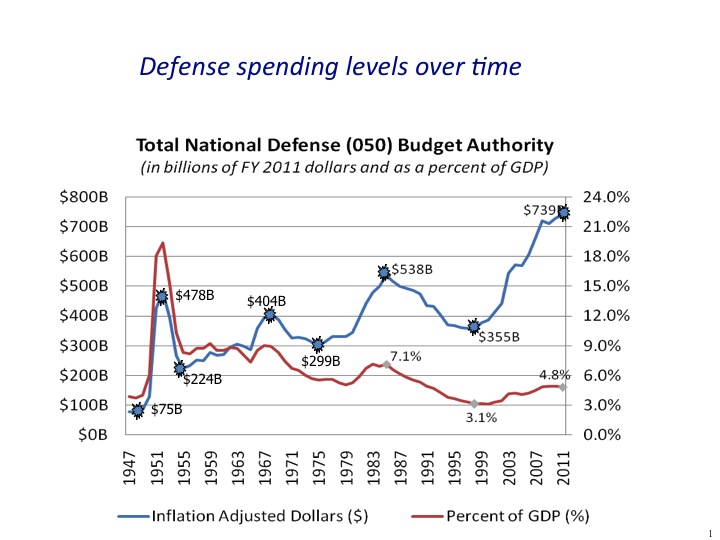
But here’s a graph that sheds some light on that last (I’ll not dignify the others with a response.  (a hostile Russia and China, 9/11, a nuclear Iran, Saddam’s inhuman butchery are sufficient answer.)

Notice that.  As a percent of GDP, defense spending has been remarkably stable.

Nevertheless, for the sake of national security, defense spending must be cut—the deficits and debts are too great and they threaten the weal and the safety of the nation.  The debt and the deficit picture certainly are as threatening as they’re made out to be, but consider: with no defense capability, where is the security?

What do we gain, though, by cutting defense?  Consider these items, courtesy of Neptunus Lex:

…shutting the doors on DoD entirely would still result in an $800 billion increase to next year’s aggregate deficit….

…radically reduce the ground forces, a couple of fighter wing equivalents and at least one or two aircraft carriers—the same forces which have allowed the US since the Cold War days to provide forward presence and deterrence.

Which is actually OK, because the Islamic Republic of Iran has just told us that the USS John C. Stennis is no longer welcome in their neck of the woods….

Well, at least one of those carriers won’t be needed, since it’s worn out its welcome in Iran as well as in DC.

One Progressive argument is that we can get away with such draconian cuts.  Even with cuts as deep as 90%, we can still wipe our attackders off the face of the earth.  But there are a couple of flaws with this argument.  The first is a moral one—and so a practical one.  With such deep cuts, we could wipe our enemies off—by going nuclear.  But with no intermediate capabilities, we’re stuck with the moral, and practical, choice of nuclear war or surrender.  There aren’t any intermediate options with such deep cuts.

The other flaw, though, goes to that ability to go nuclear.  Our nuclear weapons are aging.  They need testing and upgrade.   That takes money that’s being cut from the defense budget.  In the end, we have to ask ourselves, “what is the value of our nuclear weapons when we can’t count on them working?”  while our enemies are asking us, “Do you feel lucky, punk?  Well, do you?”

But the whole “we can cut defense” attitude suffers from another fundamental misconception.  It assumes that our enemies think like us, that their pain level is similar to ours, that their goals are similar to ours.

What do we gain by cutting defense rather than cutting somewhere else?   We keep three entitlement programs that are bankrupting us, and that will continue to do so, even after gutting national defense: Social Security, and Medicare, Medicaid.  But those are the programs that politicians use to buy votes with which to stay in power.

In the end, national defense and national security aren’t mutually exclusive.  Without both, we have neither.

Gridlock Works

Lost in the hoo-raw over the payroll tax reduction extension at the end of the year was Congressional inaction on a couple of other weighty matters—and this inaction redounds to our benefit.

Congress failed to continue a 45 cent per gallon tax credit for corn-based ethanol and a 54 cent per gallon tariff on imported ethanol (mostly from Brazil—Obama wants us to be one of their best customers).  Since these two items were among the few things Congress even constructed reasonably—they actually had sunset clauses—they expired Dec. 31.  Of course we can expect the Progressives to attempt to redress this egregious failure or to score the evil Republicans for stopping a resumption—that is, if the Republicans find their courage, lost in the debt ceiling fiasco and which loss was underscored by their screw-up on the payroll tax reduction, and block a resumption.

Another useless “green” subsidy expired through Congress’ inaction, also: the thousand dollar tax credit for installing an electric car charging station in a residential garage expired, as did the related tax credit (up to $30 thousand) for installing a commercial charging station.

Unfortunately, the gridlock didn’t achieve a sweep: fuel refiners still are required to add 36 billion gallons of ethanol to their fuel mixes by 2022, and the (maximum) $7,500 tax credit for buying an electric car remains in place.

Of course, as with all subsidies, these had just made the subsidized items more expensive.  The 45 cent credit for the ethanol-in-gasoline just followed the fuel right into your cost at the pump, for instance.  The $6 billion per year we taxpayers were being hit for this credit bought everyone else’s ethanol gasoline.  And we paid those $6 billion even when we bought an electric car, instead.  Those of us that have bought one; sales are steady, but far from outstanding.

That credit for buying the electric car is interesting in its own right.  Just to take an anecdote for an illustration, a Ford Fusion (ignoring the usual haggling, and only looking at MSRP) runs around $20 thousand.  The correspondingly ungussied-up Fusion Hybrid is a bit under $29 thousand.  With the subsidytax credit, that drops the Hybrid to a shade over $21 thousand.

In some cases, the credit doesn’t do the buyer as much good, though.  The Tesla’s Model S is a $50 thousand electric car, and their Roadster seems, from Tesla‘s Web site, to be of a price that if you have to ask, you can’t afford it.  The tax credit doesn’t have so much practical effect here.  As to the Fisker Karma, well, that electric car isn’t available at any price, at least for a while: its batteries are…defective.  The credit is useless for it.

Maybe instead of renewing the ethanol subsidies, we can get Congress to eliminate the electric car subsidy and the requirement to dump ethanol into our gasoline, too.  Keep in mind that ethanol is hard on your car‘s engine.

Or am I hoping for too much change this year?

It Isn’t Always the Government

The US Chamber of Commerce’s Institute for Legal Reform has settled on its view of the most ridiculous lawsuits of the just concluded year, borrowing from FacesOfLawsuitAbuse.org.  As the Institute points out, the US has been the lawsuit capital of the world for some time, and foolishness like these cases contributes to the title.

We can’t blame this idiocy on government, however.  I do have to wonder, though, at the lawyers who actually agree to take these things to court.  They must know the frivolous nature, so I speculate about their motives….

The most idiotic case is one that also demonstrates an amazing degree of chutzpah.  The criminal sues his victims because they didn’t keep their end of an extorted bargain.

Convict sues couple he kidnapped for not helping him evade police. A man who kidnapped a couple at knifepoint while he was running from the police is now suing the victims, claiming that they promised to hide him in exchange for an unspecified amount of money.  The plaintiff, currently in jail, is seeking $235,000 for the alleged “breach of contract.”

Here are more examples of our idiocy, beginning with one for the psychiatrist’s couch.  “It all began when I was little, and my mummy violated my Oedipus Complex….”

Young adults sue mother for sending cards without gifts and playing favorites. The plaintiffs, now 20 and 23, claimed the mother “sometimes didn’t include gifts in cards sent to her children; played favorites with her children…did not send care packages until his sixth semester away at college…changed her surname, thus ‘causing attention’ at her daughter’s school events; and refused to buy her a homecoming dress.”

Poor babies….  Let’s see, now.  I didn’t get a care package, ever.  And my mother never bought me a homecoming dress, either.  Or a tux, which would have fit me better.  Or even rent me one.  Hmm….

Everyone’s a critic, too.  Opinions, though, are as ubiquitous as certain body parts; no one is obligated to hear or view either.

Woman sues over movie trailer; says not enough driving in ‘Drive’. A Michigan woman who claims she was misled by the trailers for the movie ‘Drive’ is suing the distributors of the film.  She says she was disappointed by the lack of driving in the film and was expecting something more similar to the ‘Fast and Furious’ films.

Back to misbehaving mothers:

Mom files suit against exclusive preschool over child’s college prospects. A New Yorker is suing a private preschool, saying the school’s curriculum has seriously hurt her 4-year-old’s chances of getting into an Ivy League college.

This assumes an Ivy League education is a worthy goal.  If the private preschool is living up to Mom’s allegations, they’re actually doing little Buffy a favor.  Oh, great—now the Ivy Leaguers are going to sue….

All I can say about the next one is that it’s a good thing he didn’t pull either one of these stunts in Texas.

Man sues bar for not disarming him before he started drinking (and fighting). A Pennsylvania man illegally brought a gun into a bar, then got injured in a drunken shootout with another patron, and now has sued the bar for not searching him for a weapon on his way in.

Finally, there’s this.

Mother sues Chuck E. Cheese – says games encourage gambling in children. A California woman has filed a lawsuit against Chuck E. Cheese on the grounds that their games are actually an illegal form of gambling and could get kids hooked. She is seeking at least $5 million; the restaurant says the games are legal and has asked a judge to dismiss the suit.

I played bingo in grade school, matched pennies in junior high, and played poker all through high school.  Nine to two Mom (what is it about mothers?) loses this one.