Progressive Energy Subsidies

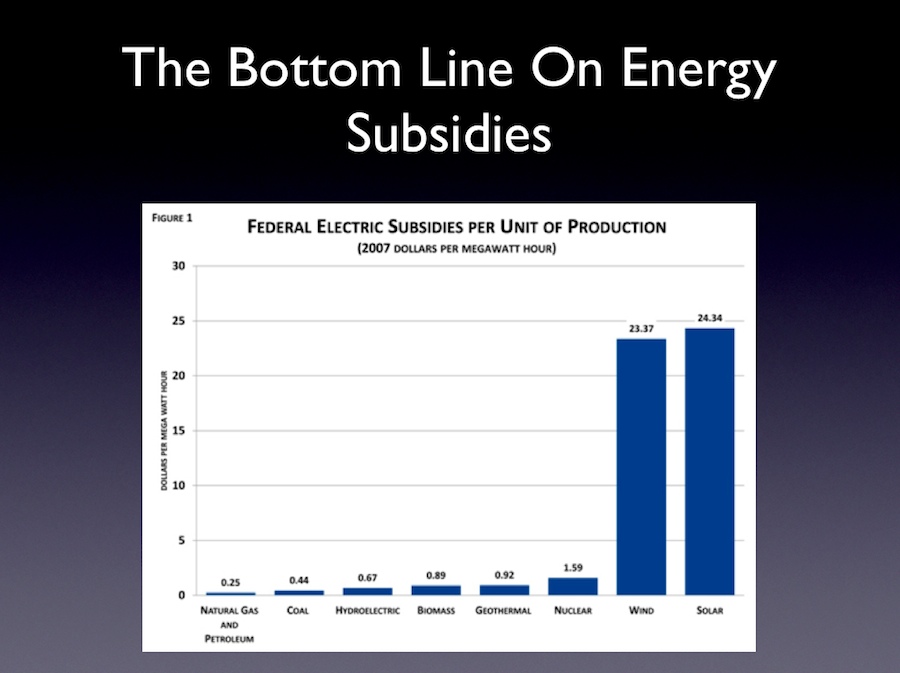
John Hinderaker has a couple of slides from a Power Line post of his from the middle of last month that are instructive.  The first indicates the relative overt subsidy payments for a range of electric energy producer types.

In case you’re having trouble reading it, the salient parts are these: the figure shows Federal electric subsidies in dollars per MW-hr produced (2007 dollars).  The values on the left are for Natural Gas and Petroleum and for Coal at $0.25 and $0.44, respectively.  The values on the right are for Wind and for Solar at $23.37 and $24.34, respectively.  Those evil oil, natural gas, and coal companies get less than 2% of the subsidy Precious wind and solar companies get.

Pop quiz: which are the market-competitive companies?

There’s also this slide, which shows oil production rates over the last several years.  Recall its backdrop: President Obama’s claim that, on his watch, oil and gas production are up sharply.

The blue line indicates oil production on Federal land, and the Red line indicates production on private and State land.  The key interval is from 2007 on, when the Progressives had control of the Congress, followed shortly by Progressive control of the Executive Branch.  Notice that while production from private and State land was rising, production from Federal land was being driven down.  This, coupled with Obama’s slow-walking of Gulf deep water drilling permits; his refusal to allow new drilling, much less production beyond existing wells, into/from known oil deposits on Federal land; his EPA’s CO2 regulation over even a Progressive Congress’ objection; his killing of the Keystone XL pipeline; and so on, represent a far more powerful, and far more insidious, subsidy of his Precious “green” energy producers: active suppression of competition from production of cheap hydrocarbon-based energy from nearby sources.

Some subsidies are more equal than others.

This Is What A Progressive Government Stands For

Our illustrious Treasury Secretary, Timothy Geithner had this to say in a recent The Wall Street Journal op-ed about the role of government in private decision making.  In setting up his meme, he described Bear Stearns’ risky investments and our own risky mortgage borrowing behavior.

Neither the Fed, nor any other federal agency, had the necessary comprehensive authority over investment firms…or the government-sponsored mortgage giants Fannie Mae and Freddie Mac.

Regulators did not have the authority they needed to oversee and impose prudent limits…. And they had no authority to put these firms, or bank holding companies, through a managed bankruptcy.…

Household debt rose to an alarming 130% of income, with a huge portion of those loans originated with little to no supervision and poor consumer protections.

Hmm….  He decries the lack of government control over our businesses and our personal borrowing.  He decries government’s inability to bypass the bankruptcy court system (except for two dinosaur car companies, whose government regulation he doesn’t mention).

He insists that  Government knows better the risks, government knows better the decisions that ought to be made.  His solution, thus, is increased intrusive government management of our decisions and our businesses.  As to the costs of this, he dismisses them:

Are the costs of reform too high? Certainly not relative to the costs of another financial crisis. Credit is relatively inexpensive….

He omits to add that cheap credit is due entirely to artificially suppressed Federal Reserve Bank rates—through which the Federal government is imposing an extreme inflationary risk on our economy.  He omits to acknowledge that the financial institutions are under resumed government pressure to quit sitting on cash and to lend—by lowering credit standards again—another government-imposed risk to our economy.

Are these reforms complex? No more complex than the problems they are designed to solve.  And, it should be noted, most of the length and complexity in the rules is the result of the care required to target safeguards where they are needed, not where they would have a damaging effect.

He chooses complexify a fundamentally simple problem: let the experts in business and business risk—businessmen themselves, exercise their own judgment, and suffer the consequences of bankruptcy if their judgment is faulty—or if they have bad luck.  He doesn’t mention the fact that the same government that wants to insert its own lending judgment in the place of our own and our business enterprises is the same government that is still owed tens of billions of dollars by those two American car companies that can never be paid back—and that one of those dinosaurs isn’t even American anymore; it’s Italian.  He also complexifies what is truly straightforward: get government out of the way, streamline regulations, and keep only those that are useful, with no overlap or conflicts.  He also demonstrates a lack of understanding of the problem: if the targets of the safeguards need “length and complexity” to address, it’s because the regulators don’t understand the targets well enough to articulate them simply and clearly, so that, if actually needed, they can be “targeted.”  The very complexity is another government-created risk.

Is there some risk that these reforms will go too far with unintended consequences? That depends on the quality of judgment of regulators in the coming months as they flesh out the remaining reforms.

Indeed.  That’s another enormous risk imposed by a Know Better government.  Look for instance, at the performance of the NLRB and the EPA, two example regulatory agencies devoid of objective judgment.  These are Progressive regulators, but there’s no reason to believe that “conservative” regulators wouldn’t wind up just as abusive, just as lacking in judgment, albeit in another direction.  The problem here is the existence of the regulators, not their political agendas.  Today’s problem, though, is compounded by so many of the regulators being subject to no oversight.

And then there’s our health.  Over in the legislative branch, Nancy Pelosi called the just-defeated Blunt Amendment a

“devastating legislation” and “the latest ploy in the Republican agenda of disrespecting the health of American women.” Planned Parenthood claimed the “dangerous proposal” would have allowed “your boss”—yes, yours—to decide “which prescriptions you can get filled and which medical procedures you can have,” including cancer screening, maternity care and AIDS medications.

Of course, it was nothing of the sort.  It was simply an effort to restore choice to women’s (and men’s) health decisions.  Yet, as the WSJ points out,

The fact that Democrats don’t dare to accurately describe their own positions, or the regulations that they want to foist on everyone else, shows how extreme those positions and regulations really are.


This is, then, what the Progressive government stands for.  A big, intrusive Federal government making business decisions for Americans and our businesses and deciding our health issues for us.  All, of course, with the best of intentions: to protect us from ourselves, and to protect us from our foolish decisions and their outcomes.  But at what cost?

At the cost of our freedom to make stupid decisions, our freedom to make decisions with which our governmental Betters might disagree, and our freedom to profit from risky decisions, or safe ones, of our choosing and not of our Betters’.  At the cost of our freedom to decide for ourselves what our health care might—or might not—entail..

At the cost of our ability to make any of our own choices.  At the cost of honoring our responsibilities ourselves, rather than having them surrendered to government to handle for us.

Another Precinct Heard From

Writing in Spiegel Online International, Wolfgang Kaden offers stern medicine for the present Greek crisis.  His thesis is stated at the outset:

It’s time to reinstate national autonomy—and responsibility—for determining financial policies and honoring treaties.

He goes on:

The euro has been a major experiment.  A (current) total of 17 countries with many things in common—but also many differences, such as their economies, politics, histories and ways of life—have embraced a common currency.  Contrary to the expectations of many (including myself), these differences have not grown smaller over the years.  Unfortunately, there is no reason to expect that such increased harmonization might occur in the foreseeable future.

And

…it appears entirely unlikely that European populations could be willing to, for example, relinquish their parliament’s right to make its own budget-related decisions to an EU body based in Brussels.  This also renders the notion of a fiscal union chimerical.

His solution, though, is to go back to the Maastricht treaty roots, terminate bailout efforts—and not just for Greece—and require individual member nations to see to their own fiscal houses, without welfare payments from their fellow member nations.

The advantages which he lays out for this return are these:

…going back to the original state of things also means returning to an environment controlled by market forces.

The hard truth is that the voters in each country make the final decision about whether to honor or violate treaty obligations, so they also bear the responsibility for dealing with the consequences of their own decisions.

But then he says:

Those incapable or unwilling to [toe the economic line] need to get out—of their own accord rather than by getting the boot.

But such a solution does not address the fundamental reason for the failure of the euro zone—that utter lack of a consistent world view on the part of the constituent nations.  Given the broad differences the nations have concerning, for instance, the purpose of money, such consistency is impossible—nor should one be imposed from on high.  Aside from the immorality of the imposition, and its attack on individual liberty, the imposition would be illogical.  If the member nations are to be left to their own devices in getting out of their troubles, they must be left to their own considerations of what is important to them.  Yet these differences make it impossible for every nation to toe the euro zone’s—much less the Maastricht and Lisbon Treaties’—economic line.

My take is that Greece should depart the euro zone.  Europe, as a whole, does not need a common currency.  Instead, Europe should be decomposed into separate and distinct common currency zones, each of which must consist of a far more homogeneous membership, in terms of societal imperatives and political and economic philosophies.  This greater commonality of purpose will make each individual currency zone far stronger than is the present entire euro zone, and were these currency zones to form a free trade zone the members would be yet stronger.  As for Greece, it easily could become an effective and valued member of one of these smaller, more homogeneous groups.

This is Stimulating

…on a couple of levels (but, no, it didn’t generate a tingle down my leg).  Paul Chesser, of the National Legal and Policy Center, wrote about a law firm and Fisker Automotive earlier this week.  Of particular interest to me in the article were two things.  One was this:

Debevoise & Plimpton LLC, received $1,842,180 in Recovery Act funds to provide legal advice, conduct due diligence, and review documents for two loans from DOE’s Advanced Technology Vehicles Manufacturing Loan Program.  One $529 million loan award was to Fisker Automotive to develop and produce two lines of electric vehicles….

Debevoise provided the same services to DOE for its $5.9 billion loan to Ford Motor Company, to convert five of its factories…so they can produce more fuel-efficient vehicles.

That’s a potful of taxpayer money for what seems a straightforward legal task (I won’t go into the political donations employees of the firm made; there’s more of that in the article.  Besides, there’s no evidence of anything illegal having been done here).  Perhaps some of the lawyers reading this can weigh in on the actual costs and charges such analyses normally entail.  I also wonder how many jobs were “saved or created” by this particular Stimulus payout.  Oh, wait, Chesser addressed this:

At the height of its legal services activity for DOE, 1.25 jobs were created that were attributable to Debevoise’s work on the two loans.

The other thing is the quality of the due diligence and analysis provided.  Now it’s certainly possible that loans on which proper due diligence has been done will still fail.  But getting information about this particular loan analysis out of the Department of Energy has been like pulling teeth from a chicken.  Judicial Watch has been forced to sue in Federal court under the Freedom of Information Act to get any serious data concerning this loan of taxpayer money.  The cynic in me has to ask what information has the administration so nervous.

Of What Polity is Merkel Chancellor?

Spiegel International Online, in an article a couple days ago, insisted that

German Chancellor Angela Merkel has a problem. External pressure on her government to back an increase in the size of the permanent euro backstop fund, the European Stability Mechanism (ESM), is rapidly growing, with Berlin now virtually isolated among the G-20 and the euro zone, with the International Monetary Fund insisting as well.  Even the world’s developing countries are calling for Merkel to agree to boost the firewall….

Internally, however, she is in a bind.  Aid fatigue has set in among Merkel’s conservatives…and the political appetite in her cabinet for countering such skepticism is limited.  …  Renegade lawmakers in the aisles of her governing coalition…meant Merkel fell short of the symbolic “chancellor’s majority,” an absolute majority of Bundestag seats with just coalition votes.

Moreover, which case the article’s author elides, the German people have never favored seeing their hard-earned money, turned over to their government in taxes, sent overseas to reward the irresponsible populations and governments of other countries for their profligacy.

Leaving aside the economic and moral foolishness of continuing—much less expanding—the bailout facility(s), Chancellor Merkel, and her fellow German citizens, need to clarify in their own minds for whom she works—those German citizens who hired her to be their country’s chief executive, or foreign nationals in Europe and elsewhere.  This clarification will eliminate the bind.