
About the Ukraine Crisis

Zbigniew Brzezinski had some thoughts in Foreign Affairs. In 1994.

Insurance is needed against the possibility, one might even argue the probability, that the weight of history will not soon permit Russia to stabilize as a democracy, and that the single-minded cultivation of a partnership with Russia, while downgrading other interests, will simply accelerate the reemergence of an ominously familiar imperial challenge to Europe’s security….

The crucial issue here, one that might well come to a dramatic head in the course of 1994, is the future stability and independence of Ukraine. It cannot be stressed strongly enough that without Ukraine, Russia ceases to be an empire, but with Ukraine suborned and then subordinated, Russia automatically becomes an empire. American policymakers must face the fact that Ukraine is on the brink of disaster: the economy is in a free-fall, while Crimea is on the verge of a Russia-abetted ethnic explosion. Either crisis might be exploited to promote the breakup or the reintegration of Ukraine in a larger Moscow-dominated framework. It is urgent and essential that the United States convince the Ukrainian government, through the promise of substantial economic assistance, to adopt long-delayed and badly needed economic reforms. At the same time, American political assurances for Ukraine’s independence and territorial integrity should be forthcoming.

Let’s see, now. Russia already has occupied Crimea, and it’s investing eastern Ukraine.

The Ukrainian government has been trying to mend its ways and to join with, and learn from, the West, via its nascent alignment with the EU and its desire to join NATO.

And yet….
 

h/t The Wall Street Journal

The Problem with a Law

In 2012, the Labor Department threatened to seize the blueberry crops of a couple of Oregon farmers until they settled a Labor complaint and signed away their right to appeal the settlement. With crops at risk of rotting away, the farmers settled, agreeing to pay Labor more than $240,000. The alleged “crimes” were Labor’s claims the farmers had violated minimum wage requirements under the 1938 Fair Labor Standards Act. Labor used the threat of seizure of these perishable crops to extort the settlement.

After signing and getting their crops back, the two farmers sued.

The courts were unimpressed with Labor’s behavior.

By using the threat of rotting crops as coercion, the feds trampled due process. In January, Magistrate Judge Thomas Coffin ruled Labor had prevented defendants from having “their day in court.”

In February, Labor asked US District Judge Michael McShane to review Judge Coffin’s decision. Judge McShane agreed with the original ruling, noting the growers had challenged “unique circumstances” involving “a highly perishable product at peak harvest.”

Yew betcha. Hence the extortionate nature of Labor’s behavior. “Nice crop you got there….”

Congressman Kurt Schrader (D, OR) has been equally unimpressed with Labor’s behavior. He’s now writing a bill that would “exempt certain perishable agricultural commodities” from this sort of action.

Schrader doesn’t go far enough, though. The law should be rescinded altogether. The Federal government has demonstrated conclusively that it can’t be trusted with it.

Economic Gains

President [Barack] Obama used Labor Day to tout the country’s economic gains under his leadership….

Let’s look at those gains.

  • he’s increased the national debt in his six years by 70%—it stood at $10 trillion at the end of 2008; it’s now over $17 trillion
  • median income has fallen—it stands now at $53,900 compared with $56,700 in December 2007 at the start of the current economic dislocation
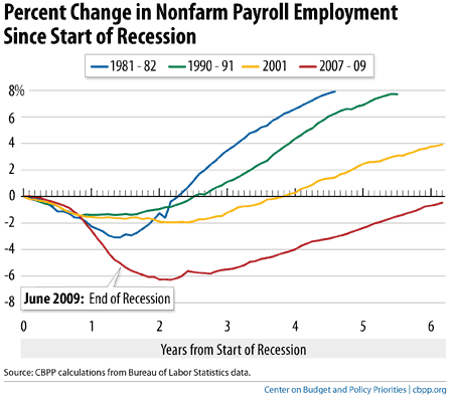
  • job creation is only just back to pre-Panic levels, 6 years into his administration, compared with normal economic recovery needing only 2-3 years to get to this point
  • unemployment rate now stands at 6.2%, dropping 1.1 points over the past year—still 20% above full employment, and again years behind schedule
  • labor force participation rate is at an historic low
  • GDP growth remains anemic at 1.5%-2.5% year on year (with this year’s growth rate projected to be in the 2.5% range) compared to a normal economic recovery growth rate in the 4.5%-6.5% range.

And this graph sums it all up:RecoveryComparison_Cox

Obama, in the same appearance, also claimed that “higher wages and other progress for workers can only be achieved through a Democrat-controlled Congress.”

Really? Can our country afford more of this Progressive progress?

In Which I Side with the “Liberal” Judges

Regarding the NSA’s broad (much too broad, IMNSHO) surveillance of American citizens, the three judges hearing an appeal to the 2nd Circuit Appellate Court (Democrat appointees, all) expressed concern about that breadth. A Federal District Court had ruled the surveillance constitutional, and the ACLU is leading the appeal (and so I’m siding with that crowd, too, on this matter).

In an oral argument that was set for less than 30 minutes and lasted nearly two hours, three judges on a panel hearing the case at the Second US Circuit Court of Appeals in Manhattan probed claims by the ACLU that the federal government’s collection of data relating to “every phone call made or received by residents of the United States” is illegal and unconstitutional.

Indeed,

[Judge Gerard] Lynch asked how well briefed members of Congress were before voting, and questioned how much they understood about the program. At one point, [Judge Robert] Sack chimed in, “We don’t know what we don’t know” about NSA operations.

Lynch and [Judge Vernon] Broderick both questioned why the government’s justification for the bulk phone data collection program would not also extend to bank records, credit card transactions, and other personal data. Lynch asked if the government’s argument would not also entitle it to access “every American’s everything.”

It’s a fine line between the legitimate security needs of the Federal government if it’s to do the job for which we hired it—to protect us from foreign threats and from each other—on the one hand, and our individual liberty and responsibility on the other. Ben Franklin was right.

It’s necessary, also, to keep in mind that without our individual liberty and responsibility, we have no security. It matters not a whit whether we’d be enslaved by our own government or by a foreign power—we’d still be slaves.

Our Constitution has drawn that line: judge-issued warrants, on a showing of probable cause, are necessary to the legitimacy of the collection. These warrants also must be particular to the person and his property, and they also must be particular to the things being sought out. Fishing expeditions are not allowed.

True, “warrants” are sought in advance via a FISA court. But the FISA court is a secret court, a Star Chamber, no matter its currently good intentions. “Warrants” issued by it similarly are secret, which is to say, they don’t exist: they’re not public, and the person being “searched” under them has neither the ability to contest the warrant in court prior to its execution nor the ability to quash at trial the data discovered and/or seized. Nor can there be any guarantee that, given an ultimate victory, whether over an individual warrant that was discovered or over the process (the DC Circuit is hearing a similar appeal, and the thing is likely to find itself in front of the Supreme Court in the next session), the collected data actually will be expunged.

The 2nd Circuit’s case can be followed as American Civil Liberties Union v Clapper, 14-42, US Court of Appeals for the Second Circuit.

What Does Europe Owe Ukraine?

The crisis in Eastern Europe…is now entering its 10th month. What began with the collapse of an association agreement between the European Union and Ukraine can now be called a war.

Emphasis added.

All Ukraine wanted was to be free. Free from Russia; free to chart its own course; free to begin to escape its own history of governmental corruption; free to align itself with, learn from the association, and perhaps to prosper in its freedom. The EU implied, with that agreed association, that it would help Ukraine work toward those goals, using that association and EU’s vasty trade market.

When the collapse of the agreement occurred, the Ukrainian people tossed the mendacious government that had collapsed it—and those people—in favor of returning to the Russian sphere; in retaliation against the Ukrainians’ making their wishes, their demands, their very sovereignty over government known, Russia invaded Ukraine. First, the Russians occupied Crimea and then partitioned Ukraine, incorporating Crimea into itself. Then the Russians invaded eastern Ukraine, initially by supplying arms and ammunition to Russian “separatists” already present in the region, then by supplying Russian soldiers “on holiday,” and now openly, driving a Russian held corridor through southern Ukraine stretching along Ukraine’s erstwhile Sea of Azov coast from Russia to Crimea.

What is Europe doing about this? They’re talking. German Chancellor Angela Merkel has telephoned Russian President Vladimir Putin 25-35 times, to engage in idle chit-chat. The EU has applied pinprick “economic sanctions.” They do not supply arms and ammunition. The openly say they will not supply troops—which Ukraine already has said they do not want, but still….

What is the value of Europe’s agreements when they dishonor the implications of an association agreement? Even the one that was signed by the government which the Ukrainian people put in place a couple short months ago?