
Inflation Ain’t Joe Biden’s Fault

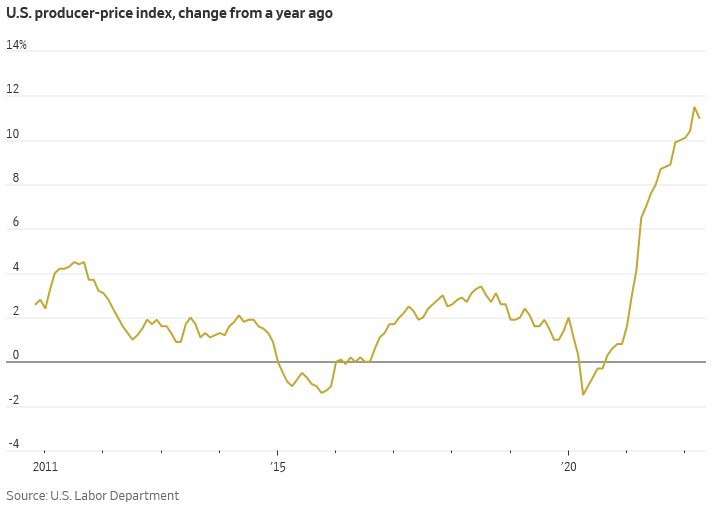
Illustrated in two graphs. The first is the overall Producer-Price Index performance over the last 11 years.
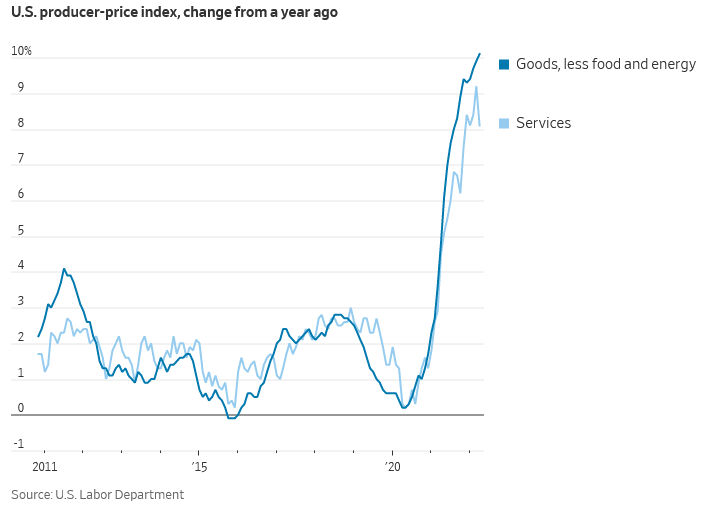
The second breaks out services from goods, the latter absent food and energy.
Now certainly, in addition to the immediacy of expectations, there are lags of some weeks to months in our economy, and it can take time for policies to have impact.

Oh, wait—notice those periods before the current inflation began spiking: the PPI was declining through the year-and-a-half before President Joe Biden (D) won the election. The PPI began its sharp rise right after that on expectations of Biden’s policy implementations, and it continued unabated as those expectations were realized and began their material impact on our economy.

Look, too, at the steadiness of the PPI rise. Neither supply chain disruptions nor Putin’s war have had any impact on the inflation rise. Look again at the 18 moths preceding Biden’s election. The pandemic, too, is wholly irrelevant to this hard rise.

This round of inflation really is Joe Biden’s fault, no matter how deeply he ducks under his desk, or how many times he scurries off to Delaware to avoid facing us average Americans.

Because Housing Price Inflation Isn’t High Enough

California State Senate Leader Toni Atkins (D) wants to exacerbate it with $10 billion more thrown at the State’s housing market to create even more buying demand for this supply-limited product.

Democratic State Senate Leader Toni Atkins on Wednesday unveiled details of a proposal she’s pushing to create a revolving fund that would provide interest-free loans for up to 30% of the purchase price of a home for low- and middle-income households.

Even spreading the money over 10 years would throw $1 billion per year at a housing market that’s already suffering enormous inflation—nearly 12% just since last August—due to the limited supply of houses for sale vs the burgeoning number of buyers, both institutional (viz., Blackrock) and individual.

That won’t add to the inflation of housing cost will it?

One Way to Make the Question Moot

The US 5th Circuit Court of Appeals is hearing a case concerning whether the President personally has the authority to suspend new oil- and gas-lease sales. The particular case centers on climate change concerns as the rationale, but the authority is much broader than that, or it’s non-existent.

The State plaintiffs argue that

a 1987 law dictating the ways in which oil and gas leases will be sold stipulates that a sale must be held at least four times annually in states with eligible land. … “…President Biden put his campaign promises above federal law: By executive fiat, he halted oil and gas leasing on federal lands.”

President Joe Biden’s (D) government employee lawyers argue that

the US president is not an “agency” and therefore not subject to the Administrative Procedure Act.

Biden’s argument strikes me as a frivolous quibble, and the States should win, with the Appellate court upholding the district court’s ruling that, in essence, in this sort of context, a President is, too, an “agency,” and so he has no such authority.

The question can be made non-existent in future, though, with a straightforward fix (however politically difficult it might be to enact): at least on Federal property, make oil- and gas-leasing and -permitting a will-issue matter with licensing requirements, including environmental questions and leasing costs, explicitly barred from being used as barriers to leasing and permitting.

A Bit More on Student Debt

I wrote a bit ago about what colleges and universities should be required to do regarding student loans and student debt.  Here’s a bit more concerning why college and university management teams’ feet should be held to the fire. Mike Brown, writing for lendedu, has some data that compares, by school, student salary expectations with salary reality. In general,

median expected salary after graduating was $60,000, but the PayScale data showed that the typical graduate with zero to five years experience makes $48,400.

Brown published salary expectation vs reality for 62 schools; here are those data for the first 15 schools in his table:

School Actual Early Career Pay (0-5 Yrs. Experience) Expected Median Salary (0 Yrs. Experience) Percent Difference
Southern Illinois University, Carbondale $49,100 $70,000 70%
Washington State University $54,600 $70,000 78%
Central Michigan University $47,000 $58,500 80%
University of Louisville $48,800 $60,000 81%
East Carolina University $47,200 $58,000 81%
University of California, Riverside $54,000 $65,000 83%
University of Tennessee, Knoxville $50,200 $60,000 84%
Binghamton University $58,900 $70,000 84%
University of Illinois at Chicago $55,000 $65,000 85%
Temple University $50,800 $60,000 85%
University of Alabama $51,200 $60,000 85%
University of Colorado Boulder $55,600 $65,000 86%
University of California, Los Angeles $60,000 $70,000 86%
Kansas State University $51,600 $60,000 86%
Oklahoma State University $51,700 $60,000 86%


Who sets these expectations? That’s not clear. Who allows these expectations to stand uncorrected? The management teams at those colleges and universities.

Allowing this distortion to stand uncorrected is one more reason colleges and universities should be required to publish

  • graduation rates for their students given
    • 1 year of attendance
    • 2 years of attendance
    • 3 years of attendance
    • 4 years of attendance
    • 5 years of attendance
  • by major, the average and median salary for their graduates one year after graduation and five years after graduation—note that these data are not for one and five years of employment

The data from Brown also demonstrate why colleges and universities should be required to play the decisive role in lending money to their students and prospective students. Colleges and universities should be required, with respect to borrowings taken in order to attend the college/university, to

  • be the lender for the majority of the money borrowed by each student or student’s parent/guardian and not allowed to sell or otherwise transfer the loan, or
  • be the co-signer with the borrowing student or student’s parent/guardian on loans the student or student’s parent/guardian originates, or
  • be the loan guarantor of such loans, or
  • any combination of those three

Colleges and universities must absorb the risk of students’ or parents’/guardians’ borrowing in order for the student to attend their school. It’s the colleges and universities that are misleading the students concerning the value of the degrees gained, whether that misleading is overt through their setting inaccurate expectations, or passive through their silence regarding inaccurate expectations.

Close in Spirit

…but wide of the mark. Wide of the target itself, even. In Wednesday’s Wall Street Journal Letters section, a letter-writer offered this on the matter of student loan debt:

The solution is to hold academic institutions accountable. If they want government to give my money to their students, they need to prove the value of their product. Set parameters: an 80% graduation rate in five years, and the ability to secure a job at a reasonable salary one year postgraduation. Failure results in withdrawal of federal money available to future students until parameters are met.

It’s entirely appropriate to hold the colleges and universities individually responsible for their product: students taught, successfully or not, for one or more years along with graduated students. But the writer’s suggestion still wants far more government intervention than is warranted.

Let the free market solve the puzzle, and here is where legitimate government intervention would be appropriate. Information is key. Require the colleges and universities to publish their dropout rates by number of years in school, graduation rates by major, and both the median and mean annual incomes, again by major, of graduated students five years after graduation.

One more path for government intervention: require the colleges and universities to be the primary lender to the student or to co-sign as borrower on the loan to their students. As part of the loan or co-signed loan document, require the borrowing student to answer the income survey.

A final act of government intervention: let the borrowing student discharge his student loan debt through personal bankruptcy, as with any other personal debt, and then deal with the economic and reputational consequences of that bankruptcy.

With this, there would be no need for government to lend to students or to guarantee any loans to students. Thus, a final final act of government intervention: government should withdraw entirely from the student loan industry.