Taking Their Cue from Wisconsin and Indiana

Congressman Adam Schiff (D, CA), during an interview on Fox News Sunday, said his party should boycott the House Special Committee being set up to investigate the Benghazi failure and the subsequent stonewalling by the Obama administration and Democrats in the House and Senate. Insisting on knowing the facts of this failure and the associated deaths of four Americans, along with the facts of the coverup, is just election year politicking as far as he’s concerned.

Sure.

The Democrats are looking to cut and run when they can’t get their way. Only, unlike their Party mentors in Wisconsin and Indiana (and the Federal Senate, come to that), this gang won’t be able to shut down the government with their refusal to be a part of democracy. They’ll just expose themselves as spoiled, arrogant brats.

Schiff also carefully elides the simple fact that if President Barack Obama, and Democrats generally (including Schiff), had not stonewalled and outright obstructed the Oversight Committees’ (yes, including the Senate Committee on Homeland Security & Governmental Affairs, the Democratic leadership of which closed their collective eyes to the matter and refused even to look at it) investigation of the Benghazi failure these past two years, there would be no opportunity for election year politicking with it.

Update: Speaker John Boehner (R, OH) has laid out the structure of the Special Committee–it’ll have 7 Republicans and 5 Democrats, should the latter deign participate.  Minority Leader Nancy Pelosi (D, CA) had held out for an even split of 6 Republicans and 6 Democrats, perhaps setting up an excuse for the Democrats to cut and run again–the committee wouldn’t be “bipartisan” enough to suit her.  This, of course, also contradicts then-Speaker Pelosi’s construction of her 2007 Special Committee on Global Warming, which she carefully stacked at 9 Democrats and 6 Republicans on that early iteration of climate panic-mongering.
A Thought on the Ukraine “Crisis”

President Barack Obama isn’t the only politician too timid to take meaningful steps vis-à-vis Ukraine and Russia’s invasion of that nation.

From the outset, Europe’s fragile economy and concerns over a crimp in energy supplies have tempered the continent’s response to Russia’s aggression in Ukraine.

But that’s the thing about war: both sides do get hurt, both sides do suffer damage. The only way to limit the damage to one side is to give in to the aggressor. But then the unilateral damage is done the acquiescer, and the aggressor is only encouraged to aggress again.

Regarding the existing “sanctions,” those

…targeting officials close to Mr Putin and a few banks and energy firms have already rattled investor nerves in Russia and accelerated the country’s downturn.

The hope here that these will somehow lead to changes in Russia’s behavior (much less Russian withdrawal from the occupied parts of Ukraine) necessarily is predicated on Vladimir Putin and a) how much discomfort he’s willing to absorb in order to achieve his goals and b) how much he cares about any discomfort the Russian people will suffer from “the country’s downturn.” And that contains the forlornly naïve, and erroneous, assumption that Putin’s pain threshold and his people’s threshold held in proxy by him are the same as ours.

Alongside these misunderstandings is another:

“It’s [figuring out what sanctions to apply to Russia] a bit like getting into a fight with your spouse,” says Bryan Carter, a senior vice president at Acadian Asset Management, which manages more than $50 billion in assets for pension funds, governments and other clients. “You want to make your point without damaging anything.”

No, it isn’t a bit like that. This is war. If I’m engaged in a war with my spouse, it’s time for a complete break, anyway.

Just like it’s time regarding Russia.

Weak of Moral Character

Monday, the Supreme Court upheld the idea of public prayer at the opening of (Greece, NY) town board meetings (and by extension at the opening of government meetings generally). The ruling, Town of Greece v Galloway, can be read here.

Justice Anthony Kennedy, writing for the 5-4 majority, wrote in part

From the earliest days of the Nation, these invocations have been addressed to assemblies comprising many different creeds. These ceremonial prayers strive for the idea that people of many faiths may be united in a community of tolerance and devotion. Even those who disagree as to religious doctrine may find common ground in the desire to show respect for the divine in all aspects of their lives and being. Our tradition assumes that adult citizens, firm in their own beliefs, can tolerate and perhaps appreciate a ceremonial prayer delivered by a person of a different faith.

Justice Elena Kagan demurred from that view of the fundamental adulthood of American citizens. She wrote in dissent

…Greece’s town meetings involve participation by ordinary citizens, and the invocations given—directly to those citizens—were predominantly sectarian in content. … So month in and month out for over a decade, prayers steeped in only one faith, addressed toward members of the public, commenced meetings to discuss local affairs and distribute government benefits. In my view, that practice does not square with the First Amendment’s promise that every citizen, irrespective of her religion, owns an equal share in her government.

Because in the Progressive view of Americans, we don’t have the strength of character, the firmness of moral belief of an adult human being. Like children, we need continual instruction by government in what to believe, we need continual stiffening by government to hew to the correct line. We can’t do these things on our own.

Once again, Progressives are projecting their own failings onto others. (And that bit about “distribut[ing] government benefits:” another Progressivism—that’s the purpose of government.)

Addendum to the Jobs Numbers

…about which I wrote earlier.

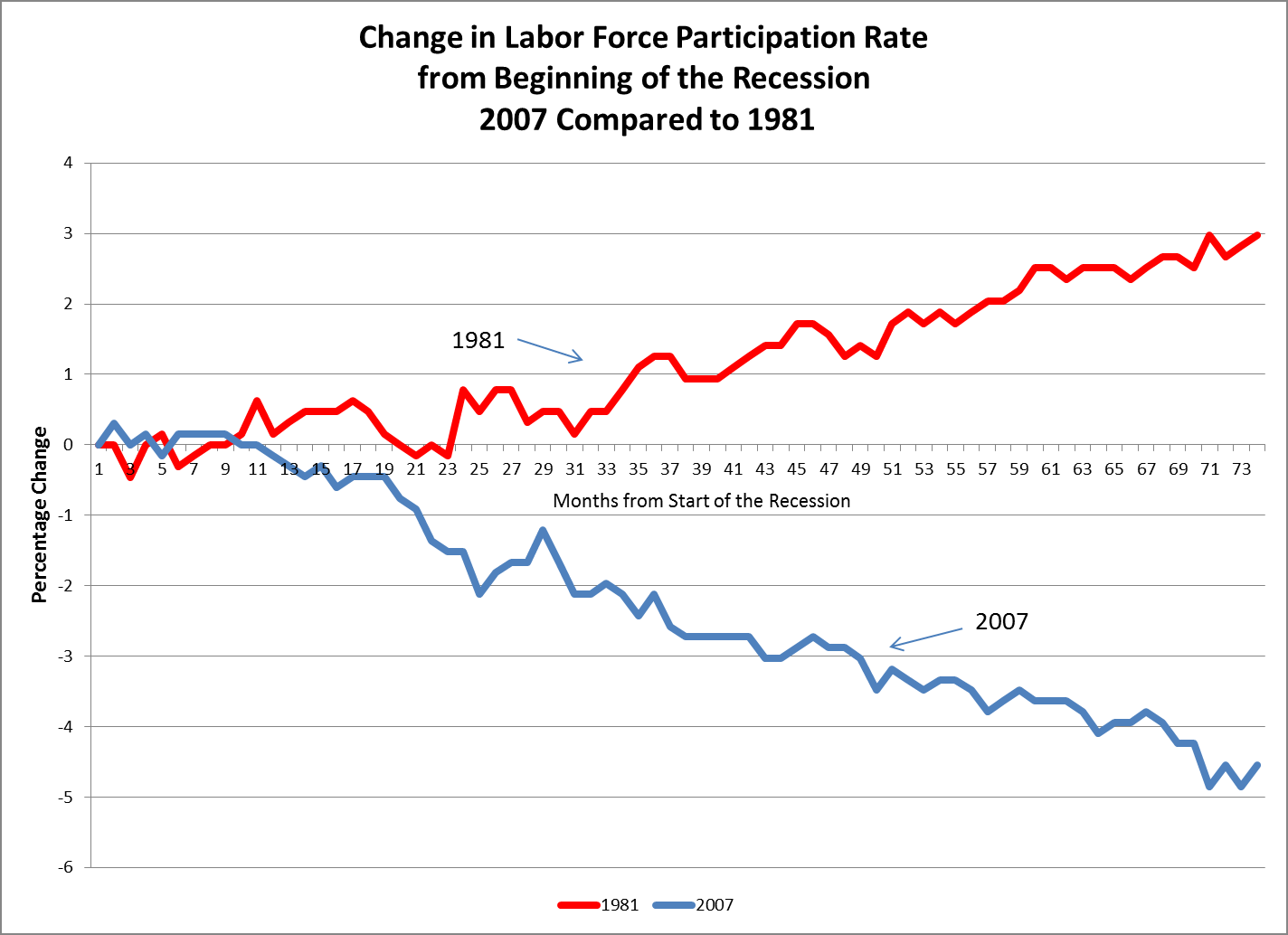
This graph (constructed from the Bureau of Labor Statistics’ Current Population Survey, Table A-1) comes from a report by Senator Jeff Sessions (R, AL), Ranking Member of the Senate Budget Committee.LaborForceParticipationRate_Sessions

Notice that. The labor force participation rate wasn’t affected at all by the Panic of 2008. Quite the contrary, the participation rate’s decline continued unaltered by the Panic—and unaltered by President Barack Obama’s policies. Closely tied to that failure is this: in 2007, just prior to the Panic, 146,273,000 Americans had jobs. As of last February, in the middle of that failed GDP quarter of which I wrote, 145,266,000 Americans had jobs—a decrease of a bit more than 1,000,000 Americans.

And Obama has been on the hustings bragging about that headline unemployment number.

Hmm….

Will We Get a Cut in our Gas Tax?

Now the Obama administration wants to let the states charge tolls for the use of the Interstate highway system. This is the system for which our road and fuel taxes have already paid; the states’ tax money is supposed to be for maintenance and repair of the system.

OK, fair enough. Those roads won’t repair themselves.

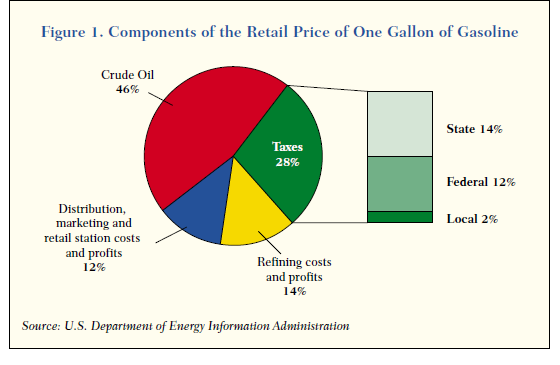
But we still pay those road and fuel taxes, and those funds are for maintenance and repair. This graph from the US Department of Energy, via the Center on Urban and Metropolitan Policy‘s Fueling Transportation Finance: A Primer on the Gas Tax, gives a breakout of what went into the price of a gallon of gas as recently as 2002.ComponentsOfGasPrice

Federal taxes were 12% of the price, or about 44¢ per gallon here in north Texas (updated to 2014).

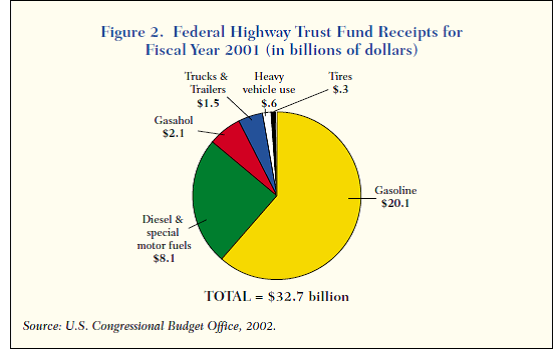
This graph, from the CBO via the same article, gives the 2001 breakout of Federal receipts for the highway trust fund.FederalHighwayTrustFundReceipts

Gasoline and diesel fuels—car and truck fuels—comprise the vast bulk of the receipts.

This 2007 table from the Federal highway administration updates those breakouts.

Table 4. – User Fee Structure.
Tax Type Tax Rate
Gasoline and gasohol 18.4 cents per gallon
Diesel 24.4 cents per gallon
Special Fuels:
General rate 18.4 cents per gallon
Liquefied petroleum gas 18.3 cents per gallon
Liquefied natural gas 24.3 cents per gallon
M85 (from natural gas) 9.25 cents per gallon
Compressed natural gas 18.3 cents per 126.67 cubic feet
Tires: (maximum rated load capacity)
0-3,500 pounds No Tax
Over 3,500 pounds 9.45 cents per each 10 pounds in excess of 3,500
Truck and Trailer Sales 12 percent of retailer’s sales price for tractors and trucks over 33,000 pounds gross vehicle weight (GVW) and trailers over 26,000 pounds GVW
Heavy Vehicle Use Annual tax: Trucks 55,000 pounds and over GVW, $100 plus $22 for each 1,000 pounds (or fraction thereof) in excess of 55,000 pounds (maximum tax of $550)

Notice in the table that taxes are broken out, also, by vehicle weight. Trucks with tire capacity over 3,500 pounds are the trucks that ship our goods over the highways.

Cars and trucks—including those shippers—comprise the vast bulk of the Interstate highway users. Guess who’ll pay the tolls. And who’ll pay higher prices for the goods we buy after they’ve been shipped to the stores we frequent.

Will we see compensatory reduction in our fuel taxes, which as noted above already exist in major part to pay for interstate highway maintenance?

Fat chance.