
Organizational Failure?

Dr Roy Marokus, who currently serves in private practice…said veterans’ appointments were cancelled so VA medical providers could attend the two-day conference. Medical providers at the VA Medical Center in Oklahoma City, where Marokus briefly worked, and providers at all other VA medical centers in the Veterans Integrated Services Network [VISN 16, which includes VA facilities in Oklahoma, Arkansas, Mississippi, Louisiana, and parts of Missouri , Texas, Alabama, and Florida], attended the conference.

A review of the paperwork handed out during the conference showed topics included advice on how to plan a party and asked the medical staff to explore, “What Color is Your Personality?”

“Veterans waiting for appointments got pushed back for two days,” Marokus said. “In human costs, you have all these veterans. Why was that conference needed?”

And this, in VISN 22, which includes parts of California and Nevada:

Another veteran took issue with the filming of the TV show Grey’s Anatomy, which takes place at the Sepulveda VA Ambulatory Care Center. The filming encompasses the entire second floor of the facility.

Gary B, who asked for his last name to be withheld due to a pending 1151 claim [such a claim is for death or disability “as if service-connected”—including VA medical malpractice] with the VA, said aside from the limited care for veterans, the show’s trailers are an inconvenience for veterans.

“They take up the whole parking lot,” he said.

And there is this incident:

A Veterans Affairs nurse who spent 28 years at the embattled agency’s facility in Albany, NY, says when she came forward to report abuse including stolen drugs [including 5,000 vials of morphine from a locked drawer(!); the vials were refilled with saline solution and replaced] and mistreatment of patients, her supervisors turned on her instead of trying to fix things.

The patient abuse and the VA’s response to her calling it out include this:

…she reported that doctors had restrained a patient for seven hours in violation of VA rules. Now she has been banished to an office cubicle, stripped of her nursing duties and supervisory role and faces a 30-day suspension without pay.
Some Folks Know What They’re About

The leader of Iraq’s Kurds said his forces won’t relinquish territory they are defending against Sunni rebels, adding to worries that continued fighting could speed the breakup of Iraq along ethnic and religious lines.

After Sunni insurgents led by the Islamic State of Iraq and al-Sham launched their military offensive in northern Iraq three weeks ago, Kurdish fighters stepped into the breach left by the Baghdad government’s ineffective and retreating armed forces.

On Friday, Massoud Barzani, president of Iraq’s semiautonomous Kurdish region, said that control of Kirkuk and other towns now guarded by Kurdish forces wouldn’t revert to the central government in Baghdad when the crisis subsides.

“Now this [issue]…is achieved,” he said, alluding to the Kurds’ long-running aspiration for self-rule in their northern Iraqi stronghold.

I’m not convinced this is all bad. The Kurds know who’ll defend the territory against invaders and terrorists—and it’s not the Iraqi army. After all, aside from both Shia and Sunni animosity toward the Kurds, the Iraqi “army” is showing it’s not capable of defending much of anything, as their failing attempt to resecure Tikrit is demonstrating.

An aside for Mr Bradley’s benefit: these aren’t “Sunni rebels,” nor are they “Sunni insurgents;” they’re ISIS terrorists. It’d be good to cut out the disingenuous euphemisms and refer to a shovel as the shovel that it is.

The Obama Recovery

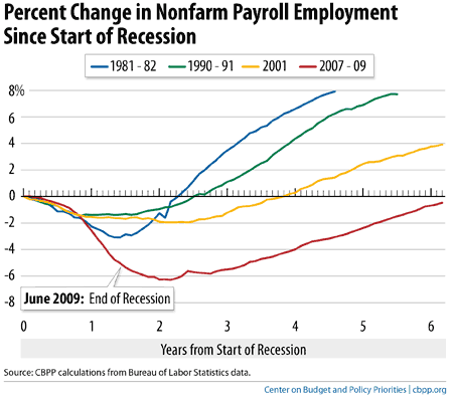
Here are some graphs of how well President Barack Obama’s regulations and economic policies have been working since he exploded our national debt with his “Stimulus” package in 2009. The graphs come from Southern Methodist University Cox School of Business’ Maguire Energy Institute.

First, the sad classic graph of how the Obama Recovery compares with past recession recoveries. It speaks for itself.RecoveryComparison_Cox

This graph shows the total number of Americans still unemployed—the flip side of the number of Americans who actually have jobs.TotalUnemployed_Cox

Like the classic above, things are improving—hence “recovery”—but unemployment still is at historic highs when we consider the number of Americans that make up the unemployed 6.3%. This is because our population is growing faster than the number of jobs available.

This graph shows that the length of time Americans are unemployed isn’t improving very much at all. See the bit about jobs not being created fast enough, above, for a major contributor to this failure. This is a problem that tends to be self-perpetuating, too. The longer folks are out of a job, the more of their skills they lose; if they were in a high-skill, and/or information intensive job (engineering comes to mind), the more obsolete they become, too, as they aren’t as able to keep up with the new data in their field as are those still employed—or even the newly graduated.UnemploymentDuration_Cox

And one more:ProductivityGrowth_Cox

Productivity growth, output per hour by an employee, or what he produces in his hour of working, isn’t very much at all. Most of the jobs that are being created in this pseudo-recovery are service jobs. There are only so many tables a waitress can handle in an hour, only so many disgruntled customers a Customer Service Representative can handle in an hour, only so many investors a brokerage’s Investment Advisor can handle in an hour.

This…recovery…is, to use the Institute’s term, anemic. But we knew that from last week’s GDP growth number. And all of you still looking for work, or who’ve given up on that, have known this for some time.

Some Empirically Determined Pipeline Benefits

A study prepared by the SMU/Cox’ Maguire Energy Institute for the Consumer Energy Alliance has some interesting data from the Keystone XL leg that connects Cushing, OK, with Nederland, TX (built because it’s a purely domestic leg and so did not require President Barack Obama’s personal approval). The figure below presents a map of the pipeline and some proposed adjuncts to it. The Gulf Coast Project is the section of the Keystone XL pipeline project that connects the two towns, and it was open for business last January, so the empirical data are current.Keystone-System-Map

Here are some of the short-term benefits of the project’s work and a couple of longer term benefits:

  • $2.3 billion in private-sector investment
  • 11 million+ hours of labor completed by 4,844 American workers
  • 50+ contracts with US manufacturers and companies that built the pipeline and associated equipment, spread across the country: Arkansas, California, Georgia, Indiana, Kansas, Louisiana, Maryland, Michigan, Minnesota, Missouri, New York, Ohio, Oklahoma, Oregon, Pennsylvania, South Carolina, and Texas
  • manufacture of 485+ miles of high-strength, advanced oil pipeline (36-inch diameter) and associated equipment: thousands of pieces of equipment used to build transformers, meters, electric motors, cabling and electrical equipment; piping assembling and structural steel for supports; etc
  • 2.25 million barrels of new oil storage capacity at Cushing
  • 6 modern pump stations

Some broader results of the pipeline:

  • pumped $3.6 billion into the Texas economy, $2.1 billion into the Oklahoma economy
  • boosted local tax revenues by millions of dollars
  • Prague, OK: “doubled our city sales tax receipts”
  • full RV parks from the construction effort contributed as much as $8,000 a month in electricity fees alone to the municipal utility
  • tax revenue available—and used—to improve education, local infrastructure, and public services
  • Local restaurants, hotels, and businesses experience a significant boos

This table summarizes the overall economic impact of the project:

  Oklahoma Pipeline Impacts Texas Pipeline Impacts
Total Economic Activity $2,143,364,856 $3,638,561,905
Labor Income $1,041,174,418 $1,696,054,834
Employment (person years) 15,852 26,924
Total Taxes $72,384,852 $144,992,343
Indirect Business Taxes $50,339,639 $112,533,584
Direct Business Taxes $22,045,213 $32,458,759

Many will argue that most of these effects will disappear in a few years, even as soon as the pipeline builders leave. Since the results are temporary, why bother, especially given the risks of an oil pipeline? Leaving aside the fact that pipelines are safer than trains for transporting oil and natural gas, ask the folks who’ve gotten these “temporary” fiscal results whether they think any of it was “worth it.”

In Which I both Agree and Disagree

…with a Supreme Court decision. In Mccullen v Coakley, the Supreme Court unanimously struck down a Massachusetts law that placed a mandatory 35 foot buffer zone around abortion clinics within which anti-abortion protests were prohibited. The purpose of the law, to allow women wishing an abortion unfettered access to the clinic, was met, but overbroadly, according to the court.

That’s the part with which I agree. If we’re going to argue as I have in the past that “free speech zones,” like those on too many college campuses, unconstitutionally restrict free speech, then so does the other side of that coin: non-free speech zones. Either we have free speech in this country, or we do not.

But Chief Justice John Roberts, writing for the Court, displayed a sad misunderstanding of that right of free speech. In his rationale for striking Massachusetts’ law, Roberts wrote

McCullen explained that she often cannot distinguish patients from passersby outside the Boston clinic in time to initiate a conversation before they enter the buffer zone.

And [emphasis added]

As explained, because petitioners in Boston cannot readily identify patients before they enter the zone, they often cannot approach them in time to place literature near their hands….

But this ignores the other person’s (here, the woman seeking the abortion) free speech right to choose what conversation she will hear, especially when that unwanted conversation is directed at her and not, from the public square, to no one in particular (and so equally to everyone). Roberts’ thesis also ignores the intended recipient’s free speech right not to have materials pressed on her without her prior consent.

I disagree with Roberts’ rationale.

In the end, an opinion founded on bad law is itself a bad opinion, even if it reaches the right conclusion.