More Obama Sequester

Recall that the Department of Transportation under President Barack Obama warned a week or two ago that nearly 150 control towers at small regional airports will close down, ostensibly due to sequester budget cuts.  DoT also warned of furloughs at major airports, cynically noting that resulting delays could be “very painful for the flying public.”

To alleviate this, Senator Jerry Moran (R, KS) proposed replacing the $50 million of Obama Sequester cuts from the FAA with savings from unspent balances, a kind agency slush fund that all agencies squirrel away against various exigencies, and by reducing other low-priority spending.

Enter, stage left, Senate Majority Leader Harry Reid (D, NV).  He pulled Moran’s amendment and refused to allow it to come to the floor for a vote.

Thus, as The Wall Street Journal puts it,

…in the weeks ahead travelers will likely experience the frustration of flight delays, cancellations and closed airports.  It won’t happen by accident or out of fiscal necessity, but because Washington Democrats refuse to prioritize federal spending.

The Supreme Court and Prop 8

In California, the people—right, wrong, or indifferent—have spoken.  What the Supreme Court needs to think about as it considers California’s Proposition 8, which bans gay marriage in that state, is whether the people are sovereign or the Court presumes to be.

Justice Anthony Kennedy, in questioning lawyers defending the Proposition, pointed out that the children of gay parents have voices that ought to be heard.  And so they should.  When they’re adults, those 40,000 children (compared with the 10 million, or so, adult Californians who already have spoken in that referendum) can spearhead a new Proposition that would reverse Prop 8.  The people, after all, can change their minds.  That’s also easier to accomplish than getting the Supreme Court to reverse itself, even on an opinion with which they’ve interfered with the 10th Amendment.

Justice Sonia Sotomayor, also questioning lawyers defending Prop 8, asked why California had an interest in denying gay couples the right to marry.   But this is to misunderstand the role of the Federal government in a Republic whose social compact has a 10th Amendment.  The Federal government—and so the Supreme Court as the pinnacle of a branch of that government—has no interest in why a state wants to do a thing, a thing that does no harm to its neighboring states or to the United States, within its own borders.

The only legitimate ruling for the Court is to let the people’s decision stand.  And leave California, in competition with those other states whose citizens have determined otherwise, to live with the consequences of its choice.  That’s simply an application of Saul Alinsky’s Rule 4.

Extremist Left on the Prowl, Again

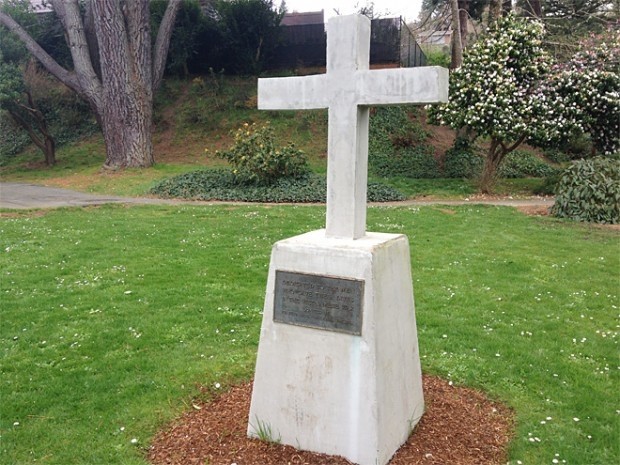
The Freedom from Religion Foundation is attacking a Viet Nam War memorial, and it’s attacking Coos Bay, OR, for having it.

The atrocity this time is a small memorial erected by the local Jaycees in 1972—as that war was winding down—and that has a Latin cross atop it*:CoosBayVietNamMemorial

FFRF attorney Rebecca Markert, in a letter to City Manager Rodger Craddock, wrote—and she was actually serious

We have no objection to the veterans’ memorials.  Our objection is to the message of endorsement of Christianity over other religions and non-religions.  The Christian-only memorial sends a message that the government only cares about the deaths of Christian soldiers, not Jewish, other non-Christian, and non-religious soldiers[.]

She might want to consult with some of those Jewish, other non-Christian, and non-religious soldiers.  They certainly have been supportive of the Latin cross at the Mojave Desert and Mt Soledad War Memorials.  Maybe it’s because Latin Crosses aren’t Christian symbols, per se, on war memorials; they’re symbols, instead of our fallen and of our respect for their sacrifice and the sacrifice of their surviving families.  That’s a degree of respect the FFRF might want to start showing.

Craddock has the right of it:

With all the issues facing our city, we probably have more important things to do[.]

Indeed.


*The photo is by KCBY.

Bias, Redux

I wrote about a case here, a case involving a Florida Atlantic University student being taken out of class a and facing expulsion because he objected to a class assignment that had him write Jesus’ name on a piece of paper, put the paper on the floor, and then stomp on it.  I closed that post with a note that FAU had “apologized” for their attack on the student.

Now more information has come to light on that case and on FAU’s “apologies.”  The latter are even more cynical than at first appeared.

Before I get to them, though, it’s important to note that the victim in the university’s charade has accepted its apology, so that case is closed.  This post, then, is on what’s masqueraded as an apology in 21st century America; I’ll be using FAU’s versions as illustrations, not to continue berating FAU.

This is more of the first apology in question:

First and foremost, we are deeply sorry for any hurt regarding this incident, any insensitivity that may have been seen by the community and the greater community at large.  We are deeply sorry.  …  We are truly sorry that this incident occurred.

And FAU’s second apology:

We are deeply sorry for any hurt this incident might have caused our students, people in the community, and beyond.  …  [The lesson involved] was insensitive and hurtful and we are truly sorry.  Please note we have not taken any disciplinary action against any student regarding this matter.  ….

Sorry for what, again?  These “apologies” carry not a whit of regret for the actual wrongful behavior—in this case the withdrawal of the student from the class and the university’s subsequent threats of suspension or expulsion.  The second version actually acknowledges those threats by asserting a final lack of disciplinary action, but it then disingenuously segues to other matters—there is no apology for that withdrawal, no apology for the threats of more punishment.

These…statements…don’t even carry any serious expression of regret for the outcomes of that behavior; they have only expressions of caveated sorrow for possible outcomes: “any hurt,” not “the hurt;” “any insensitivity,” not “our insensitivity;” and “may have been seen;” “might have caused.”  These last two are especially egregious.  There was no “may have been” to it, nor was there any “might have.”  The community and the greater community at large were quite vociferous in their expressions of outrage.  The university’s “insensitivity” was plainly seen and objected to; the hurt was palpably real and widespread.  There were no maybes involved; thus, “that was experienced by,” and “that was caused.”

How about a simple, straightforward statement of regret, promptly delivered, and devoid of weasel words and caveats?  A statement along these lines (by the Dean of Students and the Senior Vice President for Student Affairs in this example), issued publicly (as the above versions were), personally, and again in writing (as the first version seems to have been) seems suitable:

On my behalf, on behalf of Professor Deandre Poole, and on behalf of Florida Atlantic University, I apologize to [student] for our treatment of him regarding the Stomp on Jesus’ Name incident.  Our interpretation of the lesson, to actually require those actions, was erroneous.  Worse, our withdrawal of [student] from that class and our threats to suspend and/or expel him simply were wrong, and we should have known better.  I, and we, are sorry for our actions in handling this incident.

Now, back to the university.  FAU Dean of Students Corey King has said he cannot comment on employment matters when asked about Poole’s status at the university following this incident.  This is nonsense.  The comment restrictions are purely a matter of policy internal to FAU; Florida law carries no such restriction (Florida lawyers are free to correct me on this).  As such, that policy can be waived in particular cases; this one seems egregious enough that sanctions taken against Poole, if any, should be public knowledge.  Especially if FAU has chosen to take no action concerning Poole.

Freedom and Culture

From Friedrich Hayek’s The Road to Serfdom, as quoted in The Wall Street Journal:

The important point is that the political ideals of a people and its attitude toward authority are as much the effect as the cause of the political institutions under which it lives. This means, among other things, that even a strong tradition of political liberty is no safeguard if the danger is precisely that the new institutions and policies will gradually undermine and destroy that spirit.

Now where might we be seeing that today?