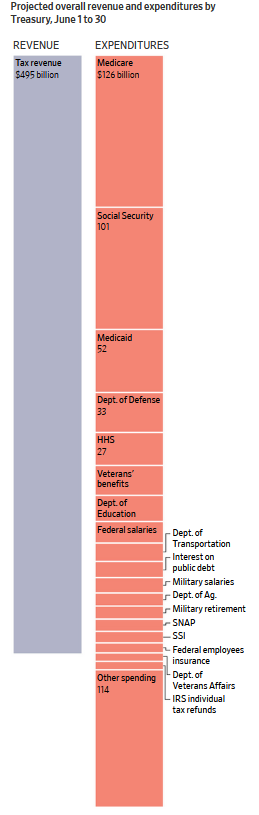
Debt and Spending

Here’s a fun fact, one that every child from three years old and up who gets an allowance clearly learns, one that’s made explicit in any high school basic economics class, and one that’s driven home in junior college and college Econ 101 classes: when you spend more than take in, you owe the difference, either explicitly by borrowing separately to make up the arrears or implicitly by the existence of the deficit resulting from spending more than is taken in.

There are two outcomes that are absolutely critical to successfully resolving such a situation: pay the debt that has been incurred, and reduce spending to fit within income in the subsequent years so as to not incur that debt again.

So it is with our nation’s Federal budget.

We have, for decades, but especially with the Obama administration’s overwrought response to the Panic of 2008, again during the Trump administration’s overwrought response to the Wuhan Virus situation, but especially with the Biden administration’s deliberate explosion of spending in response to no particular “emergency,” and without any regard for actual Federal intake under its Grove of Money Trees Modern Monetary Theory foolishness. This is coupled with a statutorily set debt limit, a limit that stops the Federal government from borrowing at all when the amount of debt already incurred reaches that limit. The bar on further borrowing forces a complete stop in spending above current Federal income—which represents a significant spending cut.

Those spending cuts include not paying on existing Federal contracts, reductions in or complete halts of welfare program payments, reductions in Social Security and Medicare payments, and reductions in payments on Federal debt, the latter which would be reductions in principal payments. Payments at least of the interest owed are Constitutionally required, which especially drives reductions in or complete withholding of any or all of those other payments in order to be able to make the debt interest payments.

Which brings us to the Federal government’s only solutions to the current debt ceiling crisis: pay the debt and reduce spending to fit within Federal intake in the subsequent years. These must be done together, or we’ll just keep needing to raise the statutory limit on Federal debt accrued.

That, in turn, brings us to the current situation vis-à-vis debt and spending. For months Republicans and Conservatives in the House have sought negotiations with President Joe Biden (D). (Republicans and Conservatives in the Senate have been remarkably silent. Some of that is driven by the Constitutional requirement that revenue and spending bills must originate in the House, but some of it, also, is driven by the timidity of those Senators.) For months, Biden has refused to negotiate, refused to talk with House Republicans and Conservatives at all.

Lately, Speaker Kevin McCarthy put forward a bill that would raise the debt ceiling by enough to support excess spending for a year while clawing back various appropriated but unspent monies, cutting spending in other areas, and capping non-defense discretionary spending at 1% growth for each of the next 10 years. Associated with that is a proposal to use that year to negotiate serious spending reductions for the next budget year and subsequent years.

Biden has ignored the proposal. Biden’s stubbornness—a stubbornness that is born of the man’s ego-driven pride—is threatening our nation with default on our debt. Such a default will be Joe Biden’s doing, and no one else’s.

McCarthy wants a different outcome:

…Biden [to] return to the negotiating table for debt ceiling negotiations….
I think as president and the leader of the free world, this is one of the problems. We have challenges around this country, around the world. He needs to show leadership and come to the negotiating table instead of putting us in default. This is risky, what he’s doing.

Biden needs to get past his ego and stoop to negotiating.

Full stop.

The Purpose of Medicaid

State Medicaid programs were created for the explicit purpose of providing health insurance coverage for State citizens on the lower rungs of that State’s economic ladder. The Federal government transfers Federal funds—the tax remittances of all of us citizens regardless of the State of which we might also be citizens—to support those Medicaid programs.

In California’s case, Federal transfers in support of Medi-Cal, that State’s Medicaid program, comprise more than 69% of the program. That amounts to 71.4 billion of our tax dollars.

Now the Progressive-Democrat governor of California, Gavin Newsom, wants Medi-Cal to pay the rent for the State’s homeless.

Newsom has proposed using federal healthcare funds to cover at least six months of rent for homeless California residents and those close to losing their homes.

The foolishness is spreading; California is not the only State pulling this stunt.

California is modeling the program off of similar programs in Oregon and Arizona that have been previously approved by the federal government.

Oregon gets 76%—$8.5 billion—of its Medicaid program covered by the Feds, and Arizona gets more than 80%—$14.3 billion—of its Medicaid funding from the Feds.

Newsom argues—and he’s actually serious—that this will save money in the long run because the State (as JtN cited him)

will not have to pay as much for these people’s expenses in hospitals, nursing homes and prisons.

This is a cynical non sequitur. Nursing homes and prisons aren’t centered on medical care, for all that medical care is a small part of those…services. Those services’ costs also are already factored into their budgets. Too, hospitals aren’t residences—and their medical service costs also are already factored into their budgets, including in part from California’s existing Medi-Cal.

Maybe it’s time to stop sending the Medicaid-related tax remittances of citizens of other States to these States.

Debt Limits and Spending

The Congressional Budget Office is out with its projection for our nation’s economic future.

As for the much-discussed federal debt, the nearby chart shows how fast it has grown in the last several years. Debt held by the public—the kind we have to pay back to creditors like the Chinese and Japanese based on contracts—is now 97% of the economy, and will soon rise to 100% and keep going to 118.2% in 2033. How high can it go before creditors stop lending? No one knows, but it will be ugly if they do.

Here is that nearby chart:

This illustrates the tight relationship between spending and debt limits, and why future spending cuts must be part of negotiations related to raising today’s debt ceiling limit. It’s barely possible to see any effect from the 2011 debt limit increase that was agreed in exchange for some “freezing” of Federal spending levels, a pseudo-freeze that in the end ended rather quickly.

There need to be real reductions in Federal spending, not just a reduction in spending growth or even a pretend freeze. There’s plenty of room in welfare spending, for instance, for cutting. Furthermore, all Federal spending is discretionary, the bad habit of calling some spending mandatory notwithstanding. Finally, to put a legitimate floor under spending (which doesn’t contradict the forgoing because it’s a floor not a mandatedly ever-increasing level), there’s a Constitutional requirement to spend adequately on national defense and debt repayment.

In the end, too, tax rate cuts, leaving more money in the hands of private economy actors—us average Americans and our businesses—leads to increases in Federal revenues. This has been empirically demonstrated by every tax rate cut since President John Fitzgerald Kennedy’s reduction of the top rate from the neighborhood of 90% to the region of 70%.

Federal spending cuts coupled with Federal tax rate cuts—they’re win-win for our economy and our nation, if only the Progressive-Democratic Party politicians in Congress and the White House would get out of the way.

Debt Ceiling “Negotiating”

In a Wall Street Journal op-ed centered on ways to “save” Social Security and Medicare, Progressive Policy Institute‘s Director of the Center for Funding America’s Future, Ben Ritz, opened with this bit for his lede:

The Biden administration has sensibly rejected attempts by some far-right Republicans to hold the full faith and credit of the US hostage in exchange for spending cuts. The administration now must show it will be open to good-faith budget negotiations after the impasse over the federal debt limit is resolved.

Leave it to a Left-winger to say, once again, “Trust us.”

No. Debt limits are reached and need lifting because of prior spending excesses.  And continued spending excesses because there follow no “good faith” budget negotiations from the political Left after the impasses. The current debt-ceiling is no exception.

It is the Progressive-Democratic Party politicians, from the White House on into both houses of Congress, who are holding our nation’s credit-worthiness and our economy as a whole hostage against their demand to continue their profligate spending.

The debt ceiling cannot be lifted, sensibly, without being paired with actual spending cuts (not reduced rates of increase) as part of the package so as to obviate future need to raise the limit once again.

If the Progressive-Democrats were serious about our credit-worthiness and our economy, they’d get out of the way of serious negotiations.

Mistaken?

In a Fox News article centered on Congressman Chip Roy’s (D, TX) proposed legislation that would bar Federal funds from going to schools that teach critical race theory (the foolishness doesn’t deserve capitalization), Cato Institute’s Colleen Hroncich had this in objecting to Roy’s proposal:

For starters, the federal government has no constitutional role in education[.]

Plainly, the Federal government does have a role, Constitutional or otherwise, in education—hence the existence of those federal funds to schools that Roy’s proposal would block.

Alternatively, Hroncich is correct, and all Federal funds transfers to schools should stop.