Federal Debt Ceiling

The Progressive-Democratic Party says they’ll refuse to negotiate on raising the debt ceiling. Not at all. Those politicians are looking to hold our nation’s weal and our national security hostage against their demand to spend, spend, spend.

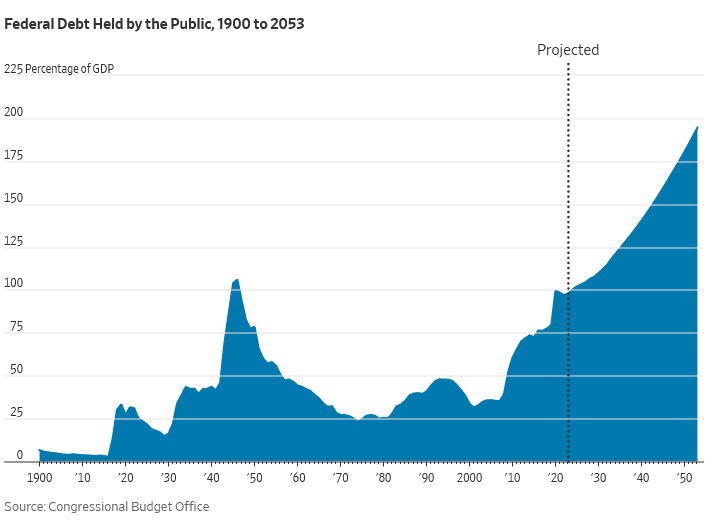
Republican Party politicians—at least those in the House and some of them in the Senate—insist that the debt ceiling can’t be raised without agreement on spending cuts in the next and subsequent budgets: not agreement to talk about cuts, but actual, specific cuts.

These Leftist politicians insist that the debt ceiling is solely about current bills that must be paid and that future spending questions—cuts or otherwise—are separate questions and must be negotiated separately. This is badly mistaken.

Today’s debt ceiling problem is the result of past failures to cut spending: failures to agree to do more than just talk about cuts and, where cuts actually were agreed, failures to honor those agreements. The next budget’s spending will impact the next debt ceiling and create pressure to raise the ceiling again. Failure to accept, or even to recognize, the relationship between a debt ceiling and budgeting just leads to functionally automatic debt ceiling raises and so functionally automatic debt increases.

Current debt ceilings and future spendings are inextricably intertwined. The Republicans in the House need to stand tall and not allow any debt ceiling increase without agreement to specific, measurable cuts (not reductions in increases) in future budgets’ spending on specific programs. Senate Republicans need to find backbone and stand tall on this pairing, also.

Progressive-Democrat refusal to negotiate on this puts our nation’s debt crisis squarely on their backs, and no place else. Their refusal to negotiate is just their demand to continue spending us average Americans‘ money in ever increasing amounts, their demand to drive our nation ever more deeply into debt—demands born of the irrational concept that money can be created out of the æther with no economic consequence.

Rules and Defense Spending Cuts

The House—in particular, the majority Republicans—along with too many so-called defense journalists are having trouble with a rule that potentially leads to defense spending cuts, a particular anathema in today’s environment of a Russia at war and a People’s Republic of China threatening war.

However, the fact is defense spending has always been vulnerable to cuts, particularly by the Progressive-Democratic Party and its predecessor Democratic Party. The proposed rule just makes the potential explicitly stated. But it does not mandate defense spending cuts; it mandates spending cuts in one (or more) places if there are to be spending increases in other places. Quoting from the proposed rules:

Initiatives to Reduce Spending and Improve Accountability. Subsection (a)(1) replaces current “pay-as-you-go” requirements with “cut-as-you- go” requirements. The provision prohibits consideration of a bill, joint resolution, conference report, or amendment that has the net effect of increasing mandatory spending within a five-year or ten-year budget window. This provision continues the current practice of counting multiple measures considered pursuant to a special order of business which directs the Clerk to engross the measures together after passage for purposes of compliance with the rule and provides a mechanism for addressing “emergency” designations.

And

Subsection (e)(2) establishes a point of order against consideration of a bill or joint resolution reported by a committee (other than the Committee on Appropriations) or an amendment thereto, or a conference report thereon, which has the net effect of increasing direct spending in excess of $2,500,000,000 for any of the four consecutive 10 fiscal year periods beginning with the first fiscal year that is 10 fiscal years after the current fiscal year. The levels of net increases in direct spending shall be determined based on estimates provided by the chair of the Committee on the Budget.

And

Spending Reduction Amendments in Appropriations Bills. Subsection (f) provides for spending reduction account transfer amendments and requires a spending reduction account section to be included in all general appropriations bills.

There’s nothing in there that mandates cuts in defense spending. All spending, though, needs to be up for discussion in light of the current Progressive-Democratic Party-driven economic condition of our nation, as Freedom Caucus Founder, Congressman Jim Jordan (R, OH) has pointed out. That I—and lots of others—disagree with not continuing to increase defense spending in these parlous times simply means that we need to make our case instead of relying on inertia to carry it. And refreshing the case is entirely good.

In the event, the rules package was passed without significant change.

The rules as proposed can be read here.

This is Why

Georgia recently won a court case in which the Biden administration had—illegally, as it turns out—blocked its program to expand Medicaid eligibility to individuals making up to 100% of the federal poverty line ($13,590 for singles) while conditioning benefits on working, going to school, or volunteering 80 hours a month.

However, under the Families First Coronavirus Response Act of 2020, States are unable to remove able-bodied Medicaid folks—i.e., folks who are fully capable of working but who choose not to—from their Medicaid rolls as long as the Wuhan Virus emergency remains in effect. The CDC conveniently continues to extend that “emergency,” even though no less a light than our Progressive-Democrat President, Joe Biden, has said the emergency is over.

Alternatively, Georgia could remove those folks and the Federal government could withhold hundreds of millions in federal funds. In all, the Federal government mainlines $130 billion in additional Medicaid funds into all the States’ veins.

As The Wall Street Journal‘s editors put it,

The emergency is a Faustian bargain for states….

This is why it’s at best idiotic for any State to take Federal (our taxpayer) money under any circumstance. The dollars don’t come with strings attached; they represent yokes around the States’ necks.

Impressiveness

Federal Reserve Chairman Jerome Powell had this to say about handling the burgeoning inflation extant in today’s American economy:

Slowing demand growth should allow supply to catch up with demand and restore the balance that will yield stable prices over time.

It’s impressive that a government official as steeped in economics as Powell is has such a deep misunderstanding of the situation.

It’s not a matter of slowing demand growth, it’s a matter of slowing government demand growth. The private economy, especially when it’s not competing with government for goods and services—and for the inputs to those goods and services—will easily and efficiently take care of itself, with changing supply and demand comprising self-correcting stabilizers on our economy.

They Should Take Him Up on His Offer

Many California local jurisdiction officials dispute with California Governor Gavin Newsom (D) over which has the larger responsibility for the homelessness rampant in those jurisdictions and what action should be taken to mitigate the problem. As a result of the dispute,

Mr Newsom recently put a temporary freeze on $1 billion of state grants for city and county homelessness programs. He also rejected a slate of proposals from local officials outlining how they would spend the money, saying the measures would have reduced homelessness statewide by 2% between 2020 and 2024, which he deemed inadequate.

In response,

Mayors and county officials, meanwhile, have said they need the Newsom administration to provide reliable, recurring revenue streams and a cohesive statewide framework to address the issue.

No, they don’t. City and county officials need to reassess their own spending priorities and their own ordinances regarding housing, employment, and homelessness and make their own adjustments. Nor should they be holding out for a Statewide “framework” for the problem: each local area has its own unique set of homeless problems, even if there might be considerable overlap among the areas.

Then these city and county officials need to accept Newsom’s generous offer to step back from interfering in city and county governance; they should accept his withholding from them of State funding.

The less State funding a city or county takes from the State government, the less hold on the city or county the State has and the weaker the ability of the State to dictate behaviors to the city or county government. This would be a relative increase in city and county power relative to the State and a net gain for the individual liberties of the local residents and the State citizens resident in there.

What’s not to like?