I’ve written before about the duplicity of Facebook and its MFWIC Mark Zuckerberg.
Here’s another example, even more blatant than that last.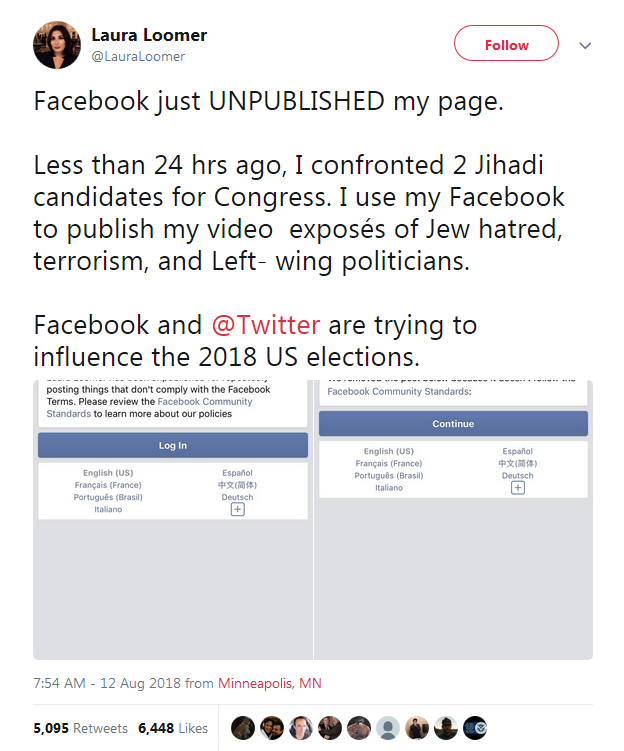

I’ve written before about the duplicity of Facebook and its MFWIC Mark Zuckerberg.
Here’s another example, even more blatant than that last.
Apple has chosen to conceal accesses to Infowars by removing links to it from Apple’s podcast facility because Apple thinks Infowars is too far right for Apple’s taste and because the site pushes bad speech.
This is rank censorship.
Eliminating easy access to Infowars podcasts marks a rare, prominent foray for Apple into an issue confronting many major internet companies: how to remove hateful or conspiratorial messages from their platforms without infringing on free speech.
This is an impossible task to achieve legitimately. Our 1st Amendment is explicitly intended to protect unpopular or disgusting or hateful speech as well as “approved” speech. The Amendment recognizes the ability of individual American citizens to think for themselves and to evaluate for themselves what speech they choose to hear, free from Government “advice.”
It’s true enough that the Amendment enjoins Government and not private enterprise. However, the principle the Amendment protects is a universal one; it applies to all of us, individuals and enterprises alike.
Apple’s MFWIC, Tim Cook, clearly thinks he’s above all of this. His attaboy for resisting the FBI’s demand that Apple destroy individuals’ ability to encrypt effectively their private communications has been used up.
Federal District Judge Robert Lasnik of the Western District of Washington has blocked, temporarily, the online distribution of blueprints for printing 3-D guns. Lasnik’s temporary restraining order is subsequent to a settlement reached between Defense Distributed and State (which previously had blocked the posting of the plans) that functionally set aside State’s security objections to the posting. The State of Washington, et al., then sued to reinstate the prior block.
In decrying the settlement that’s the subject of his TRO, Lasik wrote
the parties reached a tentative settlement agreement which, as described in the first paragraph of this order, will allow Defense Distributed to place downloadable CAD files for automated weapons printing on its website. No findings of fact or other statements are provided in the agreement that could explain the federal government’s dramatic change of position or that alter its prior analysis regarding the likely impacts of publication on the United States’ national security interests.
And
The proliferation of these firearms will have many of the negative impacts on a state level that the federal government once feared on the international stage….
Regardless of the merits of these concerns, though, they are political concerns, not judicial ones. Lasik was wrong to intrude himself into the matter rather than referring it to the political arms of our government.
Illustrating the irrationality of a judge intruding into inherently political matters, Lasnik also wrote [cites omitted]
Under the Arms Export Control Act (“AECA”), the President of the United States is authorized “to control the import and the export of defense articles and defense services” “[i]n furtherance of world peace and the security and foreign policy of the United States.” “Defense articles and defense services” includes all firearms up to .50 caliber and all technical data related to such firearms, including information that “is required for the design, development, production, manufacture, assembly, operation, repair, testing, maintenance or modification of” the firearms.
Replicas of Hawkin muzzle-loading rifles are of .50 caliber, or less. Would Lasnik seriously entertain blocking export or import of these, too?
On the other hand, there’s this:
Some firearms experts played down the danger of these guns, saying most 3-D printers use materials that aren’t strong enough to produce a reliable firearm.
This is irrelevant. The technology surely will evolve, and full-up, durable and reliable weapons will become 3-D printable, and the printers involved will come down in cost. What is relevant here is the principle of the matter: should a US citizen be able to exercise his rights under our Bill of Rights and post such plans, or not?
Lasnik’s TRO can be seen here.
Facebook, for a while, decided that our Declaration of Independence was filled with hate speech. In particular, Facebook decided that
He has excited domestic insurrections amongst us, and has endeavoured to bring on the inhabitants of our frontiers, the merciless Indian Savages, whose known rule of warfare, is an undistinguished destruction of all ages, sexes and conditions[]
which closed the list of Facts our nascent nation submitted to a candid world
goes against our [Facebook’s] standards on hate speech.
Facebook then threatened The Washington Times, which had been posting to its Facebook account successive parts of our Declaration leading up to our Independence Day celebration—which was to have included that hateful passage—with the loss of its Facebook account.
Facebook’s algorithm did it. That’s the company’s story, and apparently they’re sticking to it.
It’s true enough that Facebook later reposted the censored passage and…apologized…for the “error.”
That, though, does not alter the simple fact that Zuckerberg’s minions, hiding behind that algorithm—which Zuckerberg’s IT experts had carefully programmed—had committed this act of censorship of our Declaration of Independence.
Nor does it alter the simple fact that Zuckerberg and his minions waited to restore the censored passage until after they’d been publicly called on their misbehavior. They did not proactively, on their own initiative, undo their misbehavior.
This is free speech, Left style. Not even our founding documents can be posted without a struggle today. Just like when they first were published.
The writer JD Vance, this time in The Wall Street Journal, has made a strong case for Brett Kavanaugh, a judge on the DC Circuit, being nominated for the Supreme Court.
He is a committed textualist and originalist, one whose time on the bench has revealed a unique ability to apply these principles to legal facts. He deeply believes in the constitutional separation of powers as a means for ensuring governmental accountability and protecting individual liberty.
And
…Judge Kavanaugh’s opinions have been adopted by the Justices 11 times—a record of influence and persuasion that suggests he would be effective on the still-divided high court.
I disagree, though. Ex-President Barack Obama (D) stacked the DC Circuit with a number of “liberal,” activist judges. Kavanaugh is more valuable, say I, staying on the DC Circuit, where he can apply those qualities in counterbalancing that liberally stacked court. He still will have, from there, the influence on the Supreme Court and on our jurisprudence generally that he already has.
There are a number of other judges with the same talents, skills, and understanding of and appreciation for our Constitution, its text, and the text of our laws. Any of those would make excellent choices for the Supreme Court.
It’s true enough that any of those also would make excellent choices for backfilling Kavanaugh should he depart for the Supremes. However, that would require a second confirmation hearing and Progressive-Democratic Party time-wasting fight.