
Felons and Voting

In general, felons have no voting rights—it’s part of their punishment for having committed their crimes.  There also are growing movements to restore voting rights to felons—they are, after all, US citizens.  (I’m eliding here felons who aren’t citizens; they have no voting rights to restore.)

It’s a debate worth having, but a couple of misunderstandings need to be cleared up first.  These misunderstandings are illustrated in a recent Wall Street Journal article.

As the midterm elections draw closer, Dameon Stackhouse is eager to cast a ballot, but he can’t under New Jersey law because he remains on parole after more than a decade behind bars for second-degree robbery.

If he’s on parole, he’s still serving his punishment for his crime; he’s only entered a new stage of that punishment.  With his punishment still in progress, he shouldn’t get his right to vote back.  On successful completion of his parole—successful completion of the punishment society has said is required for his crime—then it’s worth seriously considering reenfranchising him and others in similar situations.

And this, from Stackhouse:

We have no say [without a right to vote].  This is one of the worst things you can do to a citizen.

No, Stackhouse did this to himself with his decision to commit his crime; no one else did this to him as a citizen.  His apparent inability to accept responsibility for the outcomes he created with his misbehavior in addition to the misbehavior itself does not suggest that his rehabilitation is being entirely successful.

I am spring-loaded to restore the franchise to those who’ve successfully completed their punishment—for the vast majority of crimes, there should be an endpoint to the punishment short of death, whether by execution or old age.  But the punishment must be completed before reenfranchisement.
Academic Preparedness

New York City has a program, Expanded Success Initiative, that was intended to improve the city’s K-12 “black and Latino males'” (apparently, the girls just don’t matter in New York City) performance.  It’s failing; although, the piece at the link is more optimistic than that.

Students…reported better school relationships and more fair treatment than peers in comparable schools outside the program.[]

Socialization does matter in a child’s development; however….

[A]cademic outcomes and suspension rates remained roughly similar to those in the comparison schools.

Academics are the primary purpose of schools.  ESI improved nothing important.

But here’s the kicker, completely missed by the WSJ piece:

Among the first cohort of black and Latino males in the initiative, about 71% graduated high school, 17% hit state benchmarks signifying college-readiness….

In what universe do these numbers make sense?  Leaving aside the poor graduation rate, how does a student graduate from high school without being prepared for higher education?  I’ve long disputed that college is a necessary next step for high school graduates, but a student not academically prepared for that step isn’t prepared for community college or trade school, nor is he (or she!) prepared to go straight into the work place in any job other than ditch digging or burger flipping.

Major Uncool

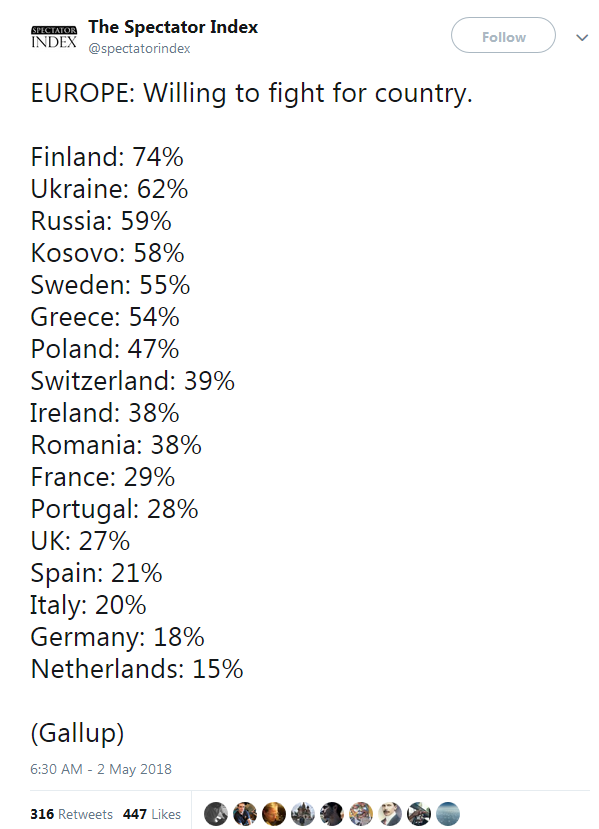
Here’s a stat from Spectator Index.

The people of most of those nations would appear to prefer to be slaves of a conqueror.  The top two nations, on the other hand, have recent and direct experience with Russian dominance.  Which makes Poland’s poor attitude surprising.

On the other hand, the general attitudes of the NATO nations makes one wonder about the utility of NATO at all, and whether we wouldn’t be better served by forming a mutual defense alliance with those eastern European nations that still have some self respect—many of which aren’t listed in the poll.

Poke around the comment thread, too.  There’s at least one who’s arguing with a straight face that Turkey and Russia are not in Europe.

Another Mueller Leak

The New York Times has published the questions Mueller wants to ask President Donald Trump regarding Mueller’s “investigation” of Trump, the Trump campaign, Trump businesses, and whatever else blows Mueller’s skirt up.  Never mind that this sort of thing is supposed to be secret, or at least known only to the target and his lawyer until they’re asked, answered, and become part of the public record of an actual trial.

How did the NYT get the questions?  They didn’t send a reporter to steal them.  No, the newspaper was given them.  There’s also no reason to believe the Trump team knew these questions and so would have been in a position to leak them.  Negotiations over the nature of a Mueller interrogation of Trump are supposedly in progress, but Mueller wouldn’t give up the questions until the negotiations have been completed and the interrogation set up.

Only Mueller’s team knew these questions.  In a separate article about the questions, the NYT does assert this:

investigators for Mr Mueller agreed days later to share during a meeting with Mr Dowd [then Trump’s lawyer] the questions they wanted to ask Mr Trump.

But there’s no reason to believe that, since the NYT chose not to identify its source for that claim, making it impossible to believe that the claim is more than just an idle rumor.

And what’s Mueller doing about this leak?  A lot of nothing.  Because if Mueller isn’t the one who leaked, he actively approved others to do it.

The NYT had this about the questions in that separate article:

The questions provide the most detailed look yet inside Mr Mueller’s investigation, which has been shrouded in secrecy since he was appointed nearly a year ago.

Umm, no, no secrecy.  Mueller has been making studied leaks right along.

But Mueller is an honorable man. So are all his team, all honorable men.

Battle Against Hate Speech?

Bob Pearson, co-author of Countering Hate and CIO of W2O Group says that AI is able to identify hate speech today.

All human beings follow patterns online.  You can see what language, content, channel, and people matter to them. You can see which words trigger information seeking, which language is most associated with hate topics or sites, which people are the most important influencers and you can see a range of behavioral characteristics.

Except that humans can’t define “hate speech;” we can’t even define “hate.”  All that can be done is for each of us, individually, to identify what it seems like that to us—not what it is to anyone else.  A Justice’s remark about pornography—that he couldn’t define it, but he knew it when he saw it—is worse than wholly inadequate when Government tries to regulate speech, or when private enterprises try to regulate speech in the public spaces they create as their business models or offshoots of them.  Such regulation is a threat to individual liberty.

Artificial Intelligence certainly is not up to this task of discriminating unacceptable speech from acceptable.  The definitions of those terms will be programed by a select group of humans—who can’t define the terms except as they personally apply the terms to themselves.  This frangibility is demonstrated by those cases that go to jury trials and the differing outcomes differing juries reach on substantially similar cases.  All AIs can do is reflect the prejudices of their programmers.

How, indeed, is “hate speech” to be discriminated from the merely rude or offensive or uncivil speech?  To narrow the thing a bit, think about civility—simple courtesy.  Why should a New Yorker’s version of civility be forced to take a back seat to a Midwesterner’s or a Californian’s version of civility?  Why should one of the other two be forced to take a back seat to a New Yorker’s version?  On what basis would any definer pick one or identify a middle ground that doesn’t wind up being a more insidious censorship?

Consider Marshall McLuhan’s the medium is the message.  Sometimes the overt rudeness—even “hate”—is a demonstration of a point.  Is burning our national flag an act of hatred or political speech?  Is posting a picture of Mohammed…?  Prove it: it’s a hard line to draw between that and rudeness on the one hand or actual hate on the other.

Not even civility is “simple.”  How is something as complex as hate speech to be handled?

Yet the whole argument over identifying, and then censoring, hate speech is irrelevant other than the threat to freedom that is that effort to identify and censor.

The problem he [Pearson] says, is that Facebook and other companies have not taken up the charge to make the battle against hate speech a major priority.

No, Pearson is utterly wrong on this.  Facebook, et al., must not take up the battle, any more than can Government be allowed to.  Any effort along these lines can only be the despicable bigotry and the equally shameful cowardice of censorship.  Bigotry because all such efforts amount to is one man, or a small group of them, imposing his prejudice of acceptability on the speech of all others.

Hackneyed as it’s become, Justice Louis Brandeis still is right: the answer to bad speech—however defined—is more, and better, speech—however defined.

Engage in the discourse, don’t cower away from it.