Why Should There Be a Cap?

Scott Atlas wrote in a recent Wall Street Journal that all of us should have access to health savings accounts, instead of just the few well-off among us who can afford the high deductible health coverage plan that’s currently a prerequisite for having an HSA.  He also wants to raise the cap for contributing to one to $7,350 per year.

He’s on the right track, but he stopped short.  Why should there be a cap on HSA contributions?  Why can’t we contribute as much or as little as we want instead of what Government will permit?

Of course, with a properly low, flat income tax rate, tax reduction/avoidance/savings facilities like HCAs, IRAs, 401(k)s, etc, would have less value because there’d be less taxes to be avoided.  We’d have more of our money in our hands to spend as we see fit and to save for the purposes that suit us rather than suit the men of Government.

Another Obamacare Episode

The Justice Department has declined to defend Obamacare in the suit against it brought by a large number of States in the aftermath of Congress’ repeal of the Individual Mandate penalty tax.  Recall that Chief Justice John Roberts rewrote the law in 2012 to recreate the penalty as a tax in order to preserve the IM as constitutional, and thereby to preserve all of Obamacare as constitutional because of the inseverability of all parts of the law.

With the repeal of the IM’s…tax…that inseverability should doom the rest of Obamacare.

As a result of Attorney General Jeff Sessions’ decision not to defend the law,

University of Michigan law professor Nicholas Bagley said three Justice Department attorneys withdrew their names from the brief [wherein DoJ advised the court of its position].

Three Justice Department attorneys also should withdraw their names from the Federal payroll.

The Veterans Administration

…won’t clean up after itself.  In this instance, literally.  This is the VA “hospital” room a veteran was placed in when he went to that…facility…for treatment that involved 18 injections.  Injections to be done in a room as filthy as this.
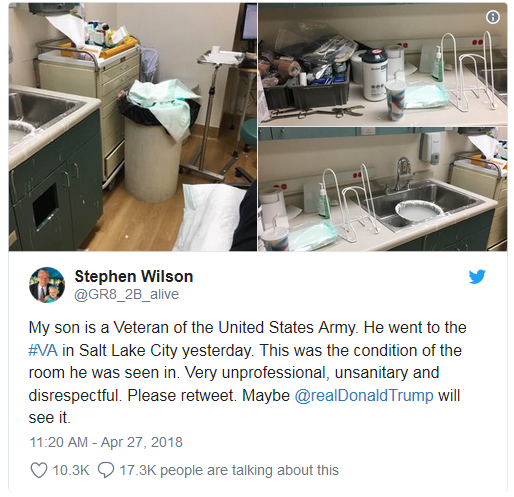
Dr Karen Gribbin, the chief of staff at the George E Wahlen Department of Veteran Affairs Medical Center, on Saturday reportedly said that Wilson should not have been in the room. She said the rooms should be cleaned prior to each patient and called on an investigation.

Wahlen is the imitation hospital at which this failure occurred.  The vetaran’s father, who posted the tweet, also tweeted

The condition of the room was the way it was when he went in, no other room was offered and no attempt to clean it up was made for the duration of his appointment[.]

Gibben also admitted that the veteran got his injections in that dirty room, but she claimed that the injection equipment—the needles, for instance—

would have been used just on him.

While that is, in fact, highly likely, how can we be sure, given the condition of the room and the level of professionalism and of integrity demonstrated by going ahead with the patient’s treatment there?

And this:

Gribbin was asked what the typical procedure was for when to clean patient rooms in order to ensure they are clean for each visit.

“We are investigating that. To be quite honest I do not work in that clinic area and I am not sure…exactly what that process is. We will be absolutely clarifying that, making sure our policies and procedures are well thought out and well communicated to staff[.]

She’s the Chief of Staff.  How is it possible that she does not know her own procedures or protocols?

Again, I say: disband the VA altogether and use its budget and nominal future budgets for vouchers for our veterans to see the doctors, clinics, and hospitals they choose, when they choose, and for the care they choose.  Enough of the VA’s trash.  Literally.

The original tweet, posted by the veteran’s father, can be seen here.  Poke through the reply thread, too.


Veteranos Administratio delende est.

An Unintended Consequence

The health coverage plan providers, companies like Humana, Aetna, Anthem, et al., are gaming the Medicare system to keep their Medicare bonuses coming in.  Surprise.

It seems that when Obamacare was passed, it included a system of paying bonuses from Medicare to those plan providers that got sufficiently high ratings on the quality of their plans.

But wait….

Medicare ranks privately managed plans…on a five-star quality scale and provides financial bonuses to providers of top-ranked plans. [A plan-holder’s] plan was set to be downgraded, which would have cost Humana its bonus. So the company merged plans covering [the plan-holder] and more than a million others into different contracts with higher scores. That preserved the bonuses.

That’s called cross-walking, and it’s entirely legal, if maybe a tad shady.

This is the sort of thing that happens, though, when Government intrudes itself too far into a marketplace.  Private enterprise is more agile than government bureaucracies can ever hope to be, and they can move much faster than any government bureaucracy can hope to do.

It’s also why black markets flourish in centrally planned economies.

The existence of this ability to cross-walk is a function of our Federal government’s intervention in what should be a free, competitive market.  The question wouldn’t even exist if we had an actual health insurance industry that operated free of Government fetters in an actual freely competitive market.

A New Insurance Plan

Idaho has one.  Blue Cross of Idaho says it’s going to take advantage of newly issued State regulations to start marketing a plan that won’t meet Obamacare requirements, and they’re going to sell the plan alongside its existing Obamacare-compliant plans.

The Idaho Department of Insurance last month became the first state regulator to say it would let insurers begin offering “state-based plans” for consumers that involved practices generally banned for individual insurance under the ACA, including tying premium rates to enrollees’ pre-existing health conditions.

In particular,

The new Blue Cross state plans’ premiums would vary based on an enrollee’s health status—for instance, for one of its new plans, the insurer suggested that the best rate for a healthy 45-year-old could be around $194.67 a month, while a person of the same age with worse health could pay as much as $525.69. For one of its “bronze”-level ACA plans, the premium for a 45-year-old, regardless of health history, would typically be around $343.09, the insurer said.

Risk-based premiums.  What a concept.  And lower risk brings a premium roughly half the Obamacare risk-be-damned charge.