Surveillance State

And it’s not the People’s Republic of China this time. It’s a European ally.

Spain is planning to keep a record of individuals who refuse to receive the coronavirus vaccine, said the country’s minister of health on Monday.

Worse, Salvador Illa, Spain’s Minister of Health says,

The log of people who refuse vaccination will be shared with the country’s “European partners,” but will not be shared with employers or otherwise made public….

Not even simple, ordinary doctor-patient confidentiality matters here. This medical information will be shared around so all of Europe’s governments can participate in a pan-European surveillance state, even though the putative purpose of such surveillance—so that local employers, et al., can take “appropriate” measures—will be blocked.

The contradiction is so obvious it can only be taken as a distraction from the move’s true purpose: to take an initial step in tracking the details of the daily lives of citizens.

This is the Europe Joe Biden and his ilk want us to emulate. Of course, that dovetails nicely with the administrative state he and his want to expand in our nation.

Economic Recovery

What sort of recovery will we have in 2021 with the Wuhan Virus situation under control and, with the release of two vaccines (I’m betting on the come with Moderna as I write on Friday) and others in the nearby pipeline about to stamp the virus into the mud?

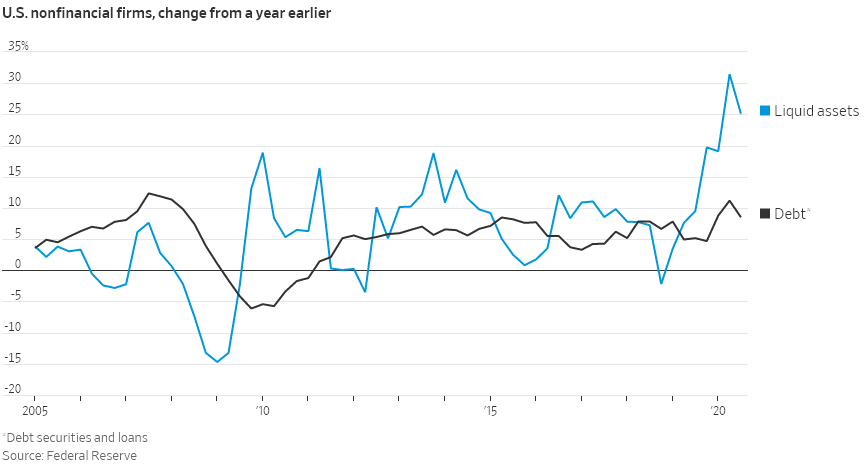
Jon Sindreu, in The Wall Street Journal, provided a couple of clues, although he was writing toward a different purpose. This graph of his is my first clue:

He fleshed that out with this:

Flow-of-funds data recently published by the Federal Reserve shows that companies have accumulated even more cash than debt this year: their liquid assets were up 25% in the third quarter. On a net basis, debt was down 7.9%. Relative to GDP, it remains well below 2007 levels.

Another clue:

Nor are property and asset prices tanking, hitting households’ net worth as they did in 2008. So consumers have kept spending when they could.

There’s more in his article, but the upshot is this: 2021’s recovery (and into the later years) won’t be nearly as weak as some have feared. It’ll be strongly positive, although—because of 2020’s already in-progress recovery—it’s unlikely to be quite as strong as hoped.

Another Reason

…why neither the People’s Republic of China nor the World Health Organization can be trusted.

Opposition from the Chinese government is preventing participants in a World Health Organization meeting on the Covid-19 pandemic from learning directly about one of the world’s biggest coronavirus success stories.
Taiwan hasn’t recorded a locally transmitted coronavirus infection in about seven months but has been blocked from participating in a virtual gathering this week [last week as this is posted] of the WHO’s 194-member World Health Assembly because of objections from Beijing, which considers the self-ruled island part of its territory.

WHO was carefully silent on the shunning, mindful of its master’s requirements.

Never mind that the Republic of China just might have some ideas on how to control the Wuhan Virus.

This is the WHO that Joe Biden wants us to cozy up to.

This is the PRC that Joe Biden wants us to trust so.

Follow the Narrative–I Mean Science

Here’s some science—the Great Barrington Declaration.

James Freeman, in his Tuesday Wall Street Journal column, opened with this:

This week dozens of esteemed medical experts with blue-chip academic credentials published a warning about the destructive policies adopted to address Covid-19. Since the Sunday publication of this Great Barrington Declaration more than a thousand biological scientists and more than 1,500 medical practitioners have added their names to the petition. Yet it’s been almost entirely ignored by the media outlets that spend much of their days presenting themselves as obedient to science.

The declaration says this, in part:

Current lockdown policies are producing devastating effects on short and long-term public health. The results (to name a few) include lower childhood vaccination rates, worsening cardiovascular disease outcomes, fewer cancer screenings, and deteriorating mental health—leading to greater excess mortality in years to come, with the working class and younger members of society carrying the heaviest burden. Keeping students out of school is a grave injustice.

The declaration closes with its recommendation for how we should deal with the virus [emphasis added].

Adopting measures to protect the vulnerable should be the central aim of public health responses to COVID-19. By way of example, nursing homes should use staff with acquired immunity and perform frequent PCR testing of other staff and all visitors. Staff rotation should be minimized. Retired people living at home should have groceries and other essentials delivered to their home.  …
Those who are not vulnerable should immediately be allowed to resume life as normal. Simple hygiene measures, such as hand washing and staying home when sick should be practiced by everyone to reduce the herd immunity threshold. Schools and universities should be open for in-person teaching. Extracurricular activities, such as sports, should be resumed. Young low-risk adults should work normally, rather than from home. Restaurants and other businesses should open. Arts, music, sport and other cultural activities should resume. People who are more at risk may participate if they wish….

Of course the Great Barrington Declaration and its Focused Protection proposal have been ignored by the media outlets. They’re also being ignored by Progressive-Democrats everywhere from Biden, Pelosi, and Schumer on down.

The Great Barrington Declaration is the wrong science to follow; it’s too politically inconvenient to settled narrative.

Likelihoods

Scott Gottlieb and Yuval Levin had an uproar in their knickers in their Sunday op-ed in The Wall Street Journal.

The two center their piece on the failure of President Donald Trump, et al., to take precautions satisfactory to Gottlieb and Levin to minimize their chances of getting the Wuhan Virus. The money quote in their piece, though—from my perspective—is this:

For months, some of them condoned nonchalance about the virus, mocking precautions such as wearing masks as marks of weakness and dismissing public-health concerns as overwrought.

Disregard the distorted characterization of the behavior of “some of them;” what Gottlieb and Levin ignore of those “months” is the empirical demonstration of the low likelihood of getting a Wuhan Virus infection serious enough to be noticed, even in a high-contact, high traffic, high-interaction environment.

On second thought, accept their mischaracterization: that nonchalance emphasizes the low likelihood.