Fiat Chrysler, the EPA, and Diesel Engines

The EPA has decided to accuse Fiat Chrysler Automobiles NV of using software to cheat on diesel emission limits during tests, sort of reminiscent of Volkswagen’s peccadillo.

The problem for the EPA, though, is that

the EPA is not yet accusing Fiat Chrysler of installing illegal software patches on its diesel engines, but of failing to disclose potentially legal ones.

Never mind that if the software is legal, there’s nothing to disclose.  Not to fear, though, the problem with Fiat Chrysler is that

[i]t’s the company’s finances that make it vulnerable.

The company in the hole with a debt pile of some €6.5 billion ($6.9 billion) as of last September.  And the EPA knows that.

With any other agency, this might be a legitimate beef.  With this EPA, though, it smacks of legal blackmail.  “Nice business you got there; be too bad if something were to happen to it.  I know you’re short of cash; maybe there’s something we can do for each other to help you out.”

“How Barack Obama rescued the US economy”

That’s the headline on a recent Financial Times piece (sorry, the FT has a paywall) by Martin Wolf.  It’s a silly headline, for a silly article.

How should we assess the economic success or failure of Barack Obama’s presidency?

This is a difficult question to answer.

No, the question is easy to answer.  Obama’s economic policies have been abject failures.  It’s also straightforward to lay the bulk of responsibility on Obama and his administration.  While it’s true that the Panic of 2008 began in the prior administration, it was Obama’s “stimulus” package that both blew up the nation’s debt and failed in its purpose of stimulating our economy with shovel ready jobs in a massive so-called Keynesian stimulus and its bailout of failing large banks.  It was his Federal Reserve’s policies (yes, yes, the central bank is supposed to be independent, but it was Obama’s Ben Bernanke, extended at Obama’s decision, and his Janet Yellen appointment) that degraded money discipline with their decisions to ease the money supply and hold interest rates artificially low.  It was his excessive—explosively so—regulation that limited business’ ability to function in the market, that limited small business’ ability to get started, that limited job growth and employment recovery.

It was the Obama administration’s Dodd-Frank, with its too big to fail policy that distorted those big business’ risk-taking decisions, decisions that used to be made in a free market but that under Dodd-Frank are made with the perception—courtesy of that “stimulus” bailout—that if the business messed up, Government would bail them out.

[S]hockingly, most congressional Republicans opposed all significant monetary, financial and fiscal actions taken to deal with the crisis.

This isn’t shocking at all; what’s shocking is the blind, knee-jerk rejection of free market principles by a Democratic Party (soon to become a Progressive-Democratic Party) suddenly in complete control of our government and cut loose from any restrictions on their power.  Absent the “stimulus,” the Panic might have been steeper, but it also would have been much shorter.  One only has to compare the Depression of 1920-21 with the Great Depression to see the efficacy of government non-response compared with Government intervention, and the Panic of 1907 with both to see another example of the efficacy of private response compared with Government intervention.  Of course, the Democrats knew—and know—this history, yet they acted as they did, anyway.

He tried to move the US closer to the universal health insurance taken for granted in other high-income countries. The Affordable Care Act (“Obamacare”) has added an estimated 20m adults and 3m children to the insurance rolls.

He didn’t try, he did it by Party fiat and then by Executive diktats—lots and lots of diktats.  Further, while Obamacare has provided health welfare to those adults and children, it also has thrown millions more out of their health insurance plans and denied them access to their doctors in direct—and knowing—contravention of Obama’s explicit promises that these denials would not happen.  The claim of cost growth reduction is a cynical one, also, being limited as it is to the cost of selected groups of Americans.  In fact, the cost has exploded, with premiums rising in double-digit per centages, deductibles going to 10s of thousands of dollars—an annual expense—the departure of heretofore health insurance companies from the health welfare plan “market,” and the cost to taxpayers similarly growing rapidly to pay for the subsidies of those given essentially free access to this health welfare.

Wolf’s discussion of our “jobs” recovery is misleading, also. Labor force participation rate is at historic lows, held back by those policies’ suppression of job creation.  Even the male labor force participation rate, which has been in a declining trend since its early ’50s peak, is farther below that long-term trend than it ever has been in that time frame.

Finally, this graph summarizes the efficacy of the Obama administration “recovery” as compared to post-WWII economic dislocation recoveries.
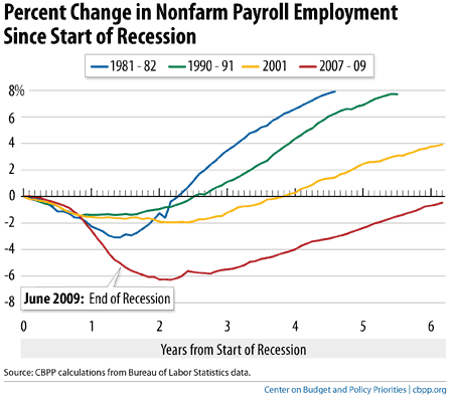
Even at the end of 2016 rate of 4.7% unemployment of 4.7%, the Obama administration’s economic policies have held back the recovery by years.

Linkages

They didn’t work when Nixon and Kissinger tried it, even though the Soviet Union generally complied, because the revolutions that the USSR was fomenting continued to occur apace after the Soviets stopped fomenting in return for nuclear and economic concessions.

Treasury Secretary Jacob Lew warned ignoring recent steps by Beijing to liberalize its economy would endanger Chinese cooperation on other major geopolitical issues, particularly containing North Korea’s nuclear program.

They’re not working now with the People’s Republic of China, but for a different reason.

And

The departing Treasury secretary further warned against steps that would prompt China to withdraw its support for tougher sanctions against North Korea.

The PRC still isn’t taking steps to “liberalize its economy,” not when it’s actively interfering with its cross-border yuan flows, manipulating domestic interest rates with a view to control who gets to lend or borrow rather than an effort to maintain a stable monetary policy, manipulating its domestic stock markets as it did in 2015 and today with manipulating the legal environment, and on and on.

Nor has the PRC ever cooperated in any meaningful way with respect to sanctions connected to northern Korea’s nuclear weapons program.  The PRC routinely slow walks its agreement to sanctions (which is why their occasional prompt agreement is such news), and it ignores sanction violations as those occur across its border with northern Korea.

And—ignored by Lew—the PRC is accelerating its aggression in the East and South China Seas and increasing its pressures on the nations rimming the South China Sea to deal with them exclusively and one at a time on trade questions.

Before today’s linkages can have effect, the parties at both ends of the lever must be willing to be responsive.

Polemics vs Reasoned Argument

As the Congress considers import taxes as part of its general tax reform agenda, toy sellers are expressing their concern: they import most of what they sell; their products are manufactured overseas.  Import taxes are surely a thing worth discussing and debating thoroughly, whether they’re essentially cost of goods sold neutral, as Doug Holtz-Eakin argues (the dollar will rise from the tax change and economic growth, and so the dollar cost of imports will fall; the cost of goods sold will simply emphasize taxes more and import costs less), or they’re dangerously like protectionist tariffs, as others argue.

Arguments that are carefully emotion-laden while devoid of facts, though, are inappropriate.  Here’s an example from Steve Pasierb, President of the Toy Industry Association:

We are fully prepared to work productively or be a royal, boisterous, media-friendly pain in the backsides of people who would take away children’s happy birthdays, steal Christmas, and destroy quality US-based jobs.  And no one wants to have to explain to their children why Santa was put out of work.

Such Leftist “feel my pain” three-hankie argument has little credibility and less validity in the sort of reasoned discourse necessary in an economic debate.

Growing Irrelevance of the World Economic Forum

The rising income gap and growing rifts in Western societies that led to the election of Donald Trump and the Brexit vote are the main global risks, according to a report by the World Economic Forum ahead of its annual forum in Davos next week.

Climate change and technological disruption were also listed as important risks in a survey of 750 law makers, business leaders and academics carried out by the WEF….

No, the rising income gap isn’t why President-Elect Donald Trump was elected, nor was it why Great Britain voted to go out from the European Union.  Quite the contrary: it was because those on the bottom and in the middle were being held down by the policies of the Know Betters and by the latter’s desperation for votes—votes bought and paid for by handouts that trap folks in the Know Betters’ welfare cages.  That that contributed to a rising income gap is only a side effect.  The bottom and middle class folks simply wanted their opportunity to get rich, too.

Climate change isn’t a risk at all; it’s a certainty.  The Earth is illuminated and warmed by the sun, the sun has been heating up for its entire four billion year existence, and it’ll continue to heat up for the next several billion years.  Global warming—which is what climatistas mean when they changed the name to and talk about “climate change”—is a pseudo-science whose sole industrial function is to transfer government funds to the “industry.”

Technological disruption is a good; it’s how progress and prosperity happen in a free market—and without a free market there is neither progress and prosperity nor any technological change at all.  It’s a risk, too, but it’s one that’s well understood by everyone who’s had a high school economics class.

And there’s this nonsense from Cecilia Reyes, Chief Risk Officer at Zurich Insurance Group, speaking at the gathering:

The momentous political changes in 2016 raised worries about the health of liberal democracy that has underpinned global prosperity[.]

No, the health of liberal democracy took a dramatic turn for the better, exemplified by the repudiation of the policies of eight years of the Obama administration and the Progressive-Democratic Party’s control over the Congress as a whole and then of the Senate.  That repudiation was broader than just a rejection of those policies, though: the real turn for the better was the repudiation of the increasingly authoritarian behavior of the Progressive-Democratic Party and of the Left in general.

No, the WEF is just getting a bit too far out of touch with the world.