Taxes, Revenue, and Growth

Do Federal revenues come from taxes or from economic growth?  (I’ll elide, for this post, a discussion of whether the Federal government needs the revenue it wants to collect.)  A couple of better men than me offer up some thoughts:

There is a point at which in peace times high rates of income and profits taxes destroy energy, remove the incentive to new enterprise, encourage extravagant expenditures and produce industrial stagnation with consequent unemployment and other attendant evils.

and more loquaciously,

Our true choice is not between tax reduction, on the one hand, and the avoidance of large Federal deficits on the other. It is increasingly clear that no matter what party is in power, so long as our national security needs keep rising, an economy hampered by restrictive tax rates will never produce enough revenue to balance our budget just as it will never produce enough jobs or enough profits.  Surely the lesson of the last decade is that budget deficits are not caused by wild-eyed spenders but by slow economic growth and periodic recessions, and any new recession would break all deficit records.

In short, it is a paradoxical truth that tax rates are too high today and tax revenues are too low and the soundest way to raise the revenues in the long run is to cut the rates now…. The purpose of cutting taxes now is not to incur a budget deficit, but to achieve the more prosperous, expanding economy which can bring a budget surplus.

Who said these things?  Those old and venerated, in some circles, Democrats: Woodrow Wilson in the first case, in his 1919 message to Congress, and John Fitzgerald Kennedy in the second, in his 1962 speech to the Economic Club of New York.

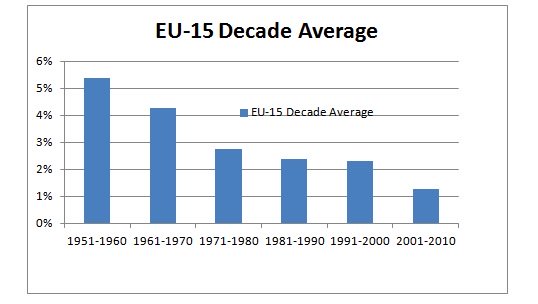
Here’s a graph from our current Progressives’ favorite exemplar, Europe, courtesy of Dan Mitchell at the International Liberty blog:

EU-15 refers to the 15 nations which comprise the 15 members of the pre-May 2004 European Union: Austria, Belgium, Denmark, Finland, France, Germany, Greece, Ireland, Italy, Luxembourg, the Netherlands, Portugal, Spain, Sweden and the United Kingdom—e.g., western Europe, less Norway and Switzerland.

The graph shows, decade by decade, the steady reduction in economic growth of those 15 EU nations as their governments, individually, and the EU “government” generally, expanded their size and control over their nations’ economies and their citizens’ abilities to make their own decisions.

As an aside, how do we get an economy to generate revenue?  Not this way:

Shall we create more jobs by aping Europe, which since 1990 has averaged 9.16% unemployment while ours was 5.95%?

[L]ike the leaders of the bankrupt states of Europe, President Obama believes that the key to prosperity is to regulate, engineer, and direct the economy; to raise taxes; to augment the powers of government; to substitute collective largess for family cohesion; to spend money that does not exist…to paraphrase Macbeth, to borrow, to borrow, and to borrow.

Hmm….

Sure, Why Not?

Congressman James Clyburn (D, SC) is advising President Obama to run against the Supreme Court if the Court is so wrong-headed as to strike down the Patient Protection and Affordable Care Act.

Clyburn says,

In terms of the Congress, I believe that it would be off-base for us to do that, but for the president, I don’t think it is.  I think the president ought to take a look at what happened in years before—we’ve seen presidents run against Congress….

He may be onto something here.  Obama can’t run, Truman-like, against a Do-Nothing Congress—those Do-Nothings are actually his own Democratic Party-controlled Senate, which has actively refused even to pass a budget for three years.  Nor can Obama run on his record.  His policies have led to national security-threatening national debt and spending deficits, historically high and prolonged unemployment, rising energy costs, and are suppressing an economic recovery that may or may not be in progress, finally.  His red herring ad hominem attacks aren’t finding traction, either.

So, sure—run against the Supreme Court.  Argue that upholding the Constitution is somehow judicial activism.

Yeah, that’s the ticket.

Our Energy Program

There are a few items of interest as President Obama continues to tout his energy “policy.”

First, there’s this:

Brazil’s ethanol program is often touted as having weaned that nation off its dependency on foreign oil.  In truth, they made a political decision 40 years ago that they did not wish to be vulnerable to Middle Eastern (and others’) machinations or crises.  As a result of that decision, and their subsequent efforts, Brazil, which used to import over three-fourths of its oil, today imports no oil.  In fact, it’s a (minor) net exporter.  While their ethanol development program has contributed to their overall reduction in dependency on foreign oil, Brazilian oil production and use have both increased sharply: consumption by nearly 120% since 1980, and production even more markedly—875% over the same time frame.  Figure 1 tells that tale.

Figure 1: Brazilian Oil Production and Consumption, 1980 – 2009

What accounts for this?  In addition to on-shore production, Brazil actively drills for oil in the Atlantic, off its coast—often far off its coast and in very deep waters.  Brazil also actively drills in the Gulf of Mexico—a vast source of off-our-own-coast oil for which President Obama won’t allow American companies to drill—as he won’t allow off our Atlantic or Pacific coasts, or in Alaska, or anywhere oil is under Federally-owned land.

Then there’s this, courtesy of Speaker of the House of Representatives, John Boehner (R, OH).  Here is made manifest President Obama’s disdain for domestic oil production and for Americans’ pocketbooks.

Don Seymour writes [emphasis and link in the original]:

President Obama called for the kind of “all of the above” energy strategy long-championed by Republicans. But far from supporting all of the above,” the Obama administration has spent more than three years blocking efforts to expand energy production and bring down gas prices, while pushing job-crushing tax hikes and taxpayer-backed loans to companies like Solyndra.

Figure 2 pretty much says it all.

Figure 2: Running on Empty: The White House Plan for Higher Gas Prices & Fewer Jobs

Finally, there’s enormous technological improvement supporting vast increases in natural gas production, which the Obama administration would just as soon see disappear.  Fracking technology has exploded our accessible domestic stores of gas.  In the Marcellus gas deposit, alone, which lies thousands of feet down in a reservoir reaching from West Virginia to New York, is enough gas to satisfy our nation’s energy needs for the next 15 years.

Fracking (hydraulic fracturing) is the technology that’s making this heretofore unreachable gas eminently reachable.  Fracking works by drilling a 5″ diameter hole (yes, it’s that small) from a more or less convenient location on the surface down several thousand feet until the drill reaches the gas-containing shale or the depth at which the shale exists, then bending to horizontal and drilling farther, now into the shale, until the pipes and rig are well into in the part of the shale containing the gas. This is where that “more-or-less convenient” part comes in: the drill doesn’t have to be vertical, or at an angle off vertical to get to  the targeted location.  This allows the surface location of the drilling to be offset quite a ways, for instance out of town, or well away from the farmer’s house.  After arrival in the targeted gas area, a high-pressure burst of water and sand is pumped into the piping, which creates millimeter-wide fractures in the shale through which the natural gas can escape into the piping.

Notice that: it’s water that does the fracturing.  The sand is along to be driven by that same pressure burst into the cracks created by the water to hold them open.  There are some impurities add to the mix: biocides akin to what gets dumped into backyard swimming pools for keeping bacteria, algae (even at that depth), and so on from clogging the pipes (they’re only 5″ across).  Other impurities include lubricants to keep the sand from abrading, too much, the pipes on the way into place.  And to facilitate withdrawing the water so the gas can flow more easily.  There are impurities added by the depths through which the drilling occurred, also, as the drilling equipment and water are withdrawn so the gas can be collected: for instance, the drilling often goes through geologically ancient underground seas, or seabeds, so the equipment coming back up is coated with the salts of those ancient seas.  The withdrawn water then is treated by the frackers, or by water treatment specialist companies hired by the frackers, to greater purity than the typical city water treatment plant before it’s released back into the environment.

But Obama’s administration keeps trying to butt in—both to “standardize” regulations concerning fracking, and to use that “standardization” to interfere with fracking itself.  It’s only necessary to review his EPA regulations concerning coal use, ethanol for our cars, his “green” energy projects.  He’s moving to block the use of coal altogether; he mandates, or continues to mandate during his “review” of excess regulation, the use of ethanol in our gasoline without regard to what that does to an automobile’s engine or what ethanol production does to the price of food.  And he has accelerated the diversion of our tax money into his favored “green” companies.  Competition, even from clean natural gas, cannot be accepted.

And never mind that state regulators see no need for Federal involvement.  This isn’t a turf battle; they make their argument on logic and facts.  Pennsylvania regulators, for instance, understand the practices and geology of Pennsylvania much more thoroughly and clearly than can Federal regulators at the remote EPA.  At best, any reasonable Federal regulatory system would end up essentially replicating what many of the states already do, but at a political and physical distance that makes those Federal regulators more remote, and they’re less accountable.  Further, that remoteness renders even well-intentioned Federal regulators unable to tailor their regulations to the varied specific state environments—political, economic, or natural—the way the individual states can,

A Thought on Self Defense

The uproar over a shooting in Florida brings up the concept of self-defense, and Joe Palazzolo and Rob Barry raise a number of points about this in their The Wall Street Journal op-ed.  In it, they write about “so-called justifiable homicides,” “leeway to attack and even kill someone who is threatening them,” and a victim’s duty to retreat when threatened or attacked.

What is self-defense; do we have a right to it; and if so, are there any limits to self-defense or to that right?

Our Declaration of Independence acknowledges the existence of a right to self-defense as a component of our suite of inalienable rights endowed by our Creator and so inherent in the fabric of our being:

We hold these truths to be self-evident, that all men are created equal, that they are endowed by their Creator with certain unalienable Rights, that among these are Life, Liberty and the pursuit of Happiness.

Plainly, the right to Life includes within it a right to defend, for ourselves, our own Lives and those of our families—and those of others related to us only through friendship and those not related at all.  “All men are created equal:” thus the right to defend a life includes the right—now the obligation—to assist in the defense of another’s life.  And this defense, and its underlying right, must come from within each of us.  We can—and we do through our social compact, of which our Declaration is our principles statement—assign to government certain tasks and obligations to help execute that self-defense.  However, we cannot surrender our right to do so to that government, for two reasons: first, as a part of our Creator’s endowment, the right is not ours to give away.  Second, and of secular and immediate importance, were we to surrender primary responsibility for our self-defense to a government, we would lose that right altogether.  By that surrender, that “right” becomes a thing that government can grant or withdraw at its whim.  At best, when the bad man comes, and seconds count, the police will be only minutes away.

Having demonstrated the existence of the right, what is it, exactly to which we have a right?  What is self-defense?  I described one aspect of it above: “a right to defend our own Lives and those of our families—and those of others related to us only through friendship and those not related at all.”  But there’s more.  Self-defense includes defense of all property, not just our property in our body: we also have a property in our thoughts, our Liberties, and our physical property.  Our thoughts are inherent in both our lives and our Happiness, as are our Liberties, and our physical property is part of the outgrowth of our pursuit of Happiness* (and without which, our Liberties and Lives are severely constrained, if they exist in this state at all.  The components of our endowment are tightly intertwined with each other, but that’s the subject of another post). Thus, we also have an inherent right to defend our possessions (and thoughts and Liberties) from attackers.

Given all of that, there can be no possibility of a “duty to retreat.”  There is no defense if we must give way to an attacker based on where we might be located at the time of the attack.  Our right of self-defense is in us, it is not in any location we might momentarily occupy.  There is no defense, if we must give up our property—any aspect of it—to a criminal’s demand, and hope that the property can be recovered intact by “authorities.”  Indeed, any retreat, of its nature, carries within it the characteristic of allowing our attacker to strike first, or threaten to do so.  Our Lives, if taken by our attacker, cannot be recovered at all, no matter how dedicated and efficient those authorities.  Retreat is only a tactical decision, driven by the exigencies of particular circumstances; it is never an obligation.

What then, are the limits to our right of self-defense?  The short answer is when the behavior ceases to be defensive and becomes offensive.  But it’s not that simple: no man has an obligation to allow his attacker to shoot, or stab, or otherwise strike first and only then to respond.  Clearly, when faced with such a threat, our right of self-defense includes a right to pre-empt our attacker’s potentially fatal assault: we can shoot first.  A couple of examples will serve to illustrate legitimate limits to our right of self-defense.

Our right, for instance, does not permit us simply to arrange our defense deliberately to kill our attacker.  That man also has a right to his Life, for all that he is endangering ours with his attack. (But we have no obligation to arrange our defense deliberately not to kill our attacker.  We have no obligation to handicap ourselves in so potentially a fatal-to-us way.)  If we kill him in the course of our defense, that’s unfortunate, but no wrong redounds to us.  If we kill him deliberately and as our goal, that legitimately can amount to one of the variations of murder.

Our right to self-defense does not allow us to hunt down our attacker in order to kill him.  We can chase him in an attempt to recover our property, and if in the course of that pursuit a struggle occurs and we kill our attacker in that struggle, we’re still engaged in self-defense.  However, we cannot chase our attacker with the goal simply of killing him, even if we recover our property in the course of that killing.  Nor, if we lose contact with our attacker in the course of our pursuit, can we then search for him in a separate act (although we certainly can aid the authorities in their search) and kill him after a successful hunt.

But if our right to Life enjoins us to help defend another’s life, how are we enabled to take another’s life, ostensibly in self-defense?  We are not so enabled while the taking is a goal.  But our right to our own Life is the primary interest.  We must protect ourselves first: we cannot see to any of our duties, including that to assist the defense of another’s life, if we are not safe and sound.  If we must kill in order to fulfill that primary interest, this is unfortunate, but it may be a necessary adjunct to our defense of our properties—whether in our selves, or our thoughts, or out Liberties, or our physical property.

As to limits on the right itself of self-defense, there is a very critical one, alluded to above: it is a part of our existence.  We neither can, nor may, surrender that right or any part of it to anyone else or to any authority.  Even that government which we hire, under our social compact, to help us protect all of our inalienable rights is hired to help us, not to substitute for us.

*As John Adams noted in his 1780 Massachusetts Constitution, in Article I of the First Part, “All men are born free and independent, and have certain natural, essential, and unalienable rights, among which may be reckoned the right of enjoying and defending their lives and liberties; that of acquiring, possessing, and protecting property; in fine, that of seeking and obtaining their safety and happiness.”

Ireland, Economic Prosperity, and the Euro

Irish Prime Minister Enda Kenny said over the weekend that Irish voters in their upcoming referendum on the European Union’s fiscal union treaty can choose between economic recovery or risking Ireland’s continued participation in the euro.  Indeed, Mr Kenny painted a clear contrast between voting up and voting down those recently (re)negotiated terms of the EU’s fiscal union: a “yes” vote, he insists, removes doubts about Ireland’s commitment to the euro zone, and it helps the country regain access to international debt markets.  On the other hand, a “no” vote removes the safety net for Ireland: access to the EU’s permanent euro-zone bailout fund.

This is a false choice, since there is no conflict between the Irish exiting the euro and their economic prosperity.  No one in European leadership, or anywhere else, has made the case—or even tried to make the case—that an inhomogeneous polity can succeed.  What Mr Kenny really needs to do is make that case.  On what basis does he think using the same currency as Greece, Spain, Italy, and Portugal is a path to prosperity?  Those nations don’t have the same social imperatives that Ireland has.  Those nations don’t see money having the purpose that Ireland sees.  Those nations don’t have the same view of the role of government that Ireland has.

The social imperative of those Mediterranean nations is the importance, in their view, of social and economic safety nets.  They want those bailouts.  They want to be protected from the results of their choices—or have their governments make those choices for them.  The Irish have shown themselves, throughout their history, to favor personal initiative, personal responsibility.  The Irish have shown themselves willing to risk failure to achieve great success, and more importantly, to learn from their failures so as to achieve even greater prosperity.

The purpose of money, in the view of those Mediterranean nations, is for current consumption. These people want to buy now, whether necessities, nice-to-haves, or luxuries. The government and the safety net it provides will take care of the future.  The purpose of money for the Irish is to store value, to store the results of their labor and/or the value of things they produce or acquire with their labor.  Certainly, that includes current consumption—those necessities, nice-to-haves, and luxuries.  But that store of value also is a store against an uncertain future, which not even government can predict with any accuracy.  That store is for their own future consumption, including their retirement, in accordance with their own view of value in the realization of that future.

The purpose of government, in the view of those Mediterranean nations, is to provide that safety net.  The purpose of government, they say, is to take care of the people.  The Irish, with their world view of the moral value of personal responsibility and personal initiative, see government’s role as providing and protecting an environment in which they as individuals are able to satisfy their own imperatives, are able to fulfill their own potential to its fullest—and both that potential and the terms of that fulfillment are defined by the individuals involved, not by government.

The path to recovery  and prosperity for Greece, Spain, Italy, and Portugal may well be participation in the euro.  The path to recovery and prosperity for Ireland does not have the euro along the way.  Nor do the Irish have anything to fear in terms of access to the international financial markets (not only the debt markets).  Their recovery and prosperity are what will provide this, not any adherence to a poorly constructed union.  Moreover, in the end, Ireland has no need of any bailouts; the Irish are made of sterner stuff.