
Trump Not a Target?

It seems that Special Counselor Robert Mueller has told President Donald Trump’s lawyers that Trump is not a criminal target of Mueller’s “investigation;” Trump is merely a subject of it.

While WaPo has based its story on sources that may or may not exist (“three people familiar with the discussions;” we don’t get to know who they are, we don’t even know if “three” is accurate), let’s take the story as accurate, arguendo.  Some of Trump’s advisors think Mueller’s remarks are just an attempt to bait Trump into sitting for a Mueller interrogation.

There’s another aspect to this, though.  Keep in mind that it’s entirely legal for a government agent—policemen, FBI agents, a special counselor—to lie to their investigatees, even as it’s a crime for the lie to go the other way around.

There’s no reason to take Mueller’s claim seriously.  Or perhaps Trump and his lawyers should: apart from being a bait attempt, it could be an attempt to sandbag Trump or anyone associated with him into getting careless.  The same perjury trap some of Trump’s lawyers worry about being the purpose of a Mueller interrogation of Trump could be in play here, too.
Abuse of the Special Counsel Function

It turns out that Deputy Attorney General Rod Rosenstein authorized—in a secret memo, yet—Special Counsel Robert Mueller to investigate Paul Manafort, Presidential candidate Donald Trump’s sometime campaign manager, regarding Manafort’s work for the Ukrainian government.

To the extent what Manafort did is a crime—Mueller has indicted him on charges of

conspiring against the US, conspiring to commit money laundering, acting as an unregistered foreign agent, and making false statements. A subsequent indictment…alleges he committed tax and bank fraud.

and Manafort has both denied the accusations and formally pled not guilty—his actions would not be out of the ordinary, and they don’t warrant a special counsel’s investigation.

If DoJ had legitimate interest in Manafort’s actions, DoJ would investigate with the FBI and/or other, established and regular, police forces.  The fact that these accusations are further alleged to have occurred in Ukraine is not relevant to such run-of-the-mill crimes.

Identity Politics

This time it’s via rank sexism.  Lots of women, lots more than in past campaigns, are running for office, and they’re doing it on the basis of their gender as much as, or more than, their policies.

Erin Collier, a 34-year-old economist, made a late entry into the crowded race [primary, to determine the Progressive-Democrat candidate who will run against Congressman John Faso (R, NY)] in March with an announcement video that ended: “I’m not going to let those boys beat me.”

Not because her policies are better for the district than those of her competitors.

Nor is it limited to Progressive-Democrats.

Congresswoman Martha McSally, a Senate candidate in Arizona…former fighter pilot, denounces “BS” and tells national GOP leaders to “grow a pair of ovaries” in her introductory campaign video.

Kelly Dittmar, Scholar at the Center for American Women and Politics at Rutgers University’s Eagleton Institute of Politics:

Women are more willingly and successfully using gender as an electoral asset instead of seeing it as a hurdle they have to overcome.  It’s going to be important for these women not to present messages that could be perceived as marginalizing men.

Dittmar’s condescension is itself sexist.  We men aren’t the precious snowflakes she assumes; we don’t feel marginalized by the sexist identity politics of these candidates.  We’re just irritated by the dishonesty of this extension of ex-President Barack Obama’s (D) identity politics.

And that’s the larger point.  Running on their gender—rather than running as an American candidate and doing so on the basis of policy—is sexist bigotry no matter the claimed motive or the cuteness of their framing of the matter.

Government Surveillance by Regulation

Loosely related to a nearby post, now it seems the government is getting worried about the size of the “private” capital market, where folks can place investments in enterprises, particularly startups, without having to go through the public—stock—markets and government regulations that are broadly extensive and deeply intrusive.

The boom is transforming how companies grow, concentrating investing in fewer hands and raising concerns about oversight

The linked-to article’s subhead lays out the whole misunderstanding. Government doesn’t need to be in the business of regulating every little thing we do.  We can manage our investments just fine without Government’s “help.”  And we can suffer our own outcomes if we choose badly or fortune moves against us despite our otherwise correct decisions.

[Some] private placements require no disclosure at all, said Anna Pinedo, a partner at law firm Mayer Brown. “It’s impossible to know who’s raising money this way or from whom.”

It’s none of government’s business to know unless it’s prepared to allege specific crimes.

Michael Piwowar, a[n SEC] commissioner, questioned “the notion that nonaccredited investors are truly protected by regulations that prevent them from investing in high-risk, high-return securities….

It’s not government’s job to protect us from ourselves. That’s our job.

The way to entice investors back to the publicly traded markets is to reduce those regulations and their intrusiveness.

AI Surveillance

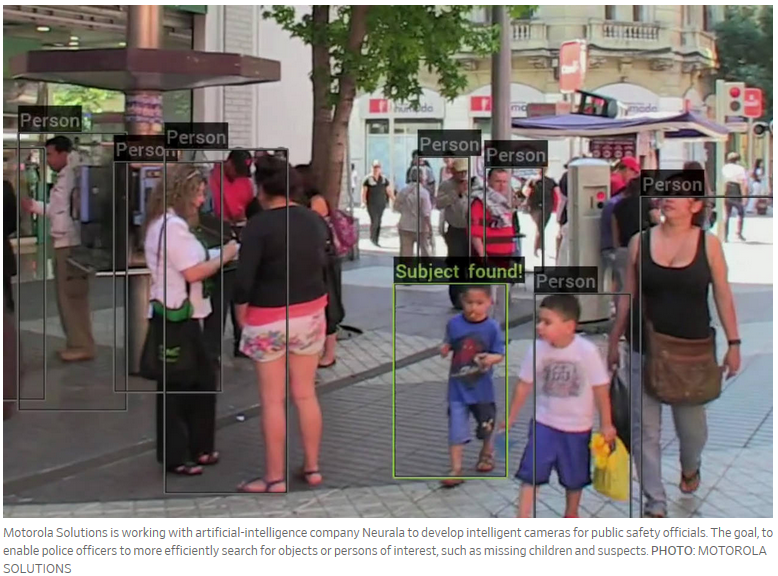
Police forces around the nation are on the verge of getting Artificial Intelligence assistance in identifying folks of interest to them in real time on our cities’ streets.  The image below and its caption illustrate the thing.

I’m all for assisting the police, especially regarding the subject of that cynically tear-jerking caption.  But this sort of thing needs to be looked at with a very jaundiced eye.  It isn’t too far away from what the People’s Republic of China already is doing in terms of routine surveillance and tracking of everyone.

It’s not that everything the PRC does is bad, but some things are inherently dangerous, no matter who developed them or uses them extensively.  This sort of technology can very easily become a direct assault on our ability to be anonymous in public spaces.

TaeWoo Kim, chief scientist at One Smart Labs, a New York-based startup that is working on such software, said the technology is “creepy and a bit Big Brother-y,” but said it is “purely intended to fight crime, terrorism and track wanted subjects.”

The road to Hell is paved with good intentions. Governments can’t be trusted with such capabilities, and we don’t even need to invoke nefarious intent or “Big Brother-y” conspiracies to see that. Governments will end up misusing, even abusing, this sort of thing just in the ordinary outcome of normal bureaucratic imperatives to justify the bureaucrat’s and his bureaucracy’s existence, to grow, to expand the bureaucracy’s power and budget.

William Bratton, the former commissioner of the NYPD, says that the public was similarly worried about DNA testing when the technology first emerged. The technology has been credited in freeing wrongfully convicted people from prison.

This is a false analogy, though.  DNA testing isn’t used for routine, real-time surveillance of the population or even of small groups or of individuals, and current technology doesn’t allow such use.  AI-based image surveillance technology lends itself to exactly that real-time watching.