
Valid Arguments

Several States’ Attorneys General have filed an amicus brief in a Supreme Court case centered on whether Texas and Florida statutes that limit Big Tech’s ability to censor speech done on their platforms are legitimate. The analogy they draw is one valid argument.

[Summarized by Fox News]: [G]iving Big Tech the ability to moderate or censor users’ content would be like giving cable or telephone companies permission to cut phone lines on speech at their discretion. The AGs note that under federal “must-carry requirements,” those companies are banned from subjugating any speech on their lines.

And:

The Eleventh Circuit concluded social media companies could censor content because they have “historically exercised” power to refuse transmission of disfavored ideas.
But telegraph companies have a much longer history of censorship. Social media is less than two decades old. Congress did not impose must-carry requirements on telegraphs until 1888, 50 years after their invention[.]
Yet it is well recognized today that those must-carry regulations were constitutional—even though this Court declared that telegraph companies are “not common carriers.” History thus provides no basis for dismissing the striking similarities between social media companies and telegraph and telephones by dubbing social-media censorship “editorial judgment[.]”
While the earlier laws applied to telegraphs and telephones, it is no different when the companies carrying other people’s speech are digital rather than analog[.]
The States thus have a paramount interest in urging this Court to affirm that longstanding, historic authority of States to protect freedom of speech and enable representative government by prohibiting dominant communication networks from censoring[.]

There is one more argument that is, IMNSHO opinion, dispositively on point. This is the status of those Big Tech platforms—X (nee Twitter), Meta’s Facebook, and Alphabet’s YouTube, for instance—as public forums. Indeed, some of these platforms have explicitly stated that they intend to be public squares for public discourse, even as they also provide mechanisms for exchanging private correspondence.

The public square is precisely where speech may not be censored except within a very few very narrowly defined boundaries—incitement to riot, explicit threats of violence against particular persons. Whether any Big Tech platform has explicitly styled itself a public square, each of these platforms have grown so large—become so dominant—that each one of them is, de facto, a public square. Their censorship practices must be barred.
Why Donald Trump Shouldn’t Get a Second Term

Or so advise the august Editors of The Wall Street Journal. They only consider one side of the question. My august self considers some additional sides.

Start with the fact that Mr Trump would be an immediate lame duck. He can’t serve more than one more term, and if he does win it will be narrowly with little political capital.

This is a wash. If Biden is reelected, he’ll also be a lame duck with little to no political capital.

If the first term is a guide, Democrats will oppose anything Mr Trump proposes that isn’t one of their priorities.

And if Biden is reelected, he’ll most likely face a similarly split Congress and get nothing passed that isn’t a Conservative/Republican priority. Another wash.

The internal opposition will still be implacable, the leaks unending, the press relentlessly hostile.

It may well be that one of things Trump has learned is how to get rid of the internal opposition that puts their whims ahead of their duties as administration employees—including leakers, who are intrinsically dishonest regardless of which party they claim to favor.

Aside from that, while there are reasons to oppose a Trump Presidency, moving to stop him simply because internal opposition will still be implacable, the leaks unending, the press relentlessly hostile would simply be to vindicate those groups’ dishonesty and encourage further obstructionism.

It also isn’t clear Mr Trump could attract first-rate advisers.

He eventually figured that out in the latter stages of his term. Biden has already demonstrated that he has no first-rate advisors; there’s no reason to believe that he could find any for his second term.

India vs PRC

The Wall Street Journal has an interesting piece comparing the People’s Republic of China’s economic future with India’s. In the second paragraph (the semi-lede?), there’s this:

The country’s population surpassed China’s last year. More than half of Indians are under 25.

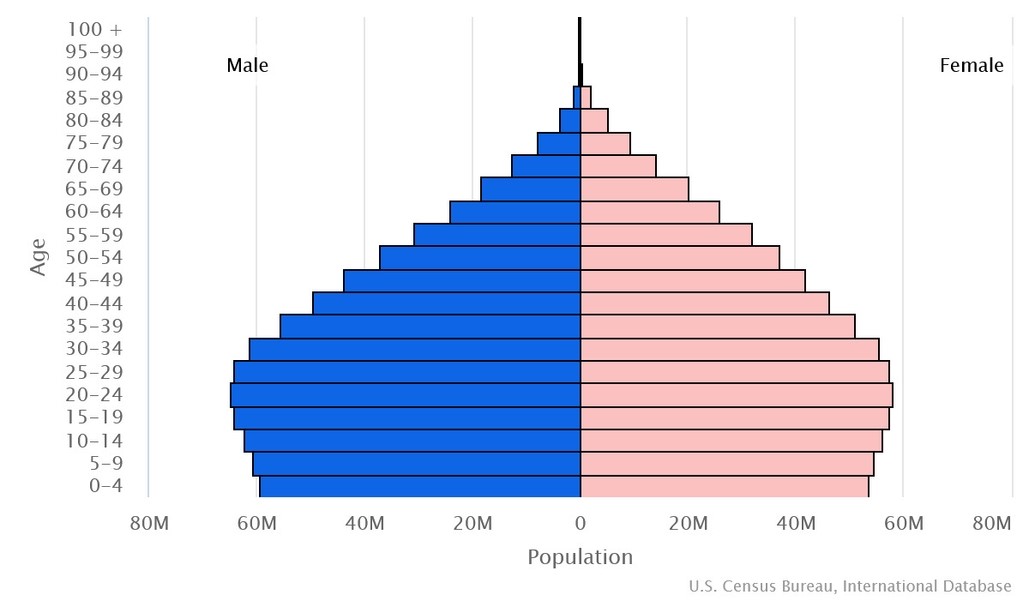
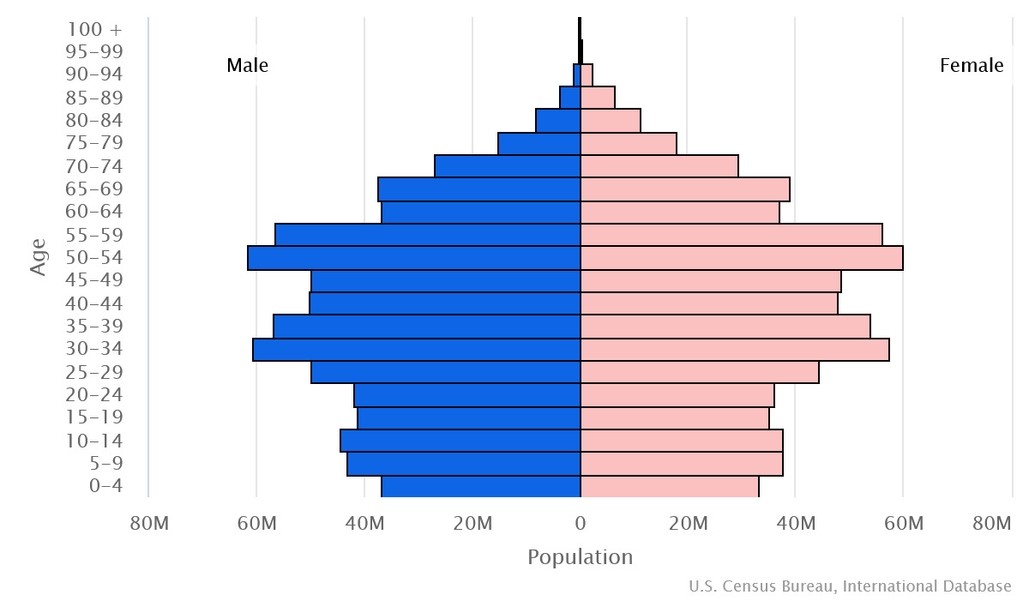
A couple of graphs from the CIA World Factbook put the two nation’s population structures in sharp relief, and at this stage of the two nations’ economic development, those structures are their future.

This is the structure of India’s population (scroll down a skosh):

This is the structure of the PRC’s population (again, scroll a tad):

India’s population of new workers is growing, so the nation’s economic capacity is capable of growing. The PRC’s population of new workers is shrinking. Not only is the PRC incapable of growing very much, economically, it’s becoming and will continue to become increasingly difficult to support its old folks, even as that portion of the nation’s population continues to grow.

Bank Capital Requirements

The Federal Reserve is looking hard at increasing the amount of capital that banks must hold in the Fed’s effort to boost bank liquidity, or their ability to handle sharply increased withdrawal rates.

There is pushback against this proposal, including objections that it might make it harder for banks to lend to folks on the lower economic tiers, even that it might make American banks less competitive than foreign competitors. That last often (not always) is just political Newspeak for “be more like Europe.”

However, the problem can be preempted—or at least pushed a considerable way down the road, allowing for more thought—by doing something different that IMNSHO is a better move, anyway.

Rather than increasing capital requirements, require all banks to mark to market (semiannually? quarterly?) all of the debt instruments the banks hold in satisfaction of existing capital requirements.

Then leave that requirement in place for some period of time (5 years, say) in order to get a serious look at how well, or poorly, that requirement supports bank liquidity during economic downturns.