Another View from the Left

From Spiegel International Online comes this description of the Republican presidential candidates in an article about Senator Rick Santorum’s decision to end his “Ludicrous Race:”

It was a circus, one in which—for long stretches—the clowns took center stage. The candidates lost their way in an extended debate on abortion and contraception; climate change was anything for them except manmade; they threatened to unceremoniously throw millions of illegal immigrants out of the country; they competed for who could promise the lowest taxes and the deepest social welfare cuts; and they pledged to shut down government ministries. And when it came to foreign policy, they repeatedly showed that they didn’t have a clue.

And this is the political Europe President Obama wishes so desperately to emulate.  These are the misunderstandings of the purpose of government, the misunderstandings of issues, and the distortions of positions the Obama insists are…gospel.

Hmm….

You Didn’t Hear It Here First

Although I have written something similar before.

Freedom of speech is on no use to a man who has nothing to say, and freedom of worship is of no use to a man who has lost his God.

And

We cannot read the history of our rise and development as a nation without reckoning with the place the Bible has occupied in shaping the advances of our Republic.

And

The lessons of history, confirmed by the evidence immediately before me, show conclusively that continued dependence upon relief induces a spiritual disintegration fundamentally destructive to the national fiber. To dole our relief in this way is to administer a narcotic, a subtle destroyer of the human spirit. It is inimical to the dictates of a sound policy. It is in violation of the traditions of America.

And on Social Security, as it was drafted originally (and ultimately as passed and evolved; although the remark was made of the draft):

This is the same old dole under another name.  It is almost dishonest to build up an accumulated deficit for the Congress of the United States to meet in 1980.  We can’t do that.  We can’t sell the United States short in 1980 any more than in 1935.

Who said this stuff?  A man not known for his modern conservatism: Franklin Roosevelt.

The catalog of Roosevelt’s economic and regulatory failures is long, but there also is much that the present administration could have listened to and thereby avoided the damage done by its own economic and regulatory failures—as could FDR, had he listened to himself.


h/t to Power Line

Capital Gains Taxes and Federal Revenues

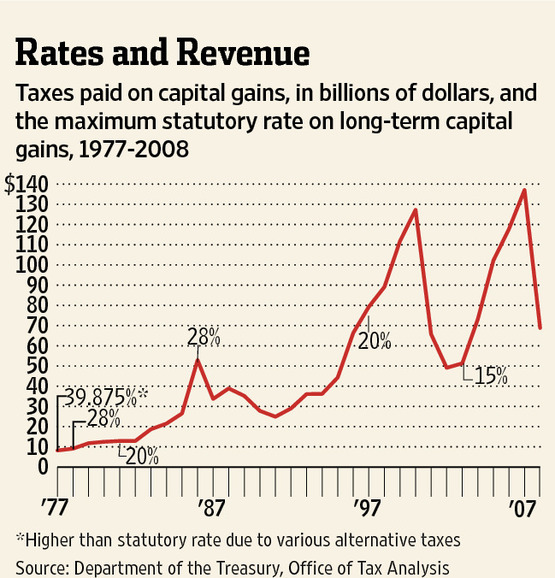
The Wall Street Journal offered a history lesson with empirical data relating taxes on investment to revenues collected by the government since 1977, a period when capital gains taxes were alternately raised and lowered by a capricious Congress.

This figure tells the story, which I’ll only summarize; you should read the whole lesson.

Essentially, raising tax rates—as has been noted for other Federal taxes—lowers tax revenues, and lowering the rates increases the collected revenues.

A couple of things in the figure are noteworthy, though.   The tax rate drop to 20% in 1981 did not lead to a drop in revenue—surprise—but 1982 was a year of a sharp recession, and collected revenue from that lowered rate still remained flat: no drop with the recession.  Collected revenue then ran up hard as we came out of the recession.  Additionally, the sharp drops after the sharp increases that resulted from the rate decreases in 1997 and 2003 came from the dot-com bubble burst that saw the NASDAQ, for instance, lose 60% of its value and from the Panic of 2008, whose hard recessionary effects we’re still in the middle of.

There’s another impact of higher capital gains tax rates, though, as the WSJ also points out.  High rates disinclines investors from selling their holdings as soon as they might.  This sequesters those investment monies in present investments, making them unavailable to other investments—younger, newer, more agile businesses with more current ideas, for instance—that might be better places, on a purely business basis, for investment dollars.  Moreover, the higher capital gains tax rates lower the returns on investments, leading other investors to demur from committing their funds in the first place to such investments.  The taxes distort the investment decisions.

But President Obama doesn’t care about healthy revenue collections for government; he doesn’t care about a healthy economy.  He cares about his definition of “fairness.”

GIBSON: So why raise [capital gains tax rates] at all, especially given the fact that 100 million people in this country own stock and would be affected?

OBAMA: Well, Charlie, what I’ve said is that I would look at raising the capital gains tax for purposes of fairness.

Another Thought on Self Defense

I wrote, a short time ago, about individual self-defense.  In this post, I’d like to explore a little bit of the self-defense rights of a nation.  Senator Jon Kyle (R, AZ) asked, in a Wall Street Journal op-ed, “What’s at Stake in the Missile-Defense Debate?”  His question also raises a larger question concerning a nation’s right to self-defense.  I’ll address the second question first, then I’ll talk about the role of missile defenses within that right.

As our Declaration of Independence acknowledges, all men have a right, among other things, to our Lives, our Liberty, and our Happiness.  In that earlier post I demonstrated the right, and the obligation, of each individual to defend himself—lethally, if necessary—against threats to himself, his family, his property, and to extend that defense to others whom he might see under similar threat.

Far too often, that individual is incapable of conducting that defense, even acting in concert with a few of his fellows.  This is why, as Hobbes, Locke, Rousseau, et al., have demonstrated, men come together to form social compacts, nations, with governing structures.  Universal among these men’s demonstrations was a purpose of those compacts: to defend the individual members against external threats.  Thus, nations are formed for an explicit purpose of defending its citizens—of defending itself.

The right of a nation to defend itself thus flows directly from its members’ individual rights to defend themselves.

Within a national right of self-defense, where do missile defenses fit?  Plainly, a nation that does not use all of the tools at its disposal is limiting itself in its ability to carry out its duty of defending its citizens, of defending itself.  A nation that disgorges itself of any of the tools it has, and/or turns its back on acquiring all the tools it might, that are useful in defending itself is turning its back entirely on its obligation to defend itself.

This failure is exacerbated in a nuclear world, where one of the weapons of attack is fully capable of destroying an entire city, murdering the hundreds of thousands or millions of people who live(d) there.  A missile defense capability becomes critical to national defense, even to national survival, when such offensive destruction is possible.  Certainly, a missile defense of the kind discussed by Lyle and dismissed by President Obama is useful only against missiles and is not proof against those missiles.  However, with our enemies capable of missile delivery of nuclear destruction, not defending against that threat is not just amoral, it’s actively immoral.

For the United States to walk away from a maximally capable defense capacity solely to appease our enemies who have that nuclear offensive capability is not just amoral, it’s actively immoral.  Yet this appears to be the path on which Obama is setting us.  He already has withdrawn missile defenses against rogue Iranian missiles from eastern Europe (where they could defend Israel and Europe against Iranian attack) at Russia’s behest.  Now he’s telling outgoing Russian President Dmitri Medvedev and incoming Russian President Vladimir Putin that, given time to win his reelection before being pressed on our missile defense system, he’ll then no longer be accountable, and he can give the Russians everything they want in the complete removal of any American missile defense capacity.

Senator Kyle rightly points out legal concerns about this course.

[President Obama] may have to ignore or circumvent commitments he made to Congress to secure support for the 2010 New Strategic Arms Reduction Treaty (Start)—among them, that he would deploy all four phases of planned U.S. missile-defense systems for Europe, and that he would modernize the Ground-based Midcourse Defense (GMD) system for the protection of the U.S. homeland.

Never mind that acceding to Russian demands would eliminate

…the only U.S. theater missile-defense system capable of catching intercontinental-range Iranian missiles, making it important for the defense of our homeland.

Senator Kyle adds

It is questionable whether concessions on missile defense would induce Russia to further reduce its nuclear arsenal.  Unlike the U.S., Russia maintains a robust nuclear warhead production capability, and its national security strategy is to increase reliance on nuclear weapons.  Russia is also modernizing ICBMs and submarine-launched ballistic missiles.

Indeed.  I’m reminded of the Third Punic War.  Rome insisted that Carthage disarm itself, and Carthage acceded to the demand.  After that, Rome attacked, razed Carthage to the ground, occupied all Carthaginian territory, and enslaved its surviving people.

But Obama has said of his moves to eliminate our missile defenses

As a nuclear power – as the only nuclear power to have used a nuclear weapon – the United States has a moral responsibility….

Sorry.  The one who would unilaterally remove our ability to defend ourselves is in no position to discuss any part of our military posture.

Further, the champion of wealth distribution, of “you’ve made enough money,” give up what I’ve determined for you as excessive for me to redistribute; the champion of denying anyone his right to live his life to the fullest of his own potential through that wealth redistribution is in no position to lecture anyone on morality.

Government Tax Increases and Government Spending Cuts

Stipulate, arguendo, that government spending is stimulative.  In order to pay for the stimulative spending, government must collect taxes or borrow.  Taxes taken away from the citizens, though, is money the citizens no longer can spend.  Raising taxes to pay for increased stimulative spending is even more money that those citizens now cannot spend.  This reduced private spending offsets the public spending funded by that taxation.

Increased taxes to support increased public spending reduces private spending even more than the amount of the tax increase, though.  The increment above the simple reduction in private spending comes from individuals and businesses now being especially careful to husband their monies: they increase their savings so as to improve their ability to handle unforeseen problems, such as a medical emergency, a roof repair, a capital plant problem, another increase in their tax bill beyond the one just suffered.  Thus, private spending is reduced further by increased saving, and a tax increase results in a net reduction in the sum of private and public spending.

This offset doesn’t change when government borrowing, rather than tax increases, is used to fund stimulative (government) spending.  Americans aren’t stupid.  We all recognize that today’s government borrowing is just tomorrow’s increased taxes and/or rising inflation, and so the above husbanding still occurs.

This is a relatively symmetric relationship.  A reduction in tax rates achieves two positive things (although after a minimum threshold, the second positive becomes a wasteful negative).  The first positive thing is that more money is left in the hands of private individuals and private businesses.  This additional money is either spent, which is directly stimulative, or it is saved against one of those unforeseen events, or for a planned large expenditure, future retirement, or future investment.

Thus, saving is stimulative tomorrow, and more than that, the saved money actually serves two stimulative roles.  One role is that this is the money private individuals and our businesses are going to spend tomorrow for one of the reasons just described.  The other role is through private or commercial lending/borrowing.  Those savings are assets that banks and other financial institutions can lend to our neighboring private individuals and to our businesses, so our neighbors and businesses have increased money for their current spending.

The second positive thing is that with these reduced tax rates, economic growth is encouraged, and that increased economic activity generates more revenue for the government beyond the direct reduction from those reduced rates.  However, since government has no need of money beyond funding the few things our government was created to effect, any amount beyond that level is wasteful and so provides room for reducing tax rates even further.

Finally, in the real world, where (Keynesian) stimulus spending has been shown to be wrong empirically (vis., FDR’s “stimulus” spending during the Great Depression, which prolonged the Depression; and Obama’s “stimulus” spending in the present deep recession, which is prolonging the recession), reduced government spending also is net stimulative.  Government spending crowds out private spending through at least two mechanisms.  Government demand artificially elevates prices compared to the level at which those prices would exist in the face of solely private demand, and private spending is reduced by lack of need to purchase: the government will buy and transfer the goods to the private individuals.  Reduced government spending reduces that crowding out, and private individuals and businesses return to the market place.