
Security and Ebola

The head of the CDC said Saturday that imposing a travel ban between the US and West African countries dealing with the Ebola virus could worsen the outbreak that has killed over 3,000 people in five countries.

“Though we might wish we can seal ourselves off from the world, there are Americans who have the right of return and many other people that have the right to enter this country,” Dr Thomas Frieden told a press conference. “We’re not going to be able to get to zero risk no matter what we do unless we control the outbreak in West Africa.”

This is carefully, cynically mendacious. “Americans who have the right of return” from western Africa are few, and they’re easily controlled at the point of departure until they can be shown to be Ebola-free. Those infected can be brought back under suitable controls, as has already been demonstrated.

Moreover, there are not at all very “many other people that have the right to enter this country;” that’s the point of border control: no nation has an obligation to let any non-citizen enter, except as that nation sees fit.

Frieden compounded his…error…with this:

We really need to be clear that we don’t inadvertently increase the risk to people in this country by making it harder for us to respond to the needs in those countries by making it harder to get assistance in and therefore those outbreaks would become worse, go on longer, and paradoxically, something that we did to try and protect ourselves might actually increase our risk.

This is more nonsense. A travel ban would be on travel from western Africa, not to it. Even were such a ban to include to western Africa, exceptions for humanitarian purposes are easily defined.

We don’t get to zero risk by restricting travel from enemy nations during time of war, either, until we control and terminate on our terms the war at its source; however, we routinely and effectively reduce risk by such restrictions. So it is here. Ebola isn’t a shooting war, but it is a war against a virus that has devastating effect wherever it invades. Travel restrictions would significantly reduce risk.
Hong Kong and Freedom

The backdrop is this: in the last few days in the Hong Kong district of Mong Kok, there have been violent clashes between peaceful student and other protestors on the one hand and “locals” consisting, allegedly, of older residents and small business owners mixed with members of the triads on the other hand, this mix attacking the protesters. The latter are losing income from their prostitution and drug…enterprises…and they’re upset about it.

My own view is that the residents and business owners are being provoked and the triads winked at by the PRC in the hope of getting sufficient pretext to justify the government’s coming violent crackdown. That’s a separate question, though; what interests me here are the charges being leveled by the current Hong Kong administration against those who were arrested during those weekend clashes.

Hong Kong’s Secretary for Security, Lai Tung-kwok, said that among other charges, those arrested had been charged with unlawful assembly.

How is it possible to unlawfully assemble in a free society?

Taxes and Expiring Tax Breaks

Time is running out for Congress to extend more than 50 tax breaks worth nearly $85 billion, including popular ones for college expenses and energy-efficient appliances.

There are other costs to these tax breaks:

The [House of Representative’s Joint Committee on Taxation has identified 79 expired or expiring federal tax provisions from 2013 to 2023.

And

…the so-called “breaks” result in less revenue for the Treasury Department and an increase to the deficit—like the projected $84.1 billion the Senate bill would add if passed in full.

However, to get onto one of my hobby horses, we wouldn’t need these tax breaks if we had a single, low flat rate. Moreover, as the above quotes illustrate, there’s a large cost to government social engineering and to government interference in a free market’s operation.

Taxes, though, aren’t for government-directed social engineering. All the social engineering government is allowed to do is named in the Constitution and the Declaration of Independence—the founding documents of our social compact. Actual social engineering is up to We the People, and no one else, no entity else.

And the kicker: with a low, flat rate, and with everyone with an income required to pay, there would be no loss of revenue to the government, breaks or not. Note, too, that this kicker ignores the question of whether such a tax reform should be revenue neutral. (Hint: it need not be, except perhaps initially for the political reason of getting the thing passed.)

Jobs Numbers

The headline numbers are in, and they seem favorable enough: unemployment has dropped to 5.9%, and 248,000 new jobs were created in September.

However.

Counting the 142,000 new jobs created in August, new jobs were created at a monthly average of 195,000 jobs per month over the total interval. Using, instead, Labor’s revised August number of 180,000 new jobs (I’d be curious to learn how President Barack Obama’s Labor Department could make such a large estimation error—a 20% error), that still works out to a pretty anemic 214,000 new jobs per month over the period.

The labor force participation rate, at 62.7%, remains at historic lows. If this rate were at 2007’s level of 66.2% (a rough average for the year), the unemployment would be nearly 11%.

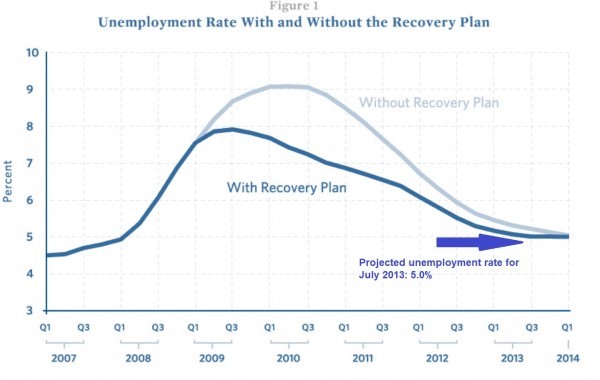
Even taking the 5.9% unemployment rate as legitimate, we’re still years behind schedule—not just behind the rate extant at this point in a normal recovery, but behind Obama’s promised unemployment rate which he used to sell his Stimulus package, as this graph illustrates.ObamaPromisedEmploymentRate

In particular, we’re still not at the 5% Obama promised we’d reach by last year. Oh, and that peak unemployment of 8% worked out to over 10%, which was worse than the No-Stimulus situation which he projected.

Additionally, median income remains down sharply from pre-Panic levels—7.9% sharply.

Additionally, new jobs created since the Panic officially ended in 2009 has only just, this past summer, matched the number of jobs extant in 2007, some three or more years later than prior recoveries. And that…milestone…ignores the fact that there are, today, 16 million more Americans in the civilian noninstitutional population (able-bodied Americans, capable of working) than there were just prior to the Panic.

What’s different between this recovery and the recoveries from prior recessions? Only Obama’s policies, actively aided and abetted by his pet, Senate Majority Leader Harry Reid (D, NV) and the latter’s Senate cohorts. All the prior recoveries proceeded much faster, and those paces occurred under both Republican and Democrat administrations.

Another VA Problem

This one, though, isn’t primarily the Veterans Affair’s doing.

Veterans at the Shreveport, LA, Veterans Administration hospital have been going without toothbrushes, toothpaste, pajamas, sheets, and blankets while department officials spend money on new Canadian-made furniture, televisions to run public service announcements and solar panels….

Some specifics:

According to the VA, the department spent $74,412 on 24 flat screen TVs for “patient/employee information”—one 50 inches wide and the others 42 inches. The furniture cost $134,082, and the solar project was approximately $3 million.

This is shameful, but this falls on Congress. Under Federal funding rules, capital equipment—the TVs, solar, etc—fall into one funding category, and supplies—toothbrushes and paste, blankets, etc—fall into a separate category. Under those same rules, the VA (and any other agency whose funding falls into different categories) cannot take funds from, say, capital equipment, and spend it on, say, supplies. It gets even more bureaucratic than that. Agencies can’t reallocate capital expenses from one capital item to another: the VA can’t, for instance, take some of those $3 million from solar and buy more TVs with it. Only Congress can authorize such reallocations.

No, Congress must answer for this misallocation. That it’s what the VA asked for in its budget request may be true, but Congress—that collection of our directly elected representatives—isn’t supposed to be a rubber stamp for every request for money that wanders by. It’s our money Congress is allocating, not Congress’ and not the VA’s.

It’s true enough that the VA could have—should have—gone to Congress and asked for a reallocation on recognition of the supply funding shortfall. That it seems not to have is an internal VA problem that supports my argument for disbanding the VA and using the budget to fund vouchers sent directly to our veterans.

There are other problems described at the Watchdog.org link above that are entirely within the VA’s ability to correct, but this one is not.