
A Misunderstanding of Economics and Human Nature

Plainly, too many have never read Adam Smith, whose Wealth of Nations showed that allowing individual self interest—personal greed—to operate in unfettered in a free market was the fastest, most efficient way to broad prosperity for the entire population of economic actors. Apparently we don’t teach basic economics in school, anymore.

In a Wall Street Journal op-ed about the failure of Vermont’s overt move toward a single-payer health system, the paper noted that Harvard’s William Hsiao and MIT’s Jonathan Gruber, architects of that state’s plan, had assured all concerned of the following:

The promise of single payer is that governments can save money by eliminating the profit motive and administrative costs.

But that could be true (but not certainly so) only if there were only one player in the market.

It’s that profit motive, after all—that individual self interest—that saves money. It’s that profit motive—that personal greed—that drives down costs.

The economically illiterate—not just Hsiao and Gruber—miss (or, a cynic might suggest that a Liberal ignores, for political gain) the competition factor: the fact that there is more than one player in the market, and every one of them—competing suppliers and competing buyers—want profit.

Suppliers (of health insurance and health provision services, for instance) compete for the buyers’ dollars, so they work hard to drive down costs so they can lower their prices farther than can their competitors. Buyers want those cheap services so they compete with each other to pay as little as possible for them, but to pay a skosh more than their competing buyers so that they succeed in closing the purchase.

The result is what those in the trade call a market clearing price: the price at which all the service sellers sell their product, with nothing left over and no seller left out, and all the buyers get what they want, with no buyer left out. That price is fair, too, because no one was forced to sell or buy at a price they didn’t want or couldn’t afford.

It’s also the lowest price, with the lowest “administrative costs” (there is a non-zero floor to those costs because the workers doing the actual production get to be paid, and the producers of the services being bought for assembly into that final service get to be paid), available in order for the service to be saleable—available to interested buyers—at all.

And it’s a more accurately set price than even well-intentioned government politicians can achieve through mandate.
Perjury?

This is the oath that witnesses before the House Committee on Oversight and Government Reform requires of its witnesses, when those witnesses are sworn (and if one witness is required to be sworn, they all must be) (scroll to Rule 9, para (g)). It’s not the same oath for all committees, but it’s typical.

Do you solemnly swear or affirm that the testimony that you are about to give is the truth, the whole truth, and nothing but the truth, so help you God?

I mention this because it turns out

Then-Deputy Commissioner Steven Miller wrote in an email in June 2012, about a month before a House Ways and Means subcommittee hearing….

“I am beginning to wonder whether I should do [the hearing] and affirmatively use it to put a stake in politics and c4 [regarding IRS targeting of conservative organizations applying for 501(c)(4) status].”

Miller also was never directly asked about the targeting. That removes the legal aspect of perjury: Miller would seem not to have perjured himself.

But morally? Yew betcha.

Crony Capitalism

Montreal-based CGI Group Inc, the company that received a $74 million contract to develop and maintain the Hawaii Health Connector web portal, will be awarded another year-long state maintenance contract despite the ongoing problems with the site.

The money comes from a $204 million federal contract the state received in 2012 to set up the Obamacare network in the islands.

This is the same crowd that had so much fun with the ObamaMart failure in 2013.

Hmm….

A(nother) Thought on Climate…Change

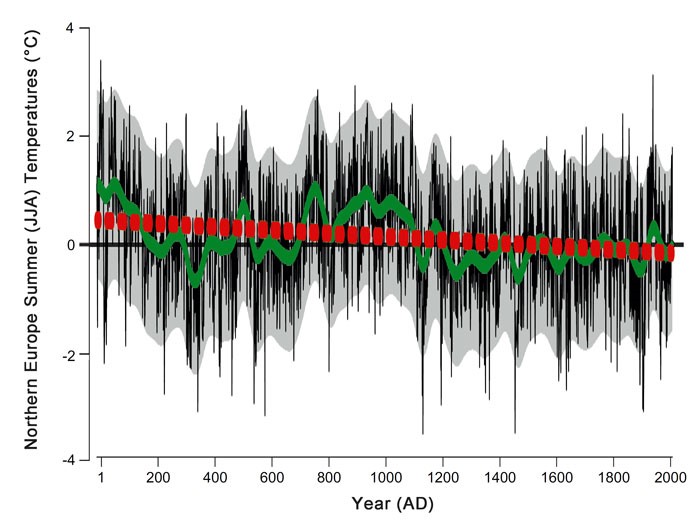
Watts Up With That has a summary article and graph on this; the basic article is on the other side of a link in the summary. It’s typically academic in its language, but it’s well worth a layman’s time in slogging through. Here’s the graph (which is a construction of Watts’; it’s not in the linked-to article):TreeRingSummary

Northern Europe summer (June, July, August) temperature reconstruction. Data shown in °C with respect to the 1961-1990 mean. Adapted from Esper et al. (2014).

The black lines are individual data points, and the grey shading smoothes the data. The green line represents the center of the grey shading, and the red line approximates a regression line showing the long-term rate of cooling over these 2,000 years. All the representations show the same thing: it was warmer in northern Europe 2,000 years ago, during the time of the Roman Empire, than it is today.

The take away for me, though, is what’s represented by the black lines and the grey shading. Compare those to the alleged warming trend of the last 100 years—and its stagnation over the last 20 years (fully a fifth of those 100 years).

Now show that that recent “trend” is distinguishable from the noise level apparent in the data and their first smoothing, the grey shade.

Obama and Economics

In the question and answer period following President Barack Obama’s end-of-year Friday press conference, Obama offered this regarding the Keystone XL pipeline, gas prices in the US, and global markets [emphasis added]:

So there’s no—I won’t say ‘no’—there is very little impact, nominal impact, on US gas prices—what the average American consumer cares about—by having this pipeline come through. And sometimes the way this gets sold is, let’s get this oil and it’s going to come here. And the implication is, is that’s going to lower gas prices here in the United States. It’s not. There’s a global oil market. It’s very good for Canadian oil companies, and it’s good for the Canadian oil industry, but it’s not going to be a huge benefit to US consumers. It’s not even going to be a nominal benefit to US consumers.

Pick one, Mr Obama. It’s either a global market or a Canadian one. If it’s global—which includes US consumers buying gas—the large increase in supply, especially if it’s more cheaply delivered to the global market via Keystone and Gulf Coast ports than via truck and train to British Columbia ports, most assuredly will have a salubrious effect on the prices US consumers pay for our gas.

And that ignores the fact that a lot of that Canadian oil going to the Gulf Coast via Keystone will be sent to US refineries there, and a lot of the refined product will be sold in the US—a prompt and nearby increase in supply.