Win Customers, Raise Revenue

That’s the Post Office’s goal. Doesn’t seem like they have a viable plan for that, though.

Postmaster General Louis DeJoy is preparing to put all first-class mail onto a single delivery track, according to two people briefed on his strategic plan for the US Postal Service, a move that would mean slower and more costly delivery for both consumers and commercial mailers.
[They plan to] eliminate a tier of first-class mail—letters, bills and other envelope-sized correspondence sent to a local address—designated for delivery in two days. Instead, all first-class mail would be lumped into the same three- to five-day window, the current benchmark for nonlocal mail.

And

The plan also prevents first-class mail from being shipped by airplane….

After all,

The Postal Service spent more than $457 million flying first-class mail in 2020, according to data it filed with the Postal Regulatory Commission, and spent $314 million transporting mail by truck.

Of course, putting all that air cargo onto trucks won’t increase truck transport cost. Uh, uh.

Oh, and the Post Office is planning to raise postage rates in order to make up for this degradation of service.

Brilliant.

A Survey of Southeast Asian Nations

This one was done by ISEAS-Yusof Ishak Institute a research institute established by the government of Singapore.

Organizers sent the survey late last year to government officials, academics, and other stakeholders from the 10 countries comprising the Association of Southeast Asian Nations (ASEAN).

Here are some interesting tidbits from the report. First, the nations’ overall concern about the situation in the South China Sea:

Notice that—even concerns about a US-PRC confrontation are a distant 3rd to concerns about the PRC’s misbehaviors. And of those 12.5% concerned about our own military presence, Singapore (6.3% [of those 12.5%]), Vietnam (4.6%), and the Philippines (4.5%) have little qualms about it. These are the nations most directly threatened by the PRC’s acquisitive adventurism.

Next, the nations’ preferred response:

The vastly preferred solutions are the nations’ enforcement of the UN Convention on the Law of the Sea, which aligns to a large degree with the US’ position on freedom of the seas, and the conclusion of a Code of Conduct with the PRC, which agreement would severely hamstring the PRC’s seizures since the nations’ view of a legitimate COC would have it align tightly with the UNCOS.

And this:

The left pie chart reflects the view of the nations concerning who has the largest economic influence in the region: 76.3% view the PRC as havng the largest influence. The right pie chart shows that nearly ¾ of the nations are concerned about that economic dominance.

These results, excerpted from a broader-reaching report, show the opportunities that former President Donald Trump was working to exploit, and that remain for President Joe Biden to exploit.

The entire report is worth reading, and it can be read here.

h/t to Just the News

The Biden Budget

Carol Platt Liebau, Yankee Institute for Public Policy President, wrote in her Friday Wall Street Journal op-ed about President Joe Biden’s dangerously expensive Wuhan Virus “relief” bill. A truly Pyrrhic relief it would be, too, even were it not occurring on an already dangerously expensive pair of “relief” bills enacted over the prior year.

She had one statement, though, that particularly jumped out at me, perhaps because it centers on a matter I’ve been on about for a bit already.

President Biden wants to send $350 billion in unrestricted cash to state and local governments to fill their budget holes.

Money is fungible. It doesn’t matter whether a dollar is “restricted” or unrestricted in its use. Even if it is, its mere existence frees up another dollar for the supposedly restricted-from use.

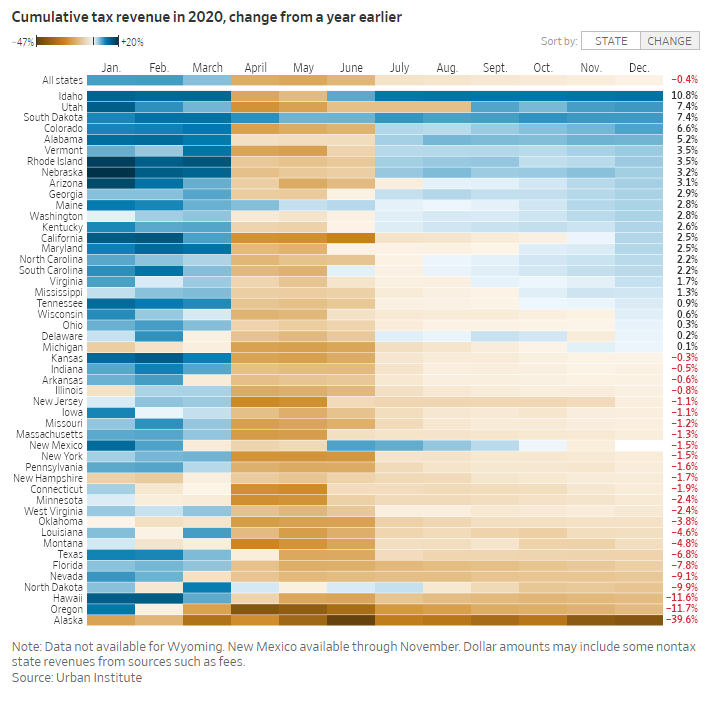
Aside from that, the States don’t need the Federal (which is to say our taxpayer) money. State revenues are much higher than initially expected, even in Progressive-Democrat-locked down and -run States.

In addition, the public union shakedowns of which Leibau wrote further demonstrate the lack of need.

A Treasury Climate Czar

That’s what new Treasury Secretary Janet Yellen wants to set up. That’s not necessarily a bad idea.

A climate risk office inside Treasury actually could be useful—were its purpose properly targeted.

The risks that are worth assessing and which realizations worth planning for, though, are political and economic, not climatic.

The political risk is from government overreacting with laws and regulations to the overhyping of climate.

The economic risk is from businesses overreacting in anticipation of such political overreactions.

Somehow, though, I doubt that’s Yellen’s intention for her new office.

Cent Wise and Euro Foolish

Barron’s has an example, centered on Europe’s very own Wuhan Virus situation.

The EU economy shrank last year by 6.3%, according to the latest EU forecast, published on Thursday. That amounts to about €877 billion ($1.1 trillion) of lost gross domestic product last year. Or about €17 billion a week.
Compared with this, the total bill of vaccines procured until now by the EU—based on contracts signed, and vaccine prices confidential in principle but tweeted last December by the Belgian health minister—would amount to €20.5 billion.

The finally agreed vaccine bill amounts to a bare day-and-a-half over a week’s lost GDP—and how many lives.

While Barron’s writes its own price-is-no-object foolishness—When dealing with the pandemic, vaccines are quite literally priceless—the EU plainly wasted ‘way too much time, money, and lives, quibbling over relative pennies.

An outcome of the European Union’s foolishness:

20% of the UK population has already received at least a shot of one of the three [EU- and British-]approved inoculations—the Pfizer-BioNTech, AstraZeneca-Oxford, and Moderna vaccines. More than 13% of Americans are in a similar situation—but barely more than 4% of Europeans[.]