
Wrong Question

And it leads into a false premise. These errors are William Galston’s, writing for The Wall Street Journal last Tuesday. His subheadline lays out the false premise:

Kyiv will have to make concessions to Russia, but it will also need security guarantees.

No. Kyiv can make almost no concessions to the barbarian without rewarding him for his invasion and giving tacit encouragement (reminiscent of ex-President Joe Biden’s (D) permission to Putin that a small incursion into Ukraine would be OK) for a renewed, expanded, and better prepared invasion a year or two later. “Almost no:” perhaps—a weak maybe—an agreement might consist of a non-exclusive lease to the barbarian of the narrow confines of the port at Sebastopol. Note: that’s the port, not a naval base, and that’s the port, not the surrounding city.

The wrong question Galston posed in his lede:

Where does Europe end and Russia begin? This centuries-old question underlies the meeting between President Trump, Ukrainian President Volodymyr Zelensky, and European leaders in Washington on Monday. The resolution of Russia’s war against Ukraine will settle this question, at least for now.

Again, no. The “centuries-old question” was answered centuries ago: the Ural mountain range is the demarcation (however blurry) between Europe and Asia. Russia west of that range is in Europe, and Russia east of it is in Asia. It really is that simple.

The real question is where does Russia end and the individual nations of the rest of Europe begin. The barbarian chieftain in the Kremlin insists that the boundary of his immediate interest lies between Russia on the one side and Moldova, Romania, Hungary, Slovakia, Poland, Lithuania, Latvia, and Estonia on the other side. The barbarian already is making early, mostly political interference, moves against Moldova, and he’s already engaging in cyberwars against those three Baltic States.

Any “settlement” between Ukraine and Russia that involves land concessions to the barbarian only puts those other nations in nearby, if not immediate, peril: the barbarian has said many times, and unequivocally, that he intends to reconstitute the Russian empire, and that means absorbing into the Rodina those other nations (as oblasts, they’d be permitted to keep their current names), and results in the Russian border being pushed even farther west. It’s imperative for the safety of those other European nations and that of our own, that we all support Ukraine materially as well as politically, and enforce the eastern border between Ukraine and Russia along with the northern border between Ukraine and the barbarian principality of Belarus.

Beyond this, the barbarian’s behavior is putting a premium on expanding NATO to include Ukraine, or alternatively, the standing up of a new mutual defense arrangement that includes the Three Seas Initiative nations, Sweden, Finland, the UK, and the United States.

There are broader implications to this struggle. The fate of the Republic of China hangs in the balance, along with the subsequent fates of Japan, the Republic of Korea, and all of the nations rimming the South China Sea. As does our own fate.
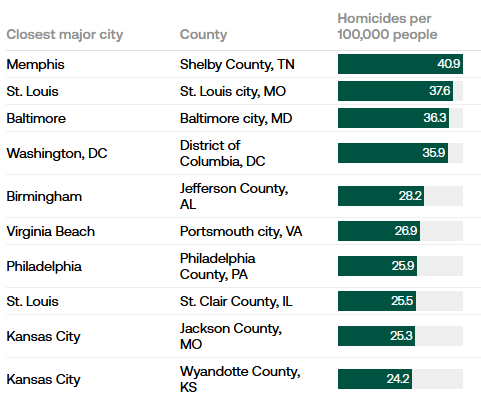
Homicide Rates

These data are from USAFacts, and they’re at the county level, since that’s the maximum data fineness that the Centers for Disease Control and Prevention, USAFacts‘ source, publishes.

The top 10 homicide rates—homicides per 100,000 population—were in these counties as of 2023 (the latest data available from CDC):

The closest major city is for context; the rates are for the indicated county.

Every single one of these counties is run by Progressive-Democratic Party politicians.

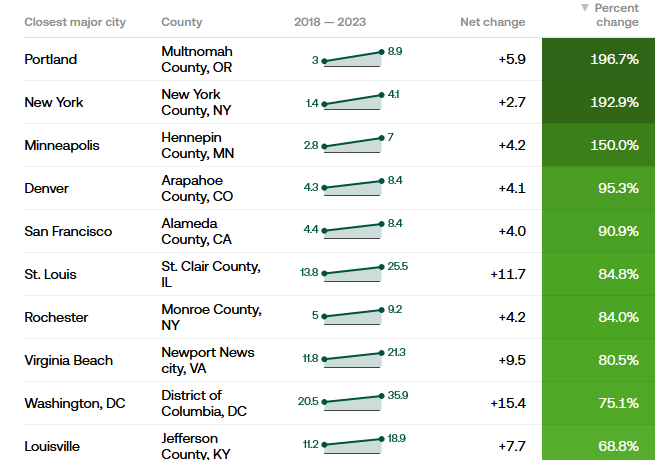
The 10 counties with the largest increase in homicide rates, 2023 over 2018, are these:

Again, the closest major city is for context; the rates are for the indicated county. All of these counties are Party run, also. Given the overlap between high rates and rising rates, it shouldn’t be surprising that at least most of these are Party run.

One item of note here, while acknowledging that these data are a year and a half-ish old, is DC. That county had the third highest homicide rate and the ninth highest rate of increase in its homicide rate. It seems true that DC’s homicide rate is lower today than in 2023, but it’s still among the highest in the nation.

No less a light than PBS cited a Rochester Institute of Technology report that indicated that DC’s homicide rate per 100,000 had fallen in 2024 to 27.3. What those “fact checkers” chose to ignore was that even in the RIT report, DC’s rate was the fourth highest of the 24 cities that RIT looked at, and it’s still higher than that 2018 starting figure by 33%. That last, though, is my calculation from comparing RIT‘s 2024 value with the starting value in the second figure above. The RIT report did not look at rates of increase of homicide rates.

Yet this is the poor performance of DC’s governance that Party is so desperate to defend as they zealously oppose President Donald Trump’s (R) concerted effort to clean the place up.

Circularly Self-Serving

Or self-servingly circular. You decide.

The IRS, this time at President Donald Trump’s (R) behest, is moving to block the trial of a couple of IRS whistleblowers who are suing the agency over its non-payment of whistleblower rewards they believe are owed them over their exposure of alleged tax irregularities inside Bill and Hillary Clinton’s foundation.

“In this case, the Whistleblower Office denied petitioners’ claims because the petitioners’ claims were never considered in an IRS action. Here, the Whistleblower Office forwarded petitioners’ claims to a classifier,” the IRS motion to dismiss argued last week. “Following the classifiers’ preliminary review, the Classifier declined to forward petitioners’ claims to exam and recommended that it be forwarded to the CI [criminal investigation] division.
“The IRS did not proceed with any potential action when it investigated petitioners’ claims,” the IRS added.

The IRS’ claim is this: we didn’t do anything about the beef, therefore, there is no beef about which to sue us.

This is one more example of an agency’s adjudicative facility being judge, jury, and executioner at the direct expense of justice for the individual(s)—or justice for the people if a proper Article III court were to find for the agency.

12 Million Don’t Use The Health Insurance They Have

The lede lays out the background.

ObamaCare really is a gift that keeps on giving—for insurers. The law forces Americans to buy pricey plans with benefits they don’t need. And now the Paragon Institute reports that taxpayers are subsidizing insurance for nearly 12 million people who never use their coverage.

As the WSJ puts it, here’s the wild part:

More than a third of all enrollees generated no medical claims last year, according to Paragon’s analysis. That includes 40% of those in plans that are fully subsidized. Between 2021 and 2024, the number of enrollees who didn’t use their health coverage more than tripled to 11.7 million from 3.5 million.

There are a couple of reasons for this. One is that being forced to buy something that isn’t needed or wanted bit. The other is that “purchasers,” after paying those enormously high premiums, or having the government pay those premiums with OPM, still would have to pay out of their own pockets for any health care throughout the year because of the enormously high deductibles those ObamaCare plans hide behind.

Forgive us for being old-fashioned, but why should taxpayers subsidize insurance for healthy people who don’t need or use it?

Indeed.

No, It’s Not

On the matter of an organization’s cybersecurity responsibilities, Kurt Knutsson opened with this in a Fox News article:

When a hospital or nonprofit falls victim to a cyberattack, it’s hard to place blame. Cybersecurity isn’t their strength, and many lack the budget for a dedicated security team, let alone a chief technology officer.

It’s completely straightforward to fix blame in such a case, as in all other cases. Knutsson identified the culprits even while denying the difficulty of identifying them. The lack of sufficient budget and (not or) the lack of security-capable IT personnel is directly the fault of the hospital or nonprofit’s management team, who refused to provide the budget necessary to have proper security against cyberattacks.

Especially for hospitals, which maintain so much personal and personally identifying medical data, such conscious decisions to not perform are inexcusable. Cybersecurity needn’t be an organization’s strength, but cybersecurity—and the personnel and resources needed to achieve and maintain it—most assuredly need to be a serious undertaking.