
Gerrymandering, Politics, and Race

The (eight Justice) Supreme Court is going to take up the question of gerrymandering and Congressional districts in Virginia and North Carolina.  In fact, the case the Court is hearing is narrower than that:

drawing legislative districts based on race.

Never mind that the Democrats’ Voting Rights Act of 1965 mandates race-based districting: the VRA

generally prohibits reducing minority-voting power through redistricting[]

which, of course, explicitly requires race-based districting in order to “protect” that “power.”

Indeed, the whole divide[] between white and minority voters nonsense with which Jess Bravin opened his piece at the link is just a tacit summary of the Left’s racism.  We’re all Americans.  Full stop.  Any “divide” is nothing but an artificiality, fueled by the Left’s fundamental identity policies that end up masking real abuses.

Were the Left, and now the courts, serious about how bad gerrymandering is, they’d agree to its elimination altogether.  Congressional districts should be squares enclosing substantially equal sized populations, differing from those straight-line boundaries only at the borders between states, and drawn without regard to the Left’s identity politics concerning which special groups of Americans are resident in which districts.
Does Trump Want a War with the Press?

That’s the thrust of a Howard Kurtz piece on FoxNews Monday morning.  Then he asked

[D]oes Trump want both sides on a permanently hostile footing?

Kurtz needs to come out of his press bubble and poke around in the world some.  The press has been hostile to anything non-Left for years.  The press has been openly hostile and deliberately biased against President-Elect Donald Trump ever since Trump announced his candidacy.

Kurtz has even acknowledged the press’ war against Trump—and this is post-election.

Donald Trump, they say, should not be normalized.

There is, also, this bit of Kurtz’ own disingenuousity:

Trump has shown he has numerous ways to circumvent the media. He hasn’t held a news conference since July (after all those months of castigating Hillary Clinton for avoiding such encounters).

What’s the purpose of a news conference, though?  During all that time since July, Hillary Clinton not only wasn’t talking to the press, she wasn’t talking to the American people, either, except through a very occasional rally or the debates.  Trump, while not talking to the press, held innumerable rallies—with people numbering in the thousands attending—and was very active on social media.  In all of this, Trump was talking directly to the citizens of the United States.  Even in the frequent interviews he had with individual…journalists…he wasn’t so much talking to the interviewer as he was talking to the viewers of and listeners to the interviews; he was talking to us Americans.

Us voters have said in so many ballots that we no longer want, no longer need, no longer are interested in the press filtering (or censoring) our communications with those we’re considering representing us in government, and Trump has demonstrated that he doesn’t need the press to hold up his end of those communications.  Of course Kurtz knows all of this.

Plainly, it’s not that Trump wants a war with the press.  It’s that the press demands war with Trump.

An Impact of Artificially Low Interest Rates?

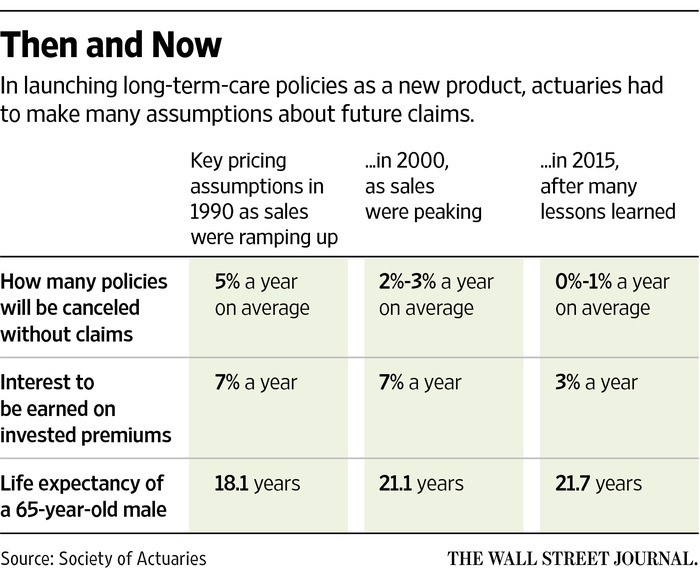
Recall that, since shortly before the Panic of 2008, the Fed has been suppressing interest rates to artificial, and very low, rates.  I’ve written about other impacts of these government-manipulated rates.  The table below could well be an illustration of an unrolling of the failure in the insurance industry first mentioned in the linked-to article.

It seems that two of the smaller insurers in the long-term care sector of the health insurance industry are about to be liquidated, proximately because they badly miscalculated the costs involved in paying out on long-term care policies.  Gary Hughes, American Council of Life Insurers General Counsel, had this on the reasons for the failures:

Penn Treaty [owner of the two failing insurers] is the poster child for what happens if everything goes wrong—when key assumptions on…claims, morbidity and interest rates go wrong—and then companies are unable to get justified rate increases[.]

This is true as far as it goes: actuaries need to be accurate in assessing future costs and the drivers of them, and State insurance commissions are reluctant to grant premium increases needed to cover rising costs.

However, premiums are not the only income source for insurers.  Far from it.  A significant income source comes from investments of those premiums, so they’re not just sitting around waiting to be paid out on a claim: they’re earning additional funds for the insurer, and those additional funds are critical bolsterers of the company’s ability to make its payout commitments.

To be safe, though, those premium investment vehicles focus on safety and liquidity.  That drives those investments to favor safe debt instruments: Federal instruments and commercial instruments that are highly rated by Moody’s, Fitch, and/or Standard & Poor’s.  That means that a significant fraction of the insurer’s additional income comes from interest payments on those debt instruments.

And that brings me to the table, with particular attention to its middle row.interestratetable

Hmm….

It Wasn’t Political

Recall that the Hampshire College President, Jonathan Lash, pulled the US flag down from all campus flagpoles, along with “all other flags.”  Recall further that he took this action after he

had lowered the US flag to half-staff after Election Day[]

followed by the US flag being burned on Veterans Day.

Lash, though, as he finally was forced by the public’s hue and cry to restore our nation’s flag to its proper place atop flagpoles, is still denying that he did it for politics.

We did not lower the flag to make a political statement. … We acted solely to facilitate much-needed dialogue on our campus about how to dismantle the bigotry that is prevalent in our society.

As an aside, what you mean “we,” Paleface?  You’re the President; it was done at your order. Full stop.

More importantly, how are lowering the flag to half-staff and then taking it down altogether under the circumstances in which you ordered these things done not political statements?  Anything done with the flag beyond its normal handling is political.

And then: Lash thoroughly contradicted himself within his own statement: the free speech that is the “dialog” engendered by his actions is at the center of what is political.

The Law Professor Misapprehends

Jacob Gershman has a piece in The Wall Street Journal‘s Law Blog about the increasing use of software algorithms to assess newsworthiness and the implications of that increasing use on legal assessments of the tradeoffs between individual privacy and what’s fit to print.  In it, Gershman quotes Georgetown University Associate Professor of Legal Research and Writing Erin Carroll.

Given the dominance of platforms like Facebook, the related influence of algorithms on how news is made, and specifically how algorithms are beginning to supplant editorial discretion and the editorial process, courts need to rethink their rationales for deference to the press. In the realm of privacy law, courts have long trusted the Fourth Estate to vet the newsworthiness of a subject before publishing, so that the courts themselves did not have to. Today, that trust is becoming misplaced.

Carroll is right that courts need to “rethink their rationales for deference to the press,” but for reasons wholly independent of the existence of news algorithms.  On the contrary, Carroll has a couple of misapprehensions here.  For one, editors (and publishers, come to that) certainly are outsourcing the work of assessments in making editorial decisions, but they cannot outsource their own responsibilities in the newsworthy judging process.

For another, related thing, there’s no reason to believe the courts’ trust “is becoming misplaced” due to the use of news algorithms.

In both instances, Carroll has missed the key factor: it’s entirely the editors’ and publishers’ decisions to use new algorithms, and it’s entirely the editors’ and publishers’ decisions to use any part of the algorithms’ outputs.  The editors and publishers remain entirely and solely responsible for the material they publish—whether that material originates from interns, news algorithms, or journalists.

Full stop.

Update: Missing word is no longer missing.