
Does Trump Want a War with the Press?

That’s the thrust of a Howard Kurtz piece on FoxNews Monday morning.  Then he asked

[D]oes Trump want both sides on a permanently hostile footing?

Kurtz needs to come out of his press bubble and poke around in the world some.  The press has been hostile to anything non-Left for years.  The press has been openly hostile and deliberately biased against President-Elect Donald Trump ever since Trump announced his candidacy.

Kurtz has even acknowledged the press’ war against Trump—and this is post-election.

Donald Trump, they say, should not be normalized.

There is, also, this bit of Kurtz’ own disingenuousity:

Trump has shown he has numerous ways to circumvent the media. He hasn’t held a news conference since July (after all those months of castigating Hillary Clinton for avoiding such encounters).

What’s the purpose of a news conference, though?  During all that time since July, Hillary Clinton not only wasn’t talking to the press, she wasn’t talking to the American people, either, except through a very occasional rally or the debates.  Trump, while not talking to the press, held innumerable rallies—with people numbering in the thousands attending—and was very active on social media.  In all of this, Trump was talking directly to the citizens of the United States.  Even in the frequent interviews he had with individual…journalists…he wasn’t so much talking to the interviewer as he was talking to the viewers of and listeners to the interviews; he was talking to us Americans.

Us voters have said in so many ballots that we no longer want, no longer need, no longer are interested in the press filtering (or censoring) our communications with those we’re considering representing us in government, and Trump has demonstrated that he doesn’t need the press to hold up his end of those communications.  Of course Kurtz knows all of this.

Plainly, it’s not that Trump wants a war with the press.  It’s that the press demands war with Trump.
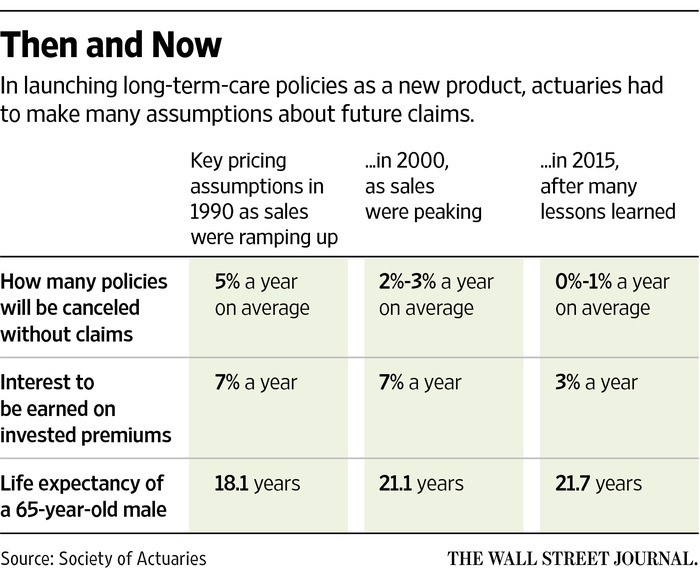
An Impact of Artificially Low Interest Rates?

Recall that, since shortly before the Panic of 2008, the Fed has been suppressing interest rates to artificial, and very low, rates.  I’ve written about other impacts of these government-manipulated rates.  The table below could well be an illustration of an unrolling of the failure in the insurance industry first mentioned in the linked-to article.

It seems that two of the smaller insurers in the long-term care sector of the health insurance industry are about to be liquidated, proximately because they badly miscalculated the costs involved in paying out on long-term care policies.  Gary Hughes, American Council of Life Insurers General Counsel, had this on the reasons for the failures:

Penn Treaty [owner of the two failing insurers] is the poster child for what happens if everything goes wrong—when key assumptions on…claims, morbidity and interest rates go wrong—and then companies are unable to get justified rate increases[.]

This is true as far as it goes: actuaries need to be accurate in assessing future costs and the drivers of them, and State insurance commissions are reluctant to grant premium increases needed to cover rising costs.

However, premiums are not the only income source for insurers.  Far from it.  A significant income source comes from investments of those premiums, so they’re not just sitting around waiting to be paid out on a claim: they’re earning additional funds for the insurer, and those additional funds are critical bolsterers of the company’s ability to make its payout commitments.

To be safe, though, those premium investment vehicles focus on safety and liquidity.  That drives those investments to favor safe debt instruments: Federal instruments and commercial instruments that are highly rated by Moody’s, Fitch, and/or Standard & Poor’s.  That means that a significant fraction of the insurer’s additional income comes from interest payments on those debt instruments.

And that brings me to the table, with particular attention to its middle row.interestratetable

Hmm….