
Economic Growth

…over last year, the 6th under the Obama administration. Which is several years late in occurring under the Obama promises, but that’s another story. See the graph. EconomicGrowth
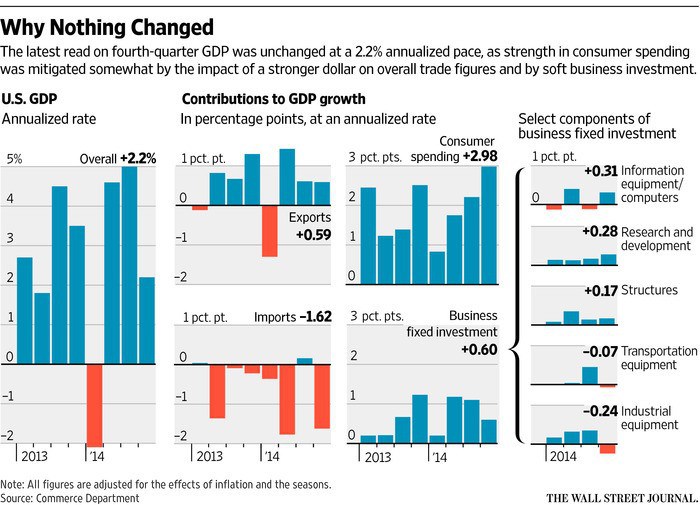
First, the overall GDP: disregard the shrinking in the first quarter of 2014; that appears to be an aberration compared to the nearby trend.

What’s interesting are the components of the GDP growth and of Business Fixed Investment in particular.

Imports remain in negative territory: we’re importing less and less (and possibly at an accelerating rate) over the last couple of years. There are a number of reasons for this, including the increasing competitiveness of domestically produced products on one hand and the continued doldrums of the our economy leaving too little discretionary funds in the hands of consumers and of businesses to buy imported goods on another. An implication of this, though, is that importation is tomorrow’s consumer and business spending.

Consumer spending is up (and possibly at an accelerating rate), but look for that to fall off if imports continue to decrease: many of those imports are for incorporation into business products for consumer purchase; that puts a lag into many of the imports’ impact on consumer spending.

Look at Business Fixed Investment, though. That never has gotten very high, peaking a bit over a year ago at just over a 1% year-on-year increase, and it’s been falling off since. Decreasing imports being used less and less by businesses.

This is especially telling in those BFI components. R&D may be accelerating, but it’s still at a pathetic rate. R&D is critical to business survival: it’s not just about how to market existing product better, though that’s important. It’s primarily developing new product, market research to guide that development, and so on. If a business’ products become obsolete, so does the business.

The tale is told in spades in Structures and Industrial Equipment. Businesses aren’t expanding their physical plant, especially in manufacturing. That means these guys don’t see any future growth in demand, either, and they don’t have the disposable funds in this still-stagnant economy to expand where they do see some glimmers.

It’s going to be a long two years on the domestic front.

Texas Education

Lawmakers in Austin are now debating SB 276, a bill that would provide school choice and educational freedom to all Texas students. It would allow parents who opt out of public schools to take with them 60% of the money the state would otherwise spend on their child—about $5,200—to pay private-school tuition. The rest of the money, roughly $3,000 per student, would go back into the state treasury.

There are a couple of alternative uses for those $3,000 than just dumping them back into the general pot.

Texas’ schooling, as elsewhere, is generally paid for with personal property taxes. Several years ago, Texas decided to consolidate those taxes, though, and redistribute them state-wide, rather than leaving them in the local community whose members had paid the taxes.

Thus: rather than sending the money to the general pot, leave the money with the school whose student(s) just left. This will increase the money available to be spent on the remaining students’ education. Of course, I’m naively assuming those $3k will be spent efficiently and for the benefit of the students….

Alternatively, the money could be earmarked, in keeping with the intent of that earlier property tax consolidation move, for the poorest of our school districts, giving them an increased opportunity to teach their students. Here, too, I’m making that same naïve assumption.

There is an alternative use for those $5,200, too. Don’t limit them to private-school tuition. Let the money be used for voucher payments/tuition at any school with room that the parents might prefer: parochial, charter, better performing public schools. Let the money be used, too, to defray parents’ costs of homeschooling.

Sending the $3k to the state’s general treasury, though, ought not at all be a deal breaker for this move, neither should the proposed commitment of the $5k to private-school tuition: SB 276 still is a major move forward. There’s plenty of time to come back again in the next legislative session to improve the move and to go farther. We’ll even have two school years of data to mull over as we consider the next move.

Now, there’s a thought.

Seems Like Evidence Tampering

…to me.

Hillary Clinton wiped her email server “clean,” permanently deleting all emails from it, the leader of the House committee investigating the 2012 terror attacks in Benghazi said Friday.

While it is not clear precisely when Secretary Clinton decided to permanently delete all emails from her server, it appears she made the decision after October 28, 2014, when the Department of State for the first time asked the secretary to return her public record to the Department[.]

Congressman Trey Gowdy (R, SC) also noted that Clinton is continuing to refuse to allow a third party to conduct an independent forensic inspection of the server, which looks to me like an effort to cover up the evidence of her evidence tampering.

Hmm….

The Left Misunderstands

Iran has a uranium enrichment facility at Fordo, a bunkered facility that Iran had built years ago in violation of its then international agreements and UN resolutions. It was only discovered in 2009, after it had been in operation for years.

The present nuclear weapons deal being “negotiated” with Iran would allow enrichment to continue at Fordo, under…inspection…, but with only several hundred centrifuges spinning.

Both Democrats and Republicans in Congress are objecting to this “deal” coming out of Lausanne, Switzerland, insisting that we’re giving away too much to Iran’s weapons program and getting too little in return, especially in the way of assurances—real block, not just “rules” and “agreements” and “protocols”—that the remaining facilities won’t, in fact, be turned to production of highly enriched uranium and the fission bombs that can be built from it.

Daryl Kimball, Executive Director of the Arms Control Association in Washington, though, thinks this is a good deal.

I think Senator Graham and Senator Menendez [leaders of the objections in the Senate] need to take a step back and put this development in a broader context. The key to Fordo is that we do not want this to be a facility with industrial-scale uranium enrichment and this report suggests they are moving in that direction.

And therein lies a bright, clear illustration of the Left’s lack of understanding of what’s happening. The key to Fordo is that it should not exist at all: its construction and operation are a demonstration that Iran cannot be trusted with any deal regarding its nuclear enrichment “program.”

Any such deal must include shutting down Iranian centrifuges—every single one of them—confiscating all uranium enriched above 5% (above that is not needed for power generating nuclear reactors), and requiring Iran to import its nuclear reactor fuel (as so many other nuclear power generating nations around the world do). Any such deal must have stern verification measures in place, also: an international inspecting presence permanently in place, able to go where it will, able to go there on no notice at all, and able to confiscate the produce of any violation. Severe sanctions to punish such violations also must be in place and triggered automatically on discovery of violation.

Full stop.

A Reason

…to decertify public “service” unions. And to terminate for cause the government’s “negotiators” for agreeing to such a thing.

Under the 1978 Civil Service Reform Act, “official time” was named, and it allows public service union members to use company time—that is, time they’re formally working for the government in a government job as a government employee—to do union administrative things. Doing union-specific work on the government’s clock also means they’re being paid by the government—by us taxpayers—to do union, and not government, work.

The thinking behind this little fillip was the premise that the union bargains in the name of all government employees, whether they’re union members or not, and this was a way to compensate the union for those alleged extra costs.

Like all sweetheart deals, this one has gotten out of hand.

According to the Office of Personnel Management, in 2012 (the most recent year there are statistics for) federal workers spent 3.4 million man-hours on union issues and not the work they were hired for. OPM estimates the cost to taxpayers was more than $157 million.

What’s more, at two government agencies that would seem least able to afford a loss of manpower—the Veterans Affairs Department and IRS—hundreds of workers spent 100% of their time doing union work. At the VA, 259 employees worked solely on union issues. At the IRS—which only disclosed their statistics when the National Review sent them a Freedom of Information Act request—the number was 201.

But wait—there’s more:

According to the Bureau of Labor Statistics, 939,000 federal workers belonged to a union in 2014. Another 139,000 were covered by collective bargaining agreements, but weren’t in a union. That brings the total number of employees covered by the unions to 31.6% of the total federal workforce.

However, there’s no requirement for any union to bargain for non-union employees, nor is there any requirement for any employer—even the government—to apply union contract terms to non-union members. Indeed, there’s no requirement for non-union employees to accept union contract terms as their own employment terms.

And so there are no costs for bargaining for the benefit of non-union employees. There never has been, requirement or cost; those are just fictions peddled by self-serving union leadership in order to get more money for union coffers.

Hence my call for decertification and termination.