
Some Thoughts on Freedom and Income

I guess today is my day for pretending to think.

Progressives have been trying to score political points by bellyaching about income inequality and pretending there’s something to this.  A couple of graphs from the Fraser Institute’s Free the World project bear on this.  The graphs below, in particular, are from their report for the year 2008; their latest report, dated 2011, covers the year 2009, and it’s not materially different vis-à-vis the poor.  Emphasis added, and kindly excuse the poor formatting.

The Institute’s reports also rank the world’s nations along various dimensions of economic freedom; there is a significant degradation in our freedoms and rankings between 2008 and 2009, as I’ll mention at the end.

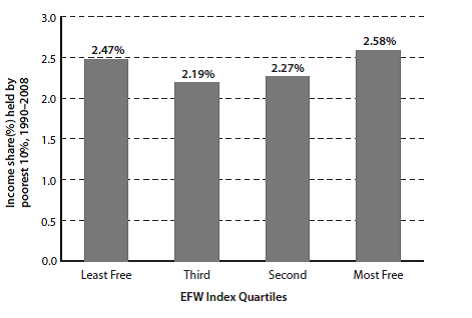
Exhibit 1.8: Economic Freedom and the Income Share of the Poorest 10%

The share of income earned by the poorest 10% of the population is unrelated to economic freedom.

Sources: Fraser Institute, Economic

Freedom of the World: 2010 Annual Report;

World Bank, World Development Indicators.
Now let’s look at another aspect of the poor’s situation.

Exhibit 1.9: Economic Freedom and the Income Level of the Poorest 10%

The amount, as opposed to the share, of income earned by the poorest 10% of the population is much higher in countries with greater economic freedom.

Sources: Fraser Institute, Economic

Freedom of the World: 2010 Annual Report;

World Bank, World Development Indicators.
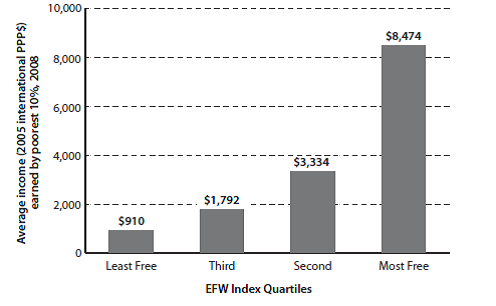
This is dramatic.  While the poor’s share of the wealth is independent of the degree of freedom in the country in which they live, their wealth in absolute terms is enormously greater, and it gets more so as the degree of freedom increases.  The poor of a free nation are far better off than the poor of a tyranny.  Of course this is not reason to disregard the relative plight of the poor in any nation.  Certainly, after (and only after) private and local community aid efforts for the needy (who are, in fact, only a subset of the poor) have been exhausted, an argument exists for aid at the state level (now speaking for the United States alone), to be followed—only as a last resort—by  Federal assistance to state-tailored and -run work-for-assistance programs for the few remaining that need assistance.

One more thing: where the US sits on the freedom scale is instructive.

The following small table is excerpted from Exhibit 1.5 from the same report as the graphs above.  The year is the year for which the rating is valid; the ratings themselves are on a scale from 1-10, with 10 being most free.  For context, the US is rated as 6th most free in the world, overall, with Hong Kong the freest and Chile ranked number 5.

Year        1970  1975  1980  1985  1990  1995    2000    2001    2002   2003   2004  2005  2006  2007  2008

US          7.74    7.83    8.03    8.18   8.43   8.32    8.45     8.23     8.22    8.17     8.15   8.07    8.01    8.08   7.93

Hong Kong 8.99   8.85   9.21   8.81   8.76   9.11    8.82     8.76     8.76    8.81     8.75   8.94    8.95    9.00   9.02

Chile      4.31   3.93    5.56    6.18    7.02   7.47    7.28     7.47     7.59    7.75     7.67   7.94    7.97    8.08   7.99

Notice the freedom trend for the US.  We were at our freest in 2000, then the Federal government began increasing the degree of regulation it forced onto our economy—both business and individual.  Yes, the Progressive rap on the Bush years is that he deregulated, and did too much of it.  But on this, as with so many things, the Progressives are wrong.  By 2008, the US only ranked 26th in our freedom to trade internationally and our business regulatory controls.  Appallingly, our credit market regulatory regime ranked only 103rd.  (As an aside, despite Congressman Ron Paul’s concern about the soundness of our money, as of 2008, we ranked number 2, with Japan at number 1.  Of course a lot has changed since 2008: in 2009, our rank fell to 11.)

And the degree of regulatory control has exploded under the Obama administration.  This has driven our ranking in overall regulatory freedom from 17th in 2008 down to 27th just in Obama’s first year, 2009 (we were 2nd in 2000).  Associated with this, the per centage of Americans living below the Federal poverty level has grown to historic highs these last three years.
Some Thoughts on a New Hampshire Exit Poll

A Fox News Exit Poll has some interesting tidbits from the just concluded New Hampshire Republican primary.  It’s important to note that in New Hampshire, Independents can vote in the Republican (or Democrat) primary, unlike the Iowa caucuses, where caucusers(?) must register in one party or the other (albeit they can register on the spot).  Finally, my summaries below talk about pluralities of the vote, rather than absolute majorities, unless I explicitly indicate otherwise.

The nearly final votes (Fox News was reporting with 95% of the precincts calling in their numbers) notwithstanding, the race was essentially between Romney and Paul, with Huntsman a strong afterthought and the others just getting in the way.  This is clearest with the age breakout exit polling: as the voters got older, they went more strongly for Romney; their only other serious candidate was Paul—who lost his edge somewhere in the voters’ mid-30s.  The other candidates just siphoned votes from these two.

The more educated the voters, the more strongly they went for Romney over Paul, although the split was, at all education levels, strongly pro-Romney.  Income level outcomes roughly mirrored the education level results; however, this is expectable, as education level strongly influences income level, especially as voters age into their careers.

On more politically oriented characteristics, the results get interesting.

Self-identified Democrats went for Paul  (the cynic in me sees two possible reasons; take them with a shaker of salt: the Democratic Party tried to influence the Republican primary, and/or Paul’s foreign policy is even more strongly Democratic than President Obama’s), while self-identified Independents split roughly evenly between Paul and Romney, with a slight edge for Paul.  On a self-identified Liberal-Conservative spectrum, the more conservative the voters, the more strongly they went to Romney, but Paul never had a significant advantage on the Liberal end: these split roughly evenly between Paul and Romney.  (Compare this with the self-identified party affiliation outcome….)

There aren’t any self-identified liberal tax and spenders in this state; the farthest Left they go is “moderate.”  And these all went strongly for Romney.  Interestingly, moderates and moderate conservatives slightly favored Huntsman over Paul.

On the social issue (gay marriage and abortion) Liberal-Conservative spectrum, only the most Liberal went to Paul; although Huntsman got a significant per centage of their votes.  The Somewhat Liberals favored Huntsman over Paul, and this group also liked Huntsman nearly as much as Romney (slightly more than one-third went to Romney, slightly less than one-third to Huntsman).  All the rest of the spectrum—Moderates to Strongly Conservative—went strongly for Romney.

Those strongly opposing the Tea Party strongly favored Huntsman.  Everyone else on the Tea Party Oppose-Favor spectrum went to Romney; although the somewhat opposers split their votes between Romney and…Huntsman (slight edge to Romney).

The single-issue voters were the only ones where Santorum had a good showing: where abortion was key, Santorum received a very strong plurality.  On the budget deficit, the voters were split between Romney and Paul, and on the economy, they strongly favored Romney.  Health care wasn’t a factor.

The single-candidate-quality voters who considered beating Obama the be-all and end-all went for Romney with a strong absolute majority—62%.  Where being a true conservative was most important, they went to Paul with a strong plurality, and Romney, Gingrich, and Santorum essentially split the rest (slight edge to Santorum among these three).  Where having a strong moral character was the thing, the voters again gave a sharp plurality to Paul, this time with the rest split among Romney, Santorum, and Huntsman.  The right experience voters split between Romney and Huntsman.

Among those feeling dissatisfied with the Obama administration, or outright angry with it (not many were as favorable toward it as “satisfied, but not enthusiastic”), most went to Romney; among the outright angry, Paul and Santorum split those who didn’t vote for Romney.  Among those somewhat to very worried about the future of our economy, the voters again went to Romney; although among the moderately worried, the rest of the voters essentially split between Paul and Huntsman.

The voters themselves were split between whether their elected officials should compromise to get things done or stick to their principles.  Both groups, though, favored Romney.  The compromisers also liked Huntsman, and the principles first-ers like Paul nearly as much as Romney.

The series of questions concerning voter satisfaction if this or that candidate won the nomination was interesting.  Nearly two-thirds of the voters would be dissatisfied if Gingrich were to win, three-fifths would be if Santorum were to be nominated, and over half would be if Paul were to be nominated.  On the other hand, three-fifths would be satisfied were Romney to be nominated.

The long series of debates paid off in New Hampshire: 80% of the voters considered them somewhat to very important to their voting decision, while over half the voters didn’t give a hoot about campaign advertising.  However, nearly a third gave some weight to the ads.

Oddly, unmarried voters broke more strongly for Paul than did their married counterparts, handing Paul a strong plurality in this demographic.

This is a strongly conservative state; they went strongly for Romney; and the more strongly they felt about anything, the more strongly they went for Romney, with some isolated exceptions.  They also liked the Libertarian Paul and the RINO Huntsman, but the self-proclaimed “true conservative” candidates the state essentially told to take a hike.

The Desperation of the Left

Now we have Larry Tribe, the esteemed Harvard professor of constitutional law, contorting himself in an attempt to justify President Obama’s unconstitutional pseudo-recess appointments.

It seems, though, that Tribe already had commented on the legitimacy of appointments of the Obama style some years back in the context of the Bush the Younger administration.  Adam White, a DC lawyer, writes about Tribe’s bias (some might suggest horrific hypocrisy) in The Weekly Standard.  White’s commentary is so clear, that I’ll just quote extensively below.

In support of Obama, Tribe asserts that the president’s power to deem the Senate to be “in recess” and then make recess appointments “is clearly stated in the Constitution….”  But against Bush, Tribe argued that “[t]he text, structure, purpose, function, and pre-1921 history of the Recess Appointments Clause all confirm…that the President may not make recess appointments during intra-session Senate breaks.”

In support of Obama, Tribe argues that intra-session recess appointments are especially justified when the Senate is deliberately “frustrat[ing] presidential appointments.”  But against Bush, he argued the opposite: recess appointments are all the more illegitimate when the nominee in question already had been the subject of Senate debate yet “failed to obtain enough votes to go forward under Senate rules.”

In support of Obama, Tribe argues that the Senate made itself “unavailable” by largely leaving Washington. But against Bush, he scoffed at the notion that the Senate was ever truly unavailable, thanks to modern technology…Senate business “can easily resume, if necessary, owing to modern communications and transportation.”

In support of Obama, Tribe invokes Alexander Hamilton’s Federalist 67 for the proposition that recess appointments, even intra-session appointments such as Cordray’s, are justified when “necessary for the public service to fill without delay.”  Against Bush, by contrast, he invoked Federalist 67 for the proposition that “recess appointments would be ‘necessary,’ and thus permissible, only outside the ‘session of the Senate”—i.e., never during type of intra-session break that President Obama exploited last week.

In defense of Obama’s recess appointments, Tribe said that the president was setting a precedent that would apply “only in instances of transparent and intolerable burdens on his authority.”  But when Bush made recess appointments, Tribe warned of a slippery slope toward tyranny[.]

Hmm….  Still, I suppose Tribe was at least partially right.  We are presently sliding down that slippery slope.

More on (Un)Employment

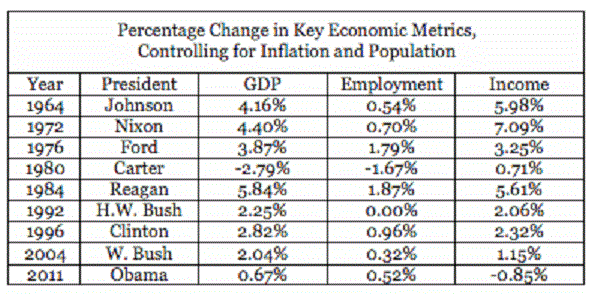
The Weekly Standard‘s Jay Cost has some thoughts on the recently reported headline jobs data.  The perspective into which these headline data fit can be neatly summarized in a table and a graph.

One aspect of this perspective is the overall economic situation in which the present data sit.  This table shows that situation for the last several Presidential election years. It’s true enough that the President Obama’s Employment growth number isn’t too different from those of past presidents in election years.  Keep in mind, though, that Obama’s number is for employment growing from an historically low employment condition: in December 2009, after a year of Obama Stimulus, unemployment was over 10%, with 15 million Americans unemployed.  Obama’s policies in 2011 have produced 0.52% annual growth against that start.  In short, we’re maintaining/growing employment very slightly at our present high unemployment rate, just as during the Clinton and Bush the Younger years, we maintained/grew employment very slightly in a time of already full employment.

Now look at those 2011 GDP and Income growth rate numbers.  They haven’t been that bad—our economy hasn’t been in such sad shape—since the Carter years.  That nearly flat employment growth rate is occurring in a terribly weak economy.

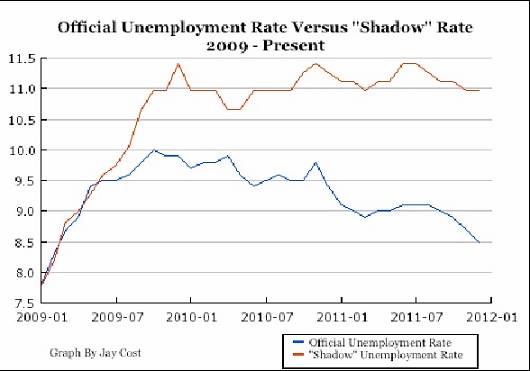
Now let’s look at the unemployment rate itself.  Cost’s graph is informative here.

Just in case the legend isn’t clear/legible, the blue line is the Official unemployment rate, as reported by the Obama administration.  The red line is the “Shadow” unemployment rate, about which neither this administration nor the NLMSM want to talk much.

As Cost points out, much of the decline shown on the Official unemployment (but not all, to be sure) is caused by the shrinking work force, as long-term unemployed give up and stop looking for jobs.  Indeed, as Cost says

Because of the length of this jobs recession, the number of people who claim to be in the workforce is near a 30-year low, and it has dropped substantially since Obama first took office (from 65.7 percent to 64 percent).

and

If we recalculate the unemployment rate based on the percentage of adults who said they were in the workforce at the start of Obama’s tenure, we get [the “Shadow” unemployment rate shown by the red line].

The Caliphate

Is it being established after all, and with the present administration’s acquiescence through ignorance?

There’s this from the Pittsburgh post-gazette (h/t to BLACKFIVE):

The war in Afghanistan may end this year in thinly disguised surrender.

“The Taliban per se is not our enemy,” Vice President Joe Biden said in an interview with Newsweek magazine Dec. 15.

We went to war in Afghanistan to oust the Taliban regime because it had sheltered al-Qaida. Perhaps Mr. Biden forgot.

and [link added]

A story in an Indian newspaper Dec. 29 suggests the reason for the vice president’s memory lapse.  The Obama administration apparently is conducting secret negotiations with the Taliban and has recruited Yusuf al-Qaradawi, the Muslim Brotherhood’s leading jurist, to mediate them.  “Earlier this month, Mr. al-Qaradawi helped draw a road map for a deal between the Taliban and the United States aimed at giving the superpower a face-saving political settlement ahead of its planned withdrawal from Afghanistan, which is due to begin in 2014,” wrote reporter Praveen Swami, citing “Indian diplomatic sources.”

Mr. al-Qaradawi seeks the establishment of a worldwide caliphate ruled by Islamic law.

(Mr Swami also goes on at some length about al-Qaradawi and the threat he poses to India as well as to the West.)

BLACKFIVE points out this:

The bottom line is we have been severely weakened by Obama….  We can start w/ losing one war and one peace [respectively, Afghanistan and Iraq],…the Arab Spring installing Islamists in Egypt, Libya and much of the rest of the Middle East….

Spain surrendered to the Islamists some years ago when it was driven from Afghanistan with its tail between its legs after a series of train bombings followed by instructions from the bombers’ handlers to depart forthwith.

Withal, we have the Umayyad Caliphate being rebuilt from the Middle East west across north Africa and back onto the Iberian Peninsula to the Pyrenees, and east through Pakistan and back into Afghanistan.  The lone holdouts seem to be Portugal and the Sarkozy French in and above Iberia, and a seemingly abandoned Israel in the heart of the redeveloping Caliphate.  It’s true enough that the present reconstruction is no more monolithic than were the Umayyads, but that doesn’t reduce the present threat any more than it did with the Umayyads.  Especially given the current Islamist goals.