Child Tax Credit

And other tax credits. Scott Hodge was one of the developers of the Child Tax Credit more than 25 years ago, and today he thinks the idea—well intended as it was—turns out to be bad tax and social policy (did I hear a sotto voce “unintended consequences?”).

His Monday Wall Street Journal op-ed went into detail on how the child tax credit, along with the subsequent proliferation of tax credits, turned out to be heavily counterproductive, reducing family prosperity through reducing the number of workers—who are family members—in the work force and thereby reducing overall GDP.

But the kicker of his piece was his closer.

No wonder the IRS is dysfunctional—it’s not equipped to be a social-service agency.
The “put money in people’s pockets” approach of the child tax credit might have been good politics, but 25 years’ experience shows it was bad policy. The country needs a tax agenda that promotes growth and opportunity, not handouts and redistribution.

Indeed.

The best tax agenda for growth and opportunity promotion begins with taking our tax code, and so the IRS, out of the social engineering milieu altogether. Tax collections should be limited (at the Federal level at least; although State tax codes would benefit from similar changes) to the Constitutionally mandated purposes of pay[ing] the Debts and provid[ing] for the common Defence and general Welfare of the United States. Keeping in mind, too, that the general Welfare of the United States is itself limited to the items enumerated in our Constitution’s Article I, Section 8.

That tax agenda concludes with enacting a tax code that eliminates business income taxes altogether (keeping in mind that it’s the business’ customers who pay the lion’s share of those taxes, anyway, in the form of higher prices, while the rest of us pay in the form of reduced innovation and fewer jobs). That adjustment needs to go along with setting a single flat tax rate on all personal income from any source, with no deductions, credits, subsidies, surcharges, or any of the other froo-froo currently extant in our existing byzantine and mendacious tax code.

The IRS as Political Tool

It’s not the tax collection agency it’s made out to be. We all recall, for instance, the IRS’ Lois Lerner-run Exempt Organizations Unit targeting Conservative tax-exempt organizations, slow-walking or outright denying those organizations tax-exempt status purely for political reasons, without consideration of how well they met statutory criteria for the status.

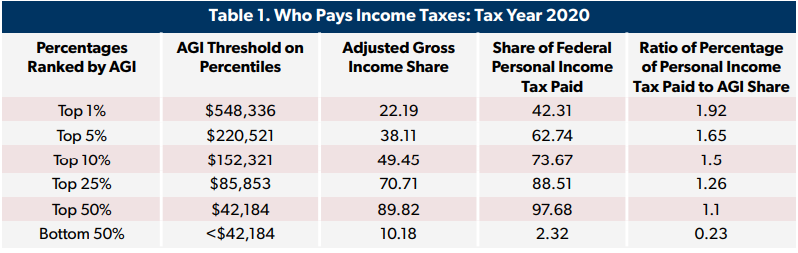
It’s also been well-publicized that the IRS has been funded for next year to hire 87,000 agents for the ostensible purpose of increasing audits of the Evil Rich, and the agency is buying ammunition and hiring agents who are willing to use lethal force in the course of their “duties.”

This is not unique to the Progressive-Democrat administrations of ex-President Barack Obama and current President Joe Biden. As far back as Lyndon Johnson’s (D) and Richard Nixon’s (R) administrations, the IRS was used to interfere with government-disapproved organizations and citizens.

Today’s IRS is just as bad across a range of…matters.

  • The IRS has disproportionately audited poorer Americans in recent years
  • IRS auditing of wealthier Americans has been declining
  • Nonpartisan projections have found increased audits under the Biden plan will heavily impact middle- and working-class Americans
  • IRS customer service has been declining, and was rated “horrendous” by its own internal watchdog
  • IRS employees have egregiously leaked or failed to protect the privacy of taxpayers’ data
  • Amid backlogs and leaks, IRS paid tax relief to dead taxpayer, prisoners on death row

The solution to this isn’t more legislation for the IRS to ignore, with or without the tacit approval of the administration then in power. IRS history and current behavior means the agency needs to be vastly shrunk.

But shrinking the IRS would be difficult as a practical matter with the current byzantine and heavily biased against some economic strata Federal tax code. IRS size and performance, then, is an argument for greatly simplifying our tax code.

Eliminate the business revenue-centric taxes. Businesses don’t pay much of those taxes, anyway; their customers pay the taxes in the form of higher prices and reduced innovation rates, and business employees and potential employees pay the taxes in the form of slower wage increases and lessened hirings.

Eliminate the personal income tax as currently constructed and have only a single, flat tax rate charged on all income from any source. Do away with subsidies, credits, exemptions, social engineering gerrymandering altogether. The new 1040 could be reduced to the current taxpayer identifying information, a line for totting up all income and reporting the total, a line for calculating the [10%] tax on that total as the total tax due, and a line for the taxpayer’s [sic] signature.

That could fit on a postcard, but with the personally identifying and income data present, I wouldn’t recommend anything less than a sealed envelope. Such a tax regime, though, would allow an IRS-like function to exist with about 14 employees (I exaggerate, but not by much).

Tough to be a political tool with that reduced function and personnel complement, too.

Arizona Has a Chance to Lead the Way

This fall, the good citizens of Arizona will be voting on, among other things, a State constitutional amendment that would make it more difficult to increase State taxes.

If passed it would amend the state constitution to require a 60% majority to raise taxes through any future referendum. Current law requires a two-thirds majority to raise taxes through legislation but only a simple majority to do so by plebiscite.

State Representative Tim Dunn (R), who led the effort to get this onto November’s ballot:

When you have something that you can’t change without going back to the voters, I think we should have overwhelming support.

Yewbetcha.

As The Wall Street Journal put it,

A 60% threshold ensures broad consensus before rates can be raised by referendum.

The point is to make it harder for Arizona to join states that raise taxes as a first fiscal resort rather than examine spending.

Windfall Taxes

With rising (finally) interest rates in Europe, European governments are starting to hatch what they’re pleased to call windfall tax plans.

European banks have started to reap higher profits from rising interest rates—and governments are already starting to clamp down on them.
In Spain, the government has laid out plans to tax lenders on their rising income and use the money to alleviate higher living costs for the population. Hungary has imposed a similar measure, and the Czech Republic, where inflation is above 17%, is also considering such a move. In Poland, where mortgages carry variable rates that are quickly rising, the government placed a moratorium on repayments to help borrowers.

Nor is this tax hatch limited to banks.

In other areas too, European governments are acting quickly when judging companies to be earning abnormally large profits. The UK has said it would introduce a windfall tax on energy companies, and Spain is imposing a similar levy as well as the new tax on banks.

Usw.

As usual, I have questions.

Define “windfall.” No glittering generalities, what constitutes a windfall profit, and based on what economic theory?

When does a windfall profit stop being windfall and becomes the normal level of profit? Again, no glittering generalities; be specific.

Related to that: discriminate between the new, reasonably steady state level of profit and “excess profit.” To do this discrimination it is, of course, necessary to define “excess profit,” with that definition devoid of glittering generalities and supported by clearly identified economic theory.

Back to windfall profit becoming the normal profit level. Does that recognition necessarily mean the prior “windfall” assessment was mistaken? If so, would that mean that the money collected as windfall taxes were mistakenly collected and a refund owed?

And finally, how many politicians will confront those questions? How many of those actually will offer concrete, measurable answers?

Just the News Has a Question

The news outlet ran a poll over the weekend. The question was this:

How concerned are you that additional IRS funding through the Inflation Reduction Act will lead to more audits for typical taxpayers?

As of Sunday morning, the enormously unscientific poll—consisting solely of JtN readers—was running 96% Extremely concerned.

Keep in mind that the IRS has been targeting Conservatives and conservative organizations at least since early in the Obama administration (if not sooner; that’s just when it became exposed).

Keep in mind, too, that Progressive-Democratic Party politicians, since Obama’s first Presidential campaign, have characterized typical taxpayers as merely bitter Bible- and gun-clinging denizens of flyover country, as irredeemable and deplorable, as 15% of us being just no good.

How is this even a question?