The Obama Debt Plan

John Hinderaker, of Power Line, commented on President Obama’s plan to pay down the national debt, as demonstrated by Obama’s mid-year budget plan update.  Obama also is campaigning on his plan to “pay down the debt in a balanced way.”

Here’s what his “balanced plan” does to our national debt, illustrated by the following graph from Power Line, and The Washington Times.

That’s a rather startling increase in the size of this paid-down debt.  “But wait,” some of you might object.  “What about the debt as a per cent of our GDP, a perhaps better way to assess the size of our debt?”

Our 2011 GDP was some $15 trillion, and it’s projected to be in the neighborhood of $24 trillion by 2021 (my calculation based on data in Table 1-6 of the CBO’s report “Budget and Economic Outlook: Fiscal Years 2011 to 2021.”

That makes our national debt 98.7% of GDP in 2011, and 105.8% of GDP by 2021.  This is how Obama intends to “pay down the debt in a balanced way” via Obamanomics’ New Math.

Fun Facts with Taxes

Some of this is old hat, but it’s worth reviewing, and some of this is relatively new.  All courtesy of Ari Fleischer in a recent Wall Street Journal piece.

[T]he only group in America paying at least a “fair share” is the top 20%—people who make more than $74,000. For everyone else, the tax code is a bargain.

This figure shows the rest of that breakout—who earns and who pays:

Note that: 60% of the income-receiving population, those bottom 3 quintiles, are just that—receiving, while paying far less in taxes.

Additionally, the trend is toward greater concentration of tax payments into fewer earners—greater unfairness.  The CBO’s “The Distribution of Household Income and Federal Taxes, 2008 and 2009” report makes this plain.

In 1979, the top 20% made 44.9% of the nation’s income and paid 55.3% of all federal taxes.  By 2009, the top 20% had risen to 50.8% of the nation’s income while their share of federal taxes paid had risen further, to 67.9%.

That’s a 13% increase in income and a 23% increase in federal tax “share.”  Meanwhile,

In 1979, the bottom 20% paid 2.1% of the federal taxes.  In 2009, their share of taxes has shrunk to 0.3%.

In 1979, middle-income earners ($34,900 to $50,100) paid 13.6% of all federal taxes.  In 2009 they paid 9.4%.

Hmm….

On the Cost of Tax Breaks

Here’s one more argument for a flat, no deduction, credit, subsidy, etc tax code.  Using the structure as a social or economic engineering tool just doesn’t work.

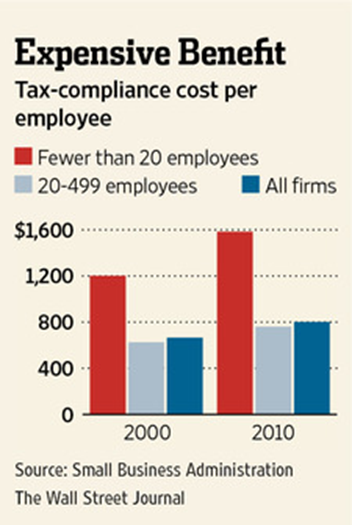
From John D McKinnon’s article in The Wall Street Journal at the above link comes this figure, showing the cost of meeting the requirements for getting Federal tax breaks generally, broken out by company size.

John Raine, CEO of Raine Inc., an Indiana manufacturer of belts and holsters for the military and other customers has an all too typical position about these “breaks.”

I usually avoid these targeted tax incentives, because it costs so much just to be compliant that it’s not worth messing with.  I can’t run a business based on what area the federal government is trying to juice.

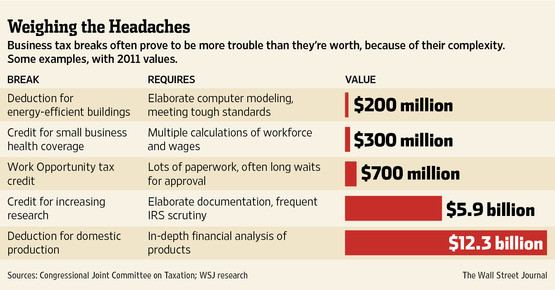
The Federal Work Opportunity credit is another example, and it, too, has a typical response.  The Work Opportunity credit was designed to reward companies for hiring people from any of a number of disadvantaged categories of workers—welfare and food stamp recipients, youths seeking summer jobs, ex-felons, and the like.  The credit is worth up to $2,400 per employee, and for businesses hiring unemployed veterans, it can be worth as much as $9,600 per.

The credit is too much trouble to collect, though.  It requires extensive paperwork for each claimed worker, and incredibly, the paperwork can take a year or more to process.  Assistant Professor of Economics at the University of Florida, Sarah Hamersma, has estimated that the credit is taken for only 20%-35% of all eligible workers.

McKinnon reports

JJ Pledger, Chief Financial Officer for the Twisted Root gourmet burger chain in the Dallas-Fort Worth area, said he spent the better part of a day last year trying to figure out how his company could obtain the credit.  Mr Pledger, a CPA, knew the credit likely would be available for a number of his company’s 200 or so annual hires.  But the more he read, “it seemed like the documentation of the tax credit could be really hard to administer,” he recalled.  One concern was all the personal information needed from job applicants. “So I put it on the back burner….

There are other examples in McKinnon’s article.

Compliance costs for US businesses and individuals have reached 1% of GDP, roughly $150 billion last year.  Out of 1.78 million US corporate tax returns, only about 20,000—just above 1%—claimed any of three dozen main business tax credits, the IRS estimates.  This figure illustrates another aspect of the costs of these “breaks.”

It’s just too hard a thing to do to collect these, never mind the value.

I’ll say it again: flat tax.  No deduction, no subsidy, no credit, no nothing.  Say what your top line income was.  Pay 10% of that.  Be done with it, and all on Governor Rick Perry’s postcard.

Defense Cuts on the Stump

President Obama, speaking before the VFW the other day, had some interesting words to say about defense, and cuts to our defense capability that are looming.  Naturally, I have a few words to say about what he said.

People in Congress ought to be able to come together and agree on a plan, a balanced approach that reduces the deficit and keeps our military strong[.]

Indeed.  When are the President and his fellow Progressives in the Senate going to get out of the way of a bipartisan solution and allow one, instead of throwing our nation’s security away on his demand to raise taxes on his disfavored group of Americans?  After all, it’s Obama’s demand that taxes be raised, rather than spending be cut elsewhere—like in our bloated entitlement programs—that’s standing in the way of salvaging our defense establishment.

And there are a number of Republicans in Congress who don’t want you to know that most of them voted for these cuts. Now they’re trying to wriggle out of what they agreed to.

Nah—they’ve made no bones about this.  Obama held a gun to their heads and forced the idiocy of sequestration during the debt ceiling “negotiations” when he threatened to destroy our economy if he couldn’t get his tax increases, even to the point of cynically blowing up an agreement that had been reached—including revenue increases, if not tax rate bumps—with his last-minute (literally) demand for an additional $1 trillion increase in taxes.

Instead of making tough choices to reduce the deficit, they’d rather protect tax cuts for some of the wealthiest Americans, even if it risks big cuts in our military.

Again, indeed.  Instead of making tough choices to reduce the deficit, Obama is ready to impose destructive cuts on our military in order to get his taxes on his disfavored Americans, and I’ve got to tell you, Mr Obama, I disagree.

As we look ahead to the challenges that we face as a nation and the leadership that’s required, you don’t just have my words, you have my deeds.

President Obama’s deeds are especially frightening.  His “deeds” include the idle chit-chat that’s allowing Iran to get nuclear weapons.  His “deeds” include the idle chit-chat that’s allowing the Syrian boss Assad to butcher his own citizens—19,000 of his fellow Syrians—and to move his chemical weapons arsenal and prepare it for use against surviving Syrians dissidents.  His deeds include surrendering to Russian demands and throwing Poland and the Czech Republic into the teeth of the Bear and cancelling a plan to build missile defense installations in those two countries.  His deeds include surrendering American foreign policy to the veto authority of Russia and The People’s Republic of China, especially vis-à-vis Iran and northern Korea.

His deeds include his claimed end to a war in Iraq that was already won and done, with only a SOFA to facilitate American troop presence for training to be negotiated.  Without any American presence—Obama’s crowning achievement here—Iraq is falling apart under terrorist attacks and secular and religious strife, and al Qaeda is resurgent.

His deeds include winding down the war in Afghanistan with an announced withdrawal schedule and nothing left behind.  He’s snatching defeat from the jaws of victory, as the Taliban are still in the field and effective, while the Afghan army is neither.

House Armed Services Committee Chairman, Buck McKeon (R, CA) has the right of it:

President Obama played no small part in setting the time bomb that is sequestration.  Indeed, automatic defense cuts were included in the Budget Control Act at his insistence.  Now he owes our troops his best efforts to defuse the cuts.  Ultimatums from the campaign trail are not enough.

The challenges we face as a nation are legion, the future is near, and the leadership Obama has demonstrated and the deeds he’s done, make change imperative.

Social Engineering Taxes

The efficacy of these taxes are amply demonstrated by their extremely regressive nature.  For instance, the payroll taxes for Social Security and Medicare/Medicaid hit the lowest income folks the hardest.  They’re taxed at the same nominal rate as everyone else (except the well-off in the case of Social Security: there’s an upper limit on the income taxable for this purpose).

However.

Someone making the Federal Poverty Guideline income ($22,350 for a man in a four-person family in 2011) was taxed at 4.2% of that income (6.2% when the cut expires next January, but we’ll stick to the lower rate here)—$938.70.  A man making $100,000 paid a tax of $4,200, including that same $938.70 on his first $22,350 of income.  Who do you suppose was hit harder by that $939 tax?

The poor man already is living at the edge of his income; the dollar taxed to him—the very same dollar that is taxed to our better off man—is far more important to the poor man.

So it is with income taxes, whether those taxes are for Article 8 purposes, or some of them are for other government-determined—social engineering—purposes.

Legitimate taxes must be evaluated for their impact on what Wretchard of Belmont Club has described as the design margin: how much safety is left for handling the unforeseen when a tax dollar is taken away from a man?

The correction, of course, is not to raise taxes on everyone else—the well-off already are paying far more than their share, while the half [sic] at the “bottom” of the distribution are paying next to nothing.  Moreover, this would do nothing to reduce the importance of those tax dollars that are in the poor man’s margin of safety between what he has and what he needs for an emergency.  No, the answer is to lower tax rates—to increase the width of the design margin—and to move to a flat tax with no deductions.  Taxation for government-mandated social engineering purposes just hammers at that design margin, shrinking it, no matter the good intentions behind the assessment.

A tax dollar always will be more important to the poor man than to the better off man; no amount of attempted progressivity in a tax code will reduce this.  A flat tax will reduce the difference in relative importance, though.