Felons and Voting

In general, felons have no voting rights—it’s part of their punishment for having committed their crimes.  There also are growing movements to restore voting rights to felons—they are, after all, US citizens.  (I’m eliding here felons who aren’t citizens; they have no voting rights to restore.)

It’s a debate worth having, but a couple of misunderstandings need to be cleared up first.  These misunderstandings are illustrated in a recent Wall Street Journal article.

As the midterm elections draw closer, Dameon Stackhouse is eager to cast a ballot, but he can’t under New Jersey law because he remains on parole after more than a decade behind bars for second-degree robbery.

If he’s on parole, he’s still serving his punishment for his crime; he’s only entered a new stage of that punishment.  With his punishment still in progress, he shouldn’t get his right to vote back.  On successful completion of his parole—successful completion of the punishment society has said is required for his crime—then it’s worth seriously considering reenfranchising him and others in similar situations.

And this, from Stackhouse:

We have no say [without a right to vote].  This is one of the worst things you can do to a citizen.

No, Stackhouse did this to himself with his decision to commit his crime; no one else did this to him as a citizen.  His apparent inability to accept responsibility for the outcomes he created with his misbehavior in addition to the misbehavior itself does not suggest that his rehabilitation is being entirely successful.

I am spring-loaded to restore the franchise to those who’ve successfully completed their punishment—for the vast majority of crimes, there should be an endpoint to the punishment short of death, whether by execution or old age.  But the punishment must be completed before reenfranchisement.

Free Speech of the Left

Recall Kanye West’s remarks supporting President Donald Trump, even though he disagrees with Trump on a number of questions, and West’s further remarks saying that 400 years of slavery was a choice—and his follow-on statement that the latter remark was “just an idea.”  Just an idea that Americans who happen to be black don’t all have to think alike—they’re as free to think and speak their own minds rather than engaging in Left-approved group think as any other American.

In a clear demonstration of West’s point, we get this from a pair of denizens of the Left:

A Detroit radio station said it will ban Kanye West’s music over controversial comments the rapper made earlier this week that slavery “was a choice.”

Hosts Shay Shay and BiGG of 105.1 the Morning Bounce made the announcement Thursday on Facebook with the hashtag “Mute Kanye.”

These two went further:

We don’t want to hear Kanye’s music, we don’t want to play Kanye on our show, we don’t want to talk about Kanye anymore.  So we are taking a stand and we aren’t playing his music anymore; we just are refusing to give him a platform.

Not only that.  Because they don’t want to hear it, these two are dictating what their listeners will be permitted to hear, and they’re dictating to their listeners how they’ll be allowed to evaluate what they are permitted to hear—because Shay and BiGG think their listeners are too grindingly stupid to think for themselves, or their listeners must be required to think only Left-approved thoughts and evaluate with Left-approved paradigms.

They have to be kept locked away in the mental prison that West talked about.

And Leftists, of which Shay and BiGG are only too typical, are the keyholders.  Because there’s only way right way to think and to speak, and these personages Know Better.  George Orwell would be proud: censorship is free speech.  Or Vladimir Putin: there is no free speech, only permitted speech.

Encryption/Decryption Race

The political one I mean, not the technological one.  Recall, for instance the San Bernardino terrorist attack, the FBI’s capture of one of the terrorists’ encrypted iPhones, Apple’s refusal to decrypt it (they couldn’t, by their design of the iPhone’s OS), then-FBI Director James Comey’s (yes, that Comey) cynically tear-jerking demand for future such personal device encryption back doors to decrypt at Government convenience, and Apple’s refusal to support development of that.

An expert on the subject—a technological expert I mean, not a political one—thinks he’s solved the problem.  His solution is described in a Wired article.  This expert thinks he has a way of providing Government “exceptional access” to a private person’s (or private enterprise’s) encrypted cell phone (for instance).  His solution, Clear, works this way:

The vendor—say it’s Apple in this case, but it could be Google or any other tech company—starts by generating a pair of complementary keys. One, called the vendor’s “public key,” is stored in every iPhone and iPad. The other vendor key is its “private key.” That one is stored with Apple, protected with the same maniacal care that Apple uses to protect the secret keys that certify its operating system updates. These safety measures typically involve a tamper­proof machine (known as an HSM or hardware security module) that lives in a vault in a specially protected building under biometric lock and smartcard key.

That public and private key pair can be used to encrypt and decrypt a secret PIN that each user’s device automatically generates upon activation. Think of it as an extra password to unlock the device. This secret PIN is stored on the device, and it’s protected by encrypting it with the vendor’s public key. Once this is done, no one can decode it and use the PIN to unlock the phone except the vendor, using that highly protected private key.

So, say the FBI needs the contents of an iPhone. First the Feds have to actually get the device and the proper court authorization to access the information it contains—Ozzie’s system does not allow the authorities to remotely snatch information. With the phone in its possession, they could then access, through the lock screen, the encrypted PIN and send it to Apple. Armed with that information, Apple would send highly trusted employees into the vault where they could use the private key to unlock the PIN. Apple could then send that no-longer-secret PIN back to the government, who can use it to unlock the device.

Included in the procedure is the requirement to send a judge’s search warrant to Apple along with the encrypted PIN, and Apple would first verify the warrant before sending anyone to the vault.

Hmm….

In a landmark 2015 paper called Keys Under Doormats, a group of 15 cryptographers and computer security experts argued that, while law enforcement has reasons to argue for access to encrypted data, “a careful scientific analysis of the likely impact of such demands must distinguish what might be desirable from what is technically possible.” Their analysis claimed that there was no foreseeable way to do this. If the government tried to implement exceptional access, they wrote, it would “open doors through which criminals and malicious nation-states can attack the very individuals law enforcement seeks to defend.”

Exceptional access is not desirable.  All Clear would do is add to the hackers’/criminals’/malicious nation-states’—and malicious network entities’—target lists the men and women running the companies “storing” the back doors, now working in cahoots with Government men through the screen of a Government-issue search warrant.

It’s true enough that

Using that same system to provide exceptional access…introduces no new security weaknesses that vendors don’t already deal with.

The “same system” is the various ways software developers and vendors encrypt keys that then are used, for instance, to verify the veracity of this or that application a user just downloaded or an OS update being offered—or pushed—to a user.  It’s also true that things like Clear add no new security weaknesses (assuming, arguendo, that the software of the Clears of this potential brave new world is well implemented).  But spreading those existing weaknesses around, putting them explicitly in the hands of Government and out of the hands of individuals using the devices solves nothing.  It’s still men and women who are the weak link in this politically-driven solution, however elegant and simple to execute the technological proposal.

No, it’s not so much a matter that exceptional access is a “crime against science,” Wired‘s phrasing in its misunderstanding of the proposal.  It’s that exceptional access is a crime against individual liberty.  Even against group liberty.

In another cynical representation, current FBI Director Christopher Wray, noting that his FBI “was locked out of 7,775 devices in 2017,” said

I reject this notion that there could be such a place that no matter what kind of lawful authority you have, it’s utterly beyond reach to protect innocent citizens.

Stipulate that Wray is pure as the driven snow with motives beyond reproach.  He’s a man.  So will be his successors.  So are all of the men and women of government and of industry.  So will be their successors.

Thus, a question for those of you to the left of center and beyond, politically: would you really want a Donald Trump’s FBI via his selection of judges to have exceptional access to your secrets?

And a question for those of you to the right of center and beyond, politically: would you really want a Hillary Clinton’s FBI via her selection of judges to have exceptional access to your secrets?  A Bernie Sanders’?

Who among you are willing to trust a James Comey FBI with any of this?  A J Edgar Hoover FBI?

Or the titans of industry, the evil 1%?  Even Tim Cook, who resisted FBI demands in the San Bernardino case, is accommodating to the demands of the People’s Republic of China government.

What the sort of solution that is Clear does is force us to trust the good offices of the men and women running a manufacturer in addition to the good offices of the men and women of government.

That’s the stuff of a socialist’s wet dream.

Battle Against Hate Speech?

Bob Pearson, co-author of Countering Hate and CIO of W2O Group says that AI is able to identify hate speech today.

All human beings follow patterns online.  You can see what language, content, channel, and people matter to them. You can see which words trigger information seeking, which language is most associated with hate topics or sites, which people are the most important influencers and you can see a range of behavioral characteristics.

Except that humans can’t define “hate speech;” we can’t even define “hate.”  All that can be done is for each of us, individually, to identify what it seems like that to us—not what it is to anyone else.  A Justice’s remark about pornography—that he couldn’t define it, but he knew it when he saw it—is worse than wholly inadequate when Government tries to regulate speech, or when private enterprises try to regulate speech in the public spaces they create as their business models or offshoots of them.  Such regulation is a threat to individual liberty.

Artificial Intelligence certainly is not up to this task of discriminating unacceptable speech from acceptable.  The definitions of those terms will be programed by a select group of humans—who can’t define the terms except as they personally apply the terms to themselves.  This frangibility is demonstrated by those cases that go to jury trials and the differing outcomes differing juries reach on substantially similar cases.  All AIs can do is reflect the prejudices of their programmers.

How, indeed, is “hate speech” to be discriminated from the merely rude or offensive or uncivil speech?  To narrow the thing a bit, think about civility—simple courtesy.  Why should a New Yorker’s version of civility be forced to take a back seat to a Midwesterner’s or a Californian’s version of civility?  Why should one of the other two be forced to take a back seat to a New Yorker’s version?  On what basis would any definer pick one or identify a middle ground that doesn’t wind up being a more insidious censorship?

Consider Marshall McLuhan’s the medium is the message.  Sometimes the overt rudeness—even “hate”—is a demonstration of a point.  Is burning our national flag an act of hatred or political speech?  Is posting a picture of Mohammed…?  Prove it: it’s a hard line to draw between that and rudeness on the one hand or actual hate on the other.

Not even civility is “simple.”  How is something as complex as hate speech to be handled?

Yet the whole argument over identifying, and then censoring, hate speech is irrelevant other than the threat to freedom that is that effort to identify and censor.

The problem he [Pearson] says, is that Facebook and other companies have not taken up the charge to make the battle against hate speech a major priority.

No, Pearson is utterly wrong on this.  Facebook, et al., must not take up the battle, any more than can Government be allowed to.  Any effort along these lines can only be the despicable bigotry and the equally shameful cowardice of censorship.  Bigotry because all such efforts amount to is one man, or a small group of them, imposing his prejudice of acceptability on the speech of all others.

Hackneyed as it’s become, Justice Louis Brandeis still is right: the answer to bad speech—however defined—is more, and better, speech—however defined.

Engage in the discourse, don’t cower away from it.

AI Surveillance

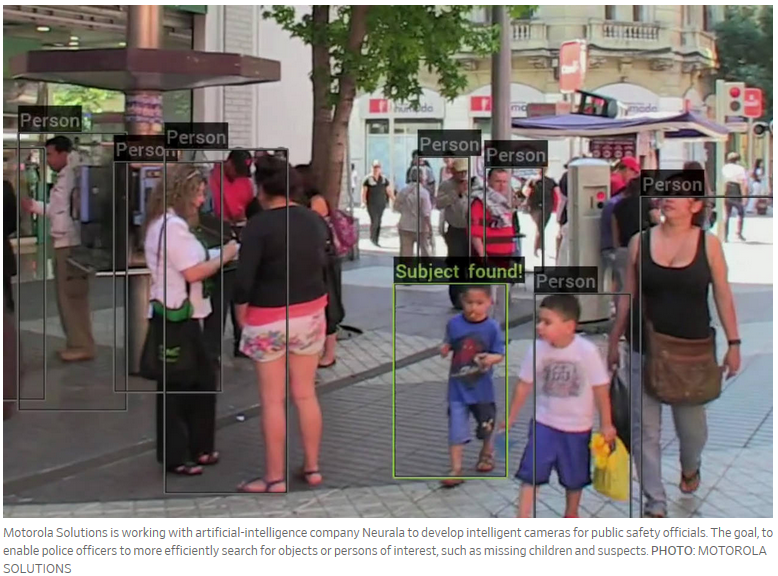
Police forces around the nation are on the verge of getting Artificial Intelligence assistance in identifying folks of interest to them in real time on our cities’ streets.  The image below and its caption illustrate the thing.

I’m all for assisting the police, especially regarding the subject of that cynically tear-jerking caption.  But this sort of thing needs to be looked at with a very jaundiced eye.  It isn’t too far away from what the People’s Republic of China already is doing in terms of routine surveillance and tracking of everyone.

It’s not that everything the PRC does is bad, but some things are inherently dangerous, no matter who developed them or uses them extensively.  This sort of technology can very easily become a direct assault on our ability to be anonymous in public spaces.

TaeWoo Kim, chief scientist at One Smart Labs, a New York-based startup that is working on such software, said the technology is “creepy and a bit Big Brother-y,” but said it is “purely intended to fight crime, terrorism and track wanted subjects.”

The road to Hell is paved with good intentions. Governments can’t be trusted with such capabilities, and we don’t even need to invoke nefarious intent or “Big Brother-y” conspiracies to see that. Governments will end up misusing, even abusing, this sort of thing just in the ordinary outcome of normal bureaucratic imperatives to justify the bureaucrat’s and his bureaucracy’s existence, to grow, to expand the bureaucracy’s power and budget.

William Bratton, the former commissioner of the NYPD, says that the public was similarly worried about DNA testing when the technology first emerged. The technology has been credited in freeing wrongfully convicted people from prison.

This is a false analogy, though.  DNA testing isn’t used for routine, real-time surveillance of the population or even of small groups or of individuals, and current technology doesn’t allow such use.  AI-based image surveillance technology lends itself to exactly that real-time watching.