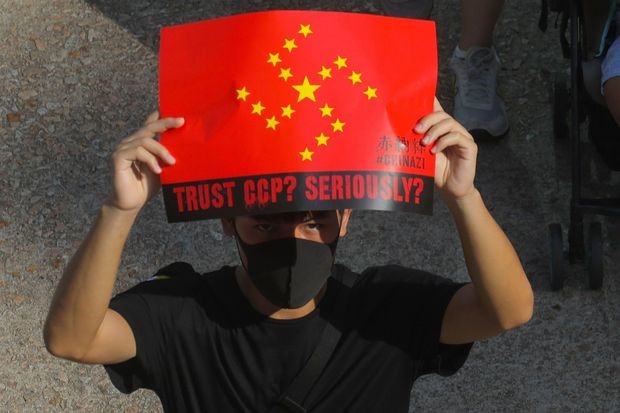
Countrymen

Claudia Rosett, of the Independent Women’s Forum, had an excellent op-ed in Monday’s Wall Street Journal.  In essence, Rosett compared the PRC of 1989’s Tiananmen Square (she was there) with Hong Kong’s situation today (she was in Hong Kong over the summer), and her essential conclusion is

that for all China’s economic advances, it remains a brutal, dehumanizing tyranny in which the ruling Communist Party would rather destroy people than give them a genuine say in their government.

After all, we’re getting the same thing, so far, in Hong Kong:

Rather than give in to their legitimate demands, the Communist Party is readying its guns.

I agree with Rosett on 99+% of what she wrote.

I do have one point of disagreement, though.

soldiers of the People’s Liberation Army open fire on their countrymen [in Tiananmen Square].

No. The soldiers of the PLA do, certainly, share citizenship with the people of the PRC and of Hong Kong. However, PLA soldiers are not countrymen; the PLA is nothing but a mercenary army in the pay of the despots running the PRC government and the CPC.

Tactically Sound?

Perhaps, but perhaps strategically disastrous.  British Prime Minister Boris Johnson asked the queen to prorogue the current parliament, and the queen agreed, in order to block it from blocking him from taking Great Britain out of the European Union on schedule 31 October without a deal in the likely event that the EU continues its intransigence in negotiating.  Prorogation is the formal end of an existing session of Parliament, and normally it’s done just prior to the beginning of the next session, to clear the decks for that session.

The current prorogation would run until 14 October, at which point the Queen’s Speech, which would reconvene Parliament, would lay out her (the PM’s) agenda for the new session. Existing bills, including those currently planned to interfere with Brexit, cease to exist with the prorogation; although, they could be reintroduced—to take their turn in the queue in those two remaining weeks.

There are a couple of reasons why Johnson’s move might be tactically sound.  Parliamentary sessions normally last for one year; however, the current Parliament has sat [sic] since June 2017, more than two years.  It’s time for this feckless band to get out of the way, go home, and contemplate their navels.

That brings up the second reason: prorogation would prevent this Parliament from blocking Johnson’s effort to bring the nation out of the EU with no further delay and associated economic uncertainty—and that uncertainty’s follow-on deleterious effects on the British weal.

The longer question that arises is whether prorogation is a strategically sound move.  It’s very likely that prorogation will result in an on-time departure from the EU, with or without a deal governing the terms of the exit.  However, it’s entirely possible that the associated hue and cry will lead to new elections (possibly triggered by a successful no-confidence vote in November) and a new, non-Tory government installed.

That government is very likely to go, hat twisting in hand, to Brussels and beg for reentry into the EU.  What then?

What would be the result on British sovereignty; British economic and political welfare; indeed, British self-respect in such an eventuality?

Even if that new government doesn’t go begging (or even if it does), what else could happen? The alternative to a Johnson-led Tory, sort-of conservative, government is a Corbyn-led Labour government.  That means the prosperity of a limited (relatively, within the constraints of present British concepts) government that Margaret Thatcher made so much progress toward and that Johnson would seek to preserve and extend would be entirely undone by the destructively socialist government that Corbyn would install.

What then of British economic and political welfare; of British self-respect?

Still, Johnson’s move is worth the risk, for the sake of British sovereignty.

There’s BDS

…and there’s BDS.  As Antonia Tamplin wondered in her Letter to the Editor of The Wall Street Journal,

Regarding Jillian Kay Melchior’s “Dissent Against Beijing Is Becoming a Firing Offense” (op-ed, 19 Aug): Where is the international BDS (Boycott, Divestment and Sanctions) movement against China?

What she said.

Red Flag Laws, Again

Now The Wall Street Journal is beating the drum for red flag laws that would authorize seizure of weapons from anyone, and anyone associated with that one, that Government, or a Government-appointed/approved body deems a threat.

Consider one of the three cute anecdotes the WSJ cited via its drumbeat.

Police were tipped off by school officials that a 14-year-old boy had praised mass shootings. He used campus computers to search firearms and terms like “white power.” Taken to a psychiatrist, the student said he was joking.
The boy’s father owned a rifle and a pistol. A short-term red-flag order was obtained, and the two firearms were relinquished. After a hearing a one-year order was issued. [In all three anecdotes cited, the outcome was a “one-year order.”]

The WSJ right wondered whether

the father whose guns were handed over suggest[ed] that he was unable or unwilling to secure them from his 14-year-old son?

Then the Editors dismissed this trivial concern.  I ask, though, what happened to the father’s Second Amendment rights? I answer with dismay: they seem to have been trampled without a fare-thee-well. His firearms were taken for no better reason than that someone associated with him was deemed maybe a threat sometime in the future. The boy’s claim that he was joking seems to have been dismissed just as out of hand.

There are larger problems, though, than just a few carefully selected anecdotes.  What about false positives? Where will the wrongly accused—whether mistakenly or maliciously—go to get his reputation back?

What about false negatives? Now the true threat is both warned and angrified—and in the same household, perhaps, as the one who accused him.

With true due process, how can the system act quickly enough to forestall an imminent threat?

The WSJ‘s Editors closed their piece with—perhaps—a glimmer of understanding:

…red-flag laws are no panacea for mass shootings. But…if reasonably drafted, they appear to be a step forward: gun control for the dangerous and unstable.

But then they demonstrate their fatal misunderstanding.  Red flag laws cannot be reasonably drafted, not only for the reasons above but for the WSJ‘s rationalization of that step forward: the laws focus on the tools a dangerous and unstable person might use and not on the dangerous and unstable person.

No system is perfect, certainly, but no system should be put in place that threatens the liberty and fundamental rights of all of us because a tiny per centage of us are bent on mayhem, especially when that system is so badly flawed as the one proposed here.

The energy being pumped into this euphemism for an assault on our 2nd Amendment should be focused instead on finding ways to deal specifically with those tiny few dangerous and unstable persons.

A Hypocrisy in Texas

The Texas State government has passed a law making it illegal for government entities in the state of Texas to enter into a transaction with an abortion provider or an abortion provider’s affiliates.

Austin, the State’s capital, thinks it knows better and is working to get 150 stacks folded into its 2020 city budget to fund abortion services.  Here’s Austin city council member Greg Casar, making plain the hypocrisy:

In Austin, we believe and announce that everyone has a right to healthcare. We believe and announce that abortion is healthcare, and we refuse to back down on protecting our continuance basic rights.

Everyone but babies have a right to healthcare, that is.  The city is working hard to turn its collective back on a baby’s basic right to life.

Keep Austin Weird is the city’s unofficial motto.  With folks like Casar, and his supporters Mayor Pro Tempore Delia Garza and fellow council members Leslie Pool and Paige Ellis in the city’s government, the motto is closer to Keep Austin Bloody.