
Interest Rates and Economic Recovery

The Fed has been actively suppressing interest rates, keeping them near zero, for a long time. This is in addition to the Obama administration’s economic policies, and the two attitudes have combined to produce an economic recovery from the Panic of 2008 that is one in name only. See this graph, adapted from one in a recent Wall Street Journal to see just how bad the current “recovery” is. The numbers other than the two first quarter 2015 are average annualized rates of increase.EconomicRecovery_Cropped-Resized
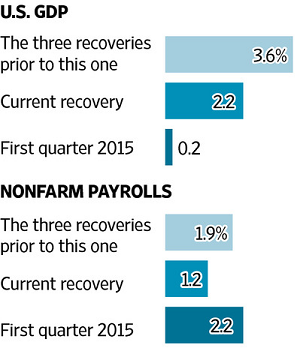
Certainly, the Obama policies need to be corrected, but here’s something the Fed can do all by itself: it could let interest rates float, and see them rise to market rates, probably with a temporary overshoot, given the duration of its suppression and separate money printing, but that’s only going to get worse as the Fed delays correcting its own error.

With interest at their more normal level, banks would be more willing to lend, and without lowering their credit standards; businesses would be more willing to borrow, since even though they’d be paying more for their debt, they’d recognize the positive economic indicator; and folks dependent on fixed income sources for their living—widows and orphans—would have more money to spend, even if only on necessities, which would help make that positive economic indicator more concrete.

Banks, Government, and Risk

Fed governor Jerome Powell, in remarks prepared for a conference of community bankers in New York, said banks under a certain asset level, “perhaps $10 billion,” should be exempt from Dodd-Frank compensation restrictions. The restrictions, which are being developed by the Fed and other agencies, are designed to remove encouragements for bankers to take excessive risk.

Couple things about this. Why $10 billion? Why not $20 billion? Why not $5 billion? Based on what logic is this limit chosen? Based on what logic is any limit chosen? How is “system risk” from bank failure, the putative rationale for Dodd-Frank at all, a lesser risk than government’s intervention into the market place?

The other thing is “excessive risk.” Based on what criteria? What constitutes “excessive?” Under what circumstance is risk excessive here, but not there? What about government’s excessive risk from the bailouts and “stimulus” package of the 2008-2009 period; risks from which our economy still has not recovered?

How is government—politicians and bureaucrats—better qualified to determine what is excessive than the businessmen and shareholders and investors involved? How are those politicians’ and bureaucrats’ solutions to actual business failure and economic dislocation better than the folks involved—including in the aggregate, the collected citizenry? We still haven’t recovered from those government men’s last set of solutions.

Gun Control

Or just control.

One guy, Cody Wilson, worked out a way to make pistols out of plastic and a 3-D printer, posted the information on the Internet, and tried to start a business out of the thing. Nothing secretive here; he wasn’t trying to hide anything.

The technology will break gun control. I stand for freedom[,]

he said.

But

…Wilson’s invention also caught the attention of the State Department, which came after him with both barrels blazing. The feds claimed Wilson violated the International Traffic in Arms Regulations, which “requires advance government authorization to export technical data,” and as a result, could spend up to 20 years in prison and be fined as much as $1 million per violation.

Wilson was ordered to remove the blueprints for The Liberator from his web site. The government also told him they were claiming ownership of his intellectual property.

Never mind that the “international arms trafficking” beef has no basis, unless simply identifying where firearms can be obtained and how to obtain them are somehow trafficking. Never mind that the “technical data” are old technology: 3-D printing is years old, and anyone can write a printing program. Nor is there anything magic about the plastic that is the printer’s ink. Indeed, that’s a major drawback for these 3-D weapons: they wear out quickly.

No, this is just an overreaching government trying to control for control’s sake. Nothing else.

EU, Taxes, and Competition

European Union regulators delayed decisions on whether four multinational companies including Apple Inc and Amazon.com Inc may have benefited from illegal tax sweeteners, citing difficulties in obtaining information to make their case.

The difficulty isn’t just from the companies: the nations involved also are reluctant to give up the data.

There’s this, too:

At a time of austerity in many countries, governments across the continent are seeking to shore up their finances and demonstrate to taxpayers that wealthy multinationals are paying their fair share of tax.

And

Brussels cannot impose tax policy on the bloc’s 28 governments, but regulators are using an EU-wide ban on selective state aid to companies to crack down on individual tax deals that they deem to have given an unfair advantage to certain enterprises.

And

The aim of the investigations, Ms [EU’s European Commissioner for Competition Margrethe] Vestager added, is to set a precedent that would “inspire” national governments to change legislation to ensure their tax systems are in line with EU rules. That has already happened in Ireland, where the government has announced it would phase out the controversial double-Irish tax loophole, she said.

Of course, all of this would go by the boards if the EU and its member nations could understand their governments don’t need the money; they need to reduce their government spending. The money in the nations’ citizens’ hands would be far more efficiently used—and provide the competition Vestager’s office claims to want.

Even accepting the fiction that each nation’s tax code should look like every other nation’s tax code, because all the nations are carbon copies of each other.  After all, suppressing competition among the nations is a core task of Vestager’s office.

The SEC’s Abuse of Authority

Actually, it’s Dodd-Frank’s abuse, and the SEC is only implementing the abuser’s requirement, but still….

At issue here is an SEC proposed rule that purports

to give investors greater clarity about the link between what corporate executives are paid each year compared to total shareholder return—the annual change in stock price plus reinvested dividends, according to people familiar with the measure.

There are a couple of things wrong with this. One, minor on the scale of this…rule’s…transgression is the idea that stock price and dividend handling are the measure of a business’ management. No, these are the outcomes; the actual measures are on the business’ financial sheets. Those P&L, Cash Flow, and Balance Sheets, among a host of other performance reporting documents, are freely available to shareholders—and to prospective shareholders: they’re public documents.

The larger problem, though, is this: the executives’ performance is the business of the shareholders, not the government. This is just a backdoor effort to insinuate government deeper into the management of private businesses.

Dodd-Frank needs to be repealed, and D-F-related SEC (and others’) rules rescinded as soon as this administration can be replaced.