From ZeroHedge, this summary, in nine charts.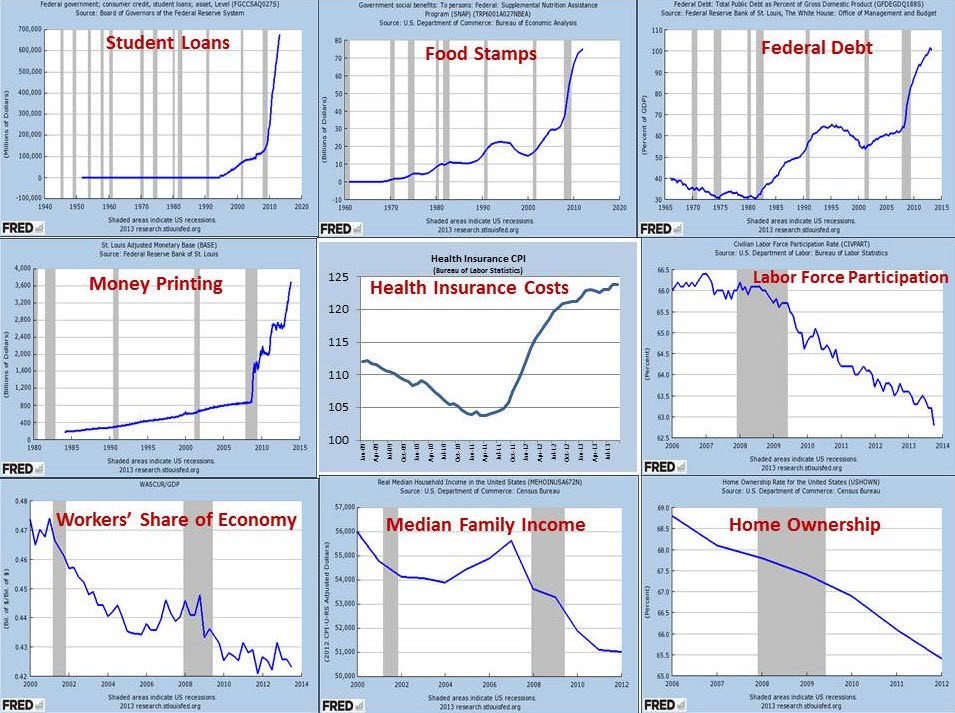 Right click on the image to enlarge it.

From ZeroHedge, this summary, in nine charts.Right click on the image to enlarge it.
The Securities and Exchange Commission’s enforcement director, Andrew Ceresney, told the Senate Judiciary Committee on Wednesday that the warrant requirement required by federal law is “impeding the ability of the SEC and other civil law enforcement agencies to investigate and uncover financial fraud.”
This, carefully, from an unelected mucky-muck of an unelected—and so unbeholden and unresponsive to us mere Americans—agency of the Federal government. The 4th Amendment’s requirement for warrants before government may conduct searches of private holdings is in the way of Big Government snooping, and so a way around that has gotta be found.
President Barack Obama’s Justice Department agrees with the SEC. Elana Tyrangiel, the Office of Legal Policy, Principal Deputy Assistant Attorney General, said this in the same hearing with an absolutely straight face:
Personal privacy is critically important to all Americans—including those of us who serve in the government. The Department remains concerned, however, about the effect a blanket warrant requirement would have on its civil operations…. Lacking warrant authority, civil investigators enforcing civil rights, environmental, antitrust, and a host of other laws would be left unable to obtain stored communications content from providers.
Never mind that if those civil investigators can’t even make a probable cause case in front of a judge known to those investigators to grant warrants easily—and there are potsful of easy judges—they don’t have a case to investigate.
Inquiring government minds want to know. That’s good enough. No government official would ever abuse that….
The proposal is described in Tom Fairless’ piece in The Wall Street Journal. I want to focus on a couple of comments in that article, though.
Campaigners [for the proposed new trade settlement court] claim that the current system constrains governments and leaves policy makers vulnerable to legal proceedings from overseas investors.
Kind of like those impertinent American companies do with the US government.
And
[O]pponents [of the existing trade settlement system] warn that large US companies could use the dispute-resolution mechanism to challenge European laws and regulations on labor, food and the environment.
As a matter of principle, what’s the downside of either of these?
Only Big Government proponents fear government being held to account by its…lessers.
Russia is increasing its military (and thereby political) aid to Syria’s Bashar al Assad by sending him Russian tanks for use against the Syrian rebels.
State Department spokesman John Kirby said Kerry called Lavrov for the third time in the last 10 days. Kerry “made clear that Russia’s continued support for President Assad risks exacerbating and extending the conflict, and undermining our shared goal of fighting extremism if we do not also remain focused on finding a solution to the conflict in Syria via a genuine political transition,” the State Department said in a written statement.”
Sharp talk. Yeah, that’ll show those Russkis.
Supreme Court Justice Stephen Breyer made some in his op-ed in The Wall Street Journal.
In describing the outcome of a case involving a civil suit between a Paraguayan citizen legally present in the US and a fellow Paraguayan citizen illegally present in the US, a case that saw the application of the US’ Alien Tort Statute of 1789, Breyer made this claim and asked these questions:
Since [that case], our courts have had to interpret that ancient statute with growing frequency. Eventually, the Supreme Court had to face an important question: whom does the statute protect today? …how can we reconcile our interpretations of the statute with the need of other countries to rely upon their own methods for compensating human-rights victims…?
The first is simply wrong. Justices—all of our Federal judges—are sworn to uphold the US Constitution and Federal law that is consistent with the Constitution. That means they are sworn to apply the Constitution and the law as they are written, not to interpret either and apply what they think it ought to mean. Full stop.
The answer to the first question should be clear, also: the 14th Amendment and Supreme Court rulings since, for good or ill (see the popular debate over birthright citizenship) means that American law—the Alien Tort Statute, for instance—applies to everyone under American legal jurisdiction: all persons present in the United States. There are no caveats in the statute or in the 14th Amendment or in all of those Supreme Court rulings that say, “Except for….”
How do Justices reconcile the needs of other countries? They must not. They cannot under their oaths of office. They’re sworn to uphold the US Constitution and Federal law. Full stop. Foreign law, foreign imperatives, have no bearing or place in a US court ruling. None. Cases brought before US courts are under US law. Alone.
Breyer then described a foreign college student’s (legally present at a US college) request of his parents in his home country to send him textbooks identical to those available at his college but more cheaply bought at home. Breyer wondered whether US copyright law allowed such a thing.
The answer is straightforward for a Justice honoring his oath of office and applying the law before him as it’s written, without his personal interpretation of what it ought to mean. Were the foreign-bought books properly licensed under our copyright law or not? Or was our copyright law silent on the particular matter, the specific parameters not addressed in the law? If properly licensed, or if the law was silent, then yes, the books were legally procured and delivered. The student was present in the US, and so he was subject to US law. The parents’ purchase is wholly irrelevant. Full stop.
And this:
The court has had to interpret domestic-relations treaties that specify whether to send a child back to a father in a foreign country when the child was brought here by the mother. We have interpreted foreign-investment treaties setting ground rules for arbitration. We have interpreted treaties granting to foreign courts, such as the International Court of Justice, the authority to make decisions limiting the scope of state or federal criminal law. We have faced questions involving Congress’s power to delegate to international bodies….
Wrong, wrong, wrong, and wrong. Justices, Federal judges in general don’t get to interpret US law—they get only to apply it as it is written. With particular reference to “granting to foreign courts…,” the Liberal Justices, especially, must remind themselves that the treaties our government might enter into are subordinate to our Constitution. Delegations of powers to foreign entities must be within the bounds of our Constitution—that is to say, domestic law takes precedence. Full stop.
The American public needs to understand what the “international” part of the Supreme Court’s work actually means….
The Liberal Justice needs, more so, to understand what the “international” part of the Supreme Court’s work actually means. There is no international part of the Supreme Court’s work—the Constitution and the laws made under it are purely domestic. The values that the Founders set forth—democracy, human rights and widespread commerce—were set forth to protect Americans, not foreign nationals in their home countries. The spreading of those values around the world was intended by our Founders to be a political matter—a matter for the people of the United States—not a legal matter.
Full stop.