Teachers Union Audacity

The Chicago Teachers Union wants a new contract. Among other things, CTU President Stacy Davis Gates wants salary increases of 9% per year over the next five years, through 2028. That would bring these teachers’ salaries to $144,620 per year.

Ordinary residents’ current income is $65,250 at the 50th percentile and $143,550 at the 90th percentile.

These top 10%-er wannabes aren’t producing commensurate with their current incomes, though.

…only 21% of the city’s eighth graders being proficient readers, according to the last Nation’s Report Card….

Gates again [elision in the original]:

It will cost $50 billion and three cents…. Yes it will, and so what, that’s audacity.

No, that’s teachers union greed. But since it’s negotiating with itself—formally they’ll be negotiating with Chicago’s government—it’ll get all of what it’s demanding.

Give Us Money

Trust us to figure out something useful to do with it. In a MarketWatch article centered on auditing the rich, this bit, early in the article, jumped out at me.

The Internal Revenue Service is getting specific about how many more audits it wants to spring on rich taxpayers and businesses, as the tax collector absorbs billions of dollars in funding in order to toughen tax compliance at the top.

This is backwards, for all that it’s too typical of the way Congress works. What should have happened, and what We the People can make happen if we finally get our own backs up and elect people who’ll represent us and not lobbyists, is that Congress should have responded to the IRS’ budget item request—here, expanded audit rates—with a requirement to show Congress IRS’ plan for carrying out those audits. That plan should have been required to lay out all the gory details and not filled with glittering generalities and vague goals.

There should have been no funds appropriated, much less allocated, until that detailed plan was provided and was satisfactory to Congress. Of course, the flip side of that, is Congress should appropriate and allocate the relevant funds, if the plan was sufficient: Congress should not micromanage the thing.

But Congress didn’t, and it won’t any time soon.

Joe Biden’s Tariffs

Progressive-Democrat President Joe Biden has raised the tariff on steel imports from The People’s Republic of China, a tariff former President Donald Trump initiated (although Trump badly diluted the effect and importance of the tariff by applying it against our allies, also). The Wall Street Journal‘s editors are in a bodice-ripping panic attack over Biden’s move.

Didn’t President Biden promise a better trade policy than his predecessor? Well, he now appears to be in a race with Donald Trump to be Protectionist in Chief. Witness his pitch for new tariffs at a campaign stop on Wednesday in Pittsburgh.

The editors’ angst also is broadly irrational (which is the nature of angst, but it’s irrational in another way, too).

Steel making is energy-intensive, and Mr Biden’s green energy agenda threatens to make US companies less competitive.

That’s also true, but it’s wholly irrelevant to the question of tariffs, which is the subject of the editors’ hysteria. The editors also seem unable to discriminate between two primary types of tariffs.

There are tariffs for protectionism, and these are dismal failures.

There are tariffs for foreign policy, and these can be dismal failures or outstanding successes, depending on the underlying policy and the moral and political courage of politicians to set serious tariffs and then strictly enforce them.

Tariffs against People’s Republic of China steel imports could, and should, fall into the latter category; the broad underlying foreign policy is one of making it supremely expensive to do any sort of business with the enemy nation.

For my money, Biden’s PRC steel tariff is just virtue-signaling as he continues to kowtow to the PRC otherwise all across the board. He needs to deepen his steel tariff and extend it across a broad and deep range of PRC exports. In parallel, he needs—and Congress needs to support him—to make it supremely expensive for American businesses to export technology-related goods and services, and to transfer intellectual property and knowledge, to the PRC.

An example of Biden’s kowtowing is his expected move to cancel

The Ambler Access Road project…that would connect a mining district in west-central Alaska to the Dalton Highway that runs through the middle of the state. The operations in the mining district could provide a steady domestic supply of copper, zinc, lead, gold, silver, and cobalt, which are strategic elements needed for manufacturing wind turbines, solar panels, transmission lines, and electric vehicle batteries.

Such a move would continue our dependence on the PRC for our own “green” energy and transportation economy.

Foreign policy tariffs will, indeed, carry domestic costs, including protectionist tariffs’ higher prices for domestically produced goods and services.

But in what fantasy world does anyone think any war—and we are in one with the PRC, no matter the lack, so far, of a kinetic aspect—is entirely bloodless for either side? And, as with any war, what are the costs—fiscal or independence of action—of our losing the present war?

Biden’s Inflation

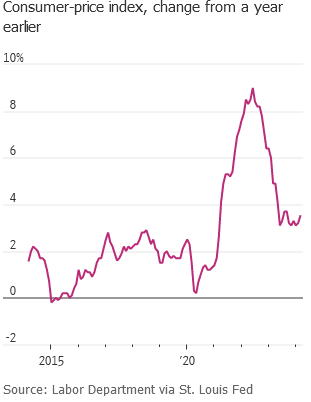
This is what Progressive-Democrat President Joe Biden’s proudly touted Bidenomics has inflicted on us: continued high inflation.

Tacitly, Biden knows his policies are a failure, but he won’t admit it.

For now, officials said, Biden and his senior aides aren’t planning any major policy or rhetorical shifts.

Yet,

Behind the scenes, administration officials said there was no magic bullet to slow rising prices immediately, an issue that has dogged the president for years.

Rising prices—inflation—has been Biden’s problem since he took office; that’s the time frame of that drily put “for years.” From the Biden-caused sharp increase that damaged so many millions of pocketbooks of us ordinary Americans through that partial fall in inflation, of which Biden is so, and so misleadingly, proud, to the last few months of steadier 3+% inflation, we’re still facing price levels increasing at much higher rates than before Biden began his reign.

Some of Biden’s cost-cutting plans will take months to come to fruition and will do little in the short term to slow the rate of price increases.

[T]ake months to come to fruition: yeah—they’ve taken three years and counting.

Some stubbornly high prices, such as the cost of groceries, are mostly out of the Biden administration’s control.

Here, the news personalities who wrote the article at the link are badly mistaken. ­All of those high prices are fully under the administration’s control. Begin with Biden’s war of destruction on our energy industry. Energy underlies every aspect of our economy: fuel for our personal vehicles, energy to heat our homes in winter and cool them in summer, fuel for generating the electricity that’s needed in every aspect of our personal and business lives, shipping costs for all of our goods and services—including shipment of our groceries—and on and on. By seeking to destroy our coal-, oil-, and natural gas-based energy production, and continuing to passively block development and construction of nuclear power plants, Biden is raising the prices of energy, and that alone raises the price of every single item in our economy. Including those groceries.

Most economists don’t believe Biden can do much at this point to bring down inflation, absent major tax increases or spending cuts that could curtail consumer spending. Even those policies, which aren’t being seriously considered in Washington, would take time to work their way through the economy.

Most economists are right as far as they go. And they’re wrong. Tax increases or government spending cuts would take time to have effect. However, tax increases would reduce economic activity in general by taking even more money out of our private economy than our usurious current tax code does. That reduced economic activity will only lead to continued, if not increased, government spending in the form of welfare handouts, and those lead to greater deficits and debt, and to increased dependence on government.

Government spending cuts won’t, though, lead to less consumer spending. On the contrary, with less government competition for the same goods and services our private economy needs, inflation—and real price levels—would come down, making it easier for us consumers to consume, not harder.

But most economists don’t go far enough. There is much the Biden administration—Biden himself as President—can do that would have more immediate favorable effects on price levels. He can remove his Executive Orders that are interfering with the free flow of goods and services and that inhibit coal, oil, and natural gas production. He can instruct his Departments and Agencies to withdraw their rules that interfere with that free flow and that inhibit energy production.

But he won’t.

Housing and Inflation

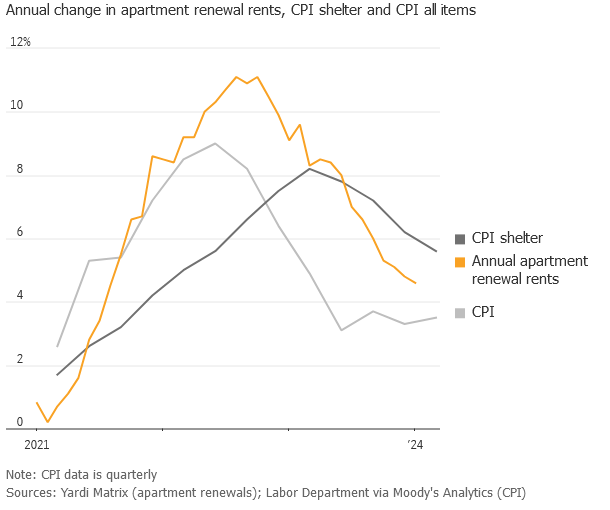
There is some concern that inflation won’t abate further until housing inflation, especially rent inflation, abates further. This graph, though, suggests that there’s more to overall inflation’s stubbornness than just rent, or housing in general, inflation.

The CPI being largely flat the last few months, despite rapidly falling housing inflation, suggests a lack of importance of housing to overall inflation relative to other factors at current levels of both. Food inflation, reflecting what we actually buy rather than the government’s idealized and mythical sack of groceries, and fuel inflation, and energy inflation seem more significant factors.