
Two Men (Or Three) Who Know What They’re About

Ihor Kolomoisky, a 51-year-old outspoken banking tycoon, and recently appointed by [Ukraine President Petro Poroshenko, himself a so-called oligarch] as governor of Dnipropetrovsk region in eastern Ukraine, has decided to dip into his fortune to bolster that army and defend the homeland.

So far, that has included buying tires, car batteries and fuel for army units, as well outfitting local militias. He also announced a program to buy up contraband weapons and offer a $10,000 bounty for any pro-Russia militant captured with a gun.

Mr Kolomoisky declined to say how much he is spending personally to build up what his aides call the “Kolomoisky army,” but experts estimate it is about $10 million a month just to fund the salaries of militia and police units, some of whom technically report to Ukraine’s army and interior ministry. His province now has close to 2,000 battle-ready troops in the field, his aides say. By comparison, Ukraine’s army had only 6,000 through the entire country when Russia took control of the Crimean peninsula earlier this year.

One of Kolomoisky’s assistants is Gennady Korban, a self-described “conflict manager in hostile corporate takeovers” and whom Kolomoisky tasked to run the military operations in the Dnipropetrovsk Oblast, was a bit more…direct…but no less clear on what the current mission is. Pointing to an imaginary boundary, he noted that on one side, the oblast was secure and safely in the hands of the legitimate government in Kiev, while the other side was held by Russia-supported rebels: “troublemakers,” “maniacs.” Korban described the enemy and the mission:

“Men without families, who don’t want families, they just like war.” If they cross over the line, he said, “We’ll just have to kill them.”

And there’s this from one of Korban’s commanders, Yury Beryoza:

If any Russian soldier wants to die for Russia, “they should come to Dnipropetrovsk, because here we will kill them.”

Critics, and there are many, question Kolomoisky’s motives, pointing out that he and other oligarchs in Ukraine may have more financial than altruistic reasons for maintaining the status quo. That’s often—usually—the case, but that doesn’t mean that acting on those motives don’t benefit everyone else, too. That’s the invisible hand: each man acts on his personal self-interest, and the voluntary outcomes of those interactions benefit both, and in their aggregate, benefit everyone.

In that light, Kolomoisky has stated his own goal.

It would have been possible to have warmer relations with Russia, but I’m not going to sacrifice my principles for it. I’m a die-hard European.

At this point, I’m far more inclined to trust these two oligarchs (three, including Ukraine’s President) than I am the Russian Vladimir Putin or any of his thugs in Dnipropetrovsk Oblast or anywhere else in Ukraine.
Organizational Failure?

Dr Roy Marokus, who currently serves in private practice…said veterans’ appointments were cancelled so VA medical providers could attend the two-day conference. Medical providers at the VA Medical Center in Oklahoma City, where Marokus briefly worked, and providers at all other VA medical centers in the Veterans Integrated Services Network [VISN 16, which includes VA facilities in Oklahoma, Arkansas, Mississippi, Louisiana, and parts of Missouri , Texas, Alabama, and Florida], attended the conference.

A review of the paperwork handed out during the conference showed topics included advice on how to plan a party and asked the medical staff to explore, “What Color is Your Personality?”

“Veterans waiting for appointments got pushed back for two days,” Marokus said. “In human costs, you have all these veterans. Why was that conference needed?”

And this, in VISN 22, which includes parts of California and Nevada:

Another veteran took issue with the filming of the TV show Grey’s Anatomy, which takes place at the Sepulveda VA Ambulatory Care Center. The filming encompasses the entire second floor of the facility.

Gary B, who asked for his last name to be withheld due to a pending 1151 claim [such a claim is for death or disability “as if service-connected”—including VA medical malpractice] with the VA, said aside from the limited care for veterans, the show’s trailers are an inconvenience for veterans.

“They take up the whole parking lot,” he said.

And there is this incident:

A Veterans Affairs nurse who spent 28 years at the embattled agency’s facility in Albany, NY, says when she came forward to report abuse including stolen drugs [including 5,000 vials of morphine from a locked drawer(!); the vials were refilled with saline solution and replaced] and mistreatment of patients, her supervisors turned on her instead of trying to fix things.

The patient abuse and the VA’s response to her calling it out include this:

…she reported that doctors had restrained a patient for seven hours in violation of VA rules. Now she has been banished to an office cubicle, stripped of her nursing duties and supervisory role and faces a 30-day suspension without pay.

Some Folks Know What They’re About

The leader of Iraq’s Kurds said his forces won’t relinquish territory they are defending against Sunni rebels, adding to worries that continued fighting could speed the breakup of Iraq along ethnic and religious lines.

After Sunni insurgents led by the Islamic State of Iraq and al-Sham launched their military offensive in northern Iraq three weeks ago, Kurdish fighters stepped into the breach left by the Baghdad government’s ineffective and retreating armed forces.

On Friday, Massoud Barzani, president of Iraq’s semiautonomous Kurdish region, said that control of Kirkuk and other towns now guarded by Kurdish forces wouldn’t revert to the central government in Baghdad when the crisis subsides.

“Now this [issue]…is achieved,” he said, alluding to the Kurds’ long-running aspiration for self-rule in their northern Iraqi stronghold.

I’m not convinced this is all bad. The Kurds know who’ll defend the territory against invaders and terrorists—and it’s not the Iraqi army. After all, aside from both Shia and Sunni animosity toward the Kurds, the Iraqi “army” is showing it’s not capable of defending much of anything, as their failing attempt to resecure Tikrit is demonstrating.

An aside for Mr Bradley’s benefit: these aren’t “Sunni rebels,” nor are they “Sunni insurgents;” they’re ISIS terrorists. It’d be good to cut out the disingenuous euphemisms and refer to a shovel as the shovel that it is.

The Obama Recovery

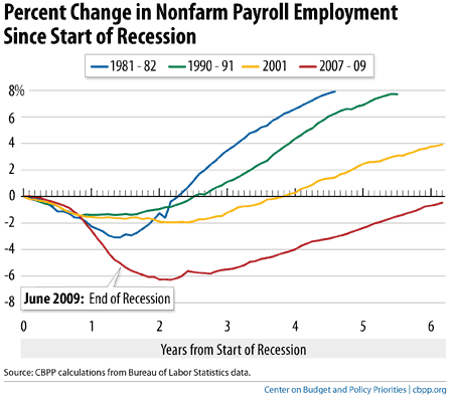
Here are some graphs of how well President Barack Obama’s regulations and economic policies have been working since he exploded our national debt with his “Stimulus” package in 2009. The graphs come from Southern Methodist University Cox School of Business’ Maguire Energy Institute.

First, the sad classic graph of how the Obama Recovery compares with past recession recoveries. It speaks for itself.RecoveryComparison_Cox

This graph shows the total number of Americans still unemployed—the flip side of the number of Americans who actually have jobs.TotalUnemployed_Cox

Like the classic above, things are improving—hence “recovery”—but unemployment still is at historic highs when we consider the number of Americans that make up the unemployed 6.3%. This is because our population is growing faster than the number of jobs available.

This graph shows that the length of time Americans are unemployed isn’t improving very much at all. See the bit about jobs not being created fast enough, above, for a major contributor to this failure. This is a problem that tends to be self-perpetuating, too. The longer folks are out of a job, the more of their skills they lose; if they were in a high-skill, and/or information intensive job (engineering comes to mind), the more obsolete they become, too, as they aren’t as able to keep up with the new data in their field as are those still employed—or even the newly graduated.UnemploymentDuration_Cox

And one more:ProductivityGrowth_Cox

Productivity growth, output per hour by an employee, or what he produces in his hour of working, isn’t very much at all. Most of the jobs that are being created in this pseudo-recovery are service jobs. There are only so many tables a waitress can handle in an hour, only so many disgruntled customers a Customer Service Representative can handle in an hour, only so many investors a brokerage’s Investment Advisor can handle in an hour.

This…recovery…is, to use the Institute’s term, anemic. But we knew that from last week’s GDP growth number. And all of you still looking for work, or who’ve given up on that, have known this for some time.

Some Empirically Determined Pipeline Benefits

A study prepared by the SMU/Cox’ Maguire Energy Institute for the Consumer Energy Alliance has some interesting data from the Keystone XL leg that connects Cushing, OK, with Nederland, TX (built because it’s a purely domestic leg and so did not require President Barack Obama’s personal approval). The figure below presents a map of the pipeline and some proposed adjuncts to it. The Gulf Coast Project is the section of the Keystone XL pipeline project that connects the two towns, and it was open for business last January, so the empirical data are current.Keystone-System-Map

Here are some of the short-term benefits of the project’s work and a couple of longer term benefits:

  • $2.3 billion in private-sector investment
  • 11 million+ hours of labor completed by 4,844 American workers
  • 50+ contracts with US manufacturers and companies that built the pipeline and associated equipment, spread across the country: Arkansas, California, Georgia, Indiana, Kansas, Louisiana, Maryland, Michigan, Minnesota, Missouri, New York, Ohio, Oklahoma, Oregon, Pennsylvania, South Carolina, and Texas
  • manufacture of 485+ miles of high-strength, advanced oil pipeline (36-inch diameter) and associated equipment: thousands of pieces of equipment used to build transformers, meters, electric motors, cabling and electrical equipment; piping assembling and structural steel for supports; etc
  • 2.25 million barrels of new oil storage capacity at Cushing
  • 6 modern pump stations

Some broader results of the pipeline:

  • pumped $3.6 billion into the Texas economy, $2.1 billion into the Oklahoma economy
  • boosted local tax revenues by millions of dollars
  • Prague, OK: “doubled our city sales tax receipts”
  • full RV parks from the construction effort contributed as much as $8,000 a month in electricity fees alone to the municipal utility
  • tax revenue available—and used—to improve education, local infrastructure, and public services
  • Local restaurants, hotels, and businesses experience a significant boos

This table summarizes the overall economic impact of the project:

  Oklahoma Pipeline Impacts Texas Pipeline Impacts
Total Economic Activity $2,143,364,856 $3,638,561,905
Labor Income $1,041,174,418 $1,696,054,834
Employment (person years) 15,852 26,924
Total Taxes $72,384,852 $144,992,343
Indirect Business Taxes $50,339,639 $112,533,584
Direct Business Taxes $22,045,213 $32,458,759

Many will argue that most of these effects will disappear in a few years, even as soon as the pipeline builders leave. Since the results are temporary, why bother, especially given the risks of an oil pipeline? Leaving aside the fact that pipelines are safer than trains for transporting oil and natural gas, ask the folks who’ve gotten these “temporary” fiscal results whether they think any of it was “worth it.”