
Fiduciary Duty

State and local governments are at it again.  Or still.

The value of investments by public pension funds declined last quarter, widening the gap between what these funds say they will earn and what they actually earn.  Pension fund managers—especially government pension fund managers—must make annual “estimates” (they’re actually politically self-serving pie-in-the-sky claims) of the market returns they expect to make on the funds under their nominal care.  These WAGs determine the amount of money “the government that is affiliated with the pension fund must pay into it”.

(Aside: notice the directionality of that emphasis.  The state or local government (and the Federal government with its own public pension funds) is an affiliate of the fund; the fund is not a benefit provided by the government.  Which controls what, now?)

But these fiduciary money managers have been off, and not just occasionally.  They’ve consistently overstated the returns they claim they’ll get compared to the returns they actually get.  Currently, these worthies are claiming they’ll get a return of 7.25% on the taxpayers’ monies with which they’re entrusted and from which they’re promising the funds’ beneficiaries retirement payouts.  The reality is that these worthies have only been able to get 6.49% on average over the last 20 years.

That difference—0.0076%–that’s just chump change; who cares?  Us taxpayers should, and so should the funds’ retirees.  On a $1 million investment—a tiny fraction of many of state-level pension funds, but a significant part of most county- and city-level pension funds, the three-quarters of one per cent difference over those 20 years works out to a more than $4 million dollar difference.

Where’s the money?

How is this not a violation of fiduciary duty?
“It Does Because It Does”

The dishonesty of Special Counsel Robert Mueller’s case against ex- and brief-Trump Campaign Manager is made manifest in the opening questions Eastern District of Virginia Federal Judge TS Ellis III and Michael Dreeben’s (arguing for the Mueller side) answers.

Ellis noted

Apparently, if I look at the indictment, none of that information has anything to do with links or coordination between the Russian government and individuals associated with the campaign of Donald Trump. That seems to me to be obvious because they all long predate any contact or any affiliation of this defendant with the campaign.

Then, after a long soliloquy regarding the rationale for a prosecutor indicting a lesser player on lesser charges in order to squeeze that player into extruding information on a larger player, Ellis asked,

Where am I wrong in that regard?

Dreeben: The issue before you is Manafort’s motion to dismiss the charges.

Ellis: Yes, now answer my question.

Dreeben: “our investigatory scope does cover the activities [of the indictment]”

Ellis: Answer my question.

Dreeben: “the authorization for the special counsel to investigate matters is described generally in the appointment order on May”

Ellis: Yes, I have that letter.  Answer my question.  How does that letter include the indictment?

Dreeben: “So the authorization order permits….”

Ellis: “You’re running away from my question again. You know, I’m focused on the indictment that is here.”

Dreeben: “Well, Your Honor, we are the Justice Department.”

And there it is.  Mueller’s team flatly refused to explain how indictments related to 13-year-old events in Ukraine are tied in to an investigation of the relationship between the Trump campaign and Russia, choosing instead to be deliberately evasive.  Here, by the way, are the public parts of the Mueller Special Counsel Authorization Letter (my title for the thing), as quoted by Ellis:

Sub-paragraph b(i):

any links and/or coordination between the Russian government and individuals associated with the campaign of President Donald Trump.

Sub-paragraph b(ii):

any matters that arose or may arise directly from the [Mueller] investigation.

Nothing in there about any allegedly nefarious activities in Ukraine.  “Arose or may arise” from the Mueller investigation means exactly that.  Stuff from outside the investigation—the Manafort money laundering charges, for instance—aren’t part of the investigation.  And so Dreeben’s implication that Ellis should just sit down and shut up: “We are the Justice Department.”

Which only emphasizes the Special Counsel’s team’s evasions.

The transcript can be read here.

The Special Counsel Authorizing Letter

House investigating committees have demanded that Deputy Attorney General Rod Rosenstein turn over his letter to Special Counsel Robert Mueller, and Rosenstein has refused to do so.  Now, in a case Mueller brought against ex- and brief-Trump Campaign Manager Paul Rosenstein, the presiding Federal judge TS Ellis has demanded that Mueller turn over to him an unredacted copy of that letter, and he’s given Mueller two weeks to comply, which works out to 18 May.

We’ll see. Two weeks is much too long to give Mueller to produce his copy of Rosenstein’s authorizing letter; 36-48 hours is plenty—especially since Mueller’s team plainly has that copy always ready to hand; they are, after all, responsible persons.

Ellis also needs to be prepared to jail Mueller and possibly Rosenstein for contempt if Mueller doesn’t meet the deadline, whether Ellis’ or mine, or Rosenstein won’t allow him to, and keep them locked up until the letter is produced.

President Donald Trump could speed things along by declassifying the letter, if Mueller/Rosenstein try to hide behind that. This is a national affair, and We the People need, and have the fundamental right, to know what Government’s unelected bureaucrats are doing under the pretense that it’s in our name.

Misunderstanding

At the tail end of a Wall Street Journal article discussing the relationship between Deputy Attorney General Rod Rosenstein and Congress (and in particular the House Freedom Caucus), Rosenstein made this remark:

We have a responsibility to work with the Congress. They have a responsibility to understand their duty is not to interfere.

This is a breathtaking lack of understanding by a Federal lawyer. Oversight by Congress does not mean simply watching. Interference is absolutely required if Congress, through its oversight, detects inappropriate or wrong behaviors.

Or would Rosenstein insist that funding cuts—Congress doing its job—are interference?

Major Uncool

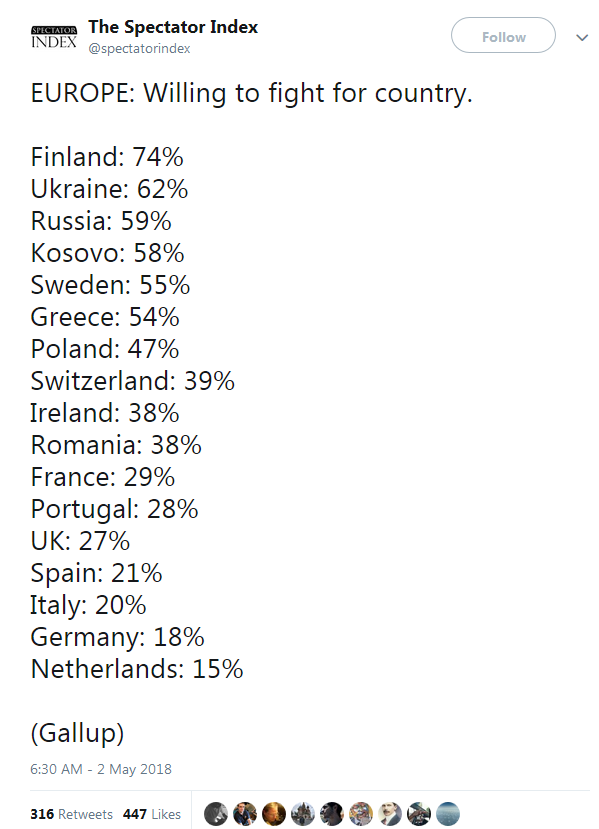
Here’s a stat from Spectator Index.

The people of most of those nations would appear to prefer to be slaves of a conqueror.  The top two nations, on the other hand, have recent and direct experience with Russian dominance.  Which makes Poland’s poor attitude surprising.

On the other hand, the general attitudes of the NATO nations makes one wonder about the utility of NATO at all, and whether we wouldn’t be better served by forming a mutual defense alliance with those eastern European nations that still have some self respect—many of which aren’t listed in the poll.

Poke around the comment thread, too.  There’s at least one who’s arguing with a straight face that Turkey and Russia are not in Europe.