Virtual Attacks on Disapproved-of Businesses

That’s what Facebook is planning to allow regarding merchants that advertise on Facebook.

The social-media giant is rolling out a new feature that lets people leave feedback about their shopping experience after viewing a Facebook ad. The company said it is warning businesses that receive a high volume of negative feedback to give them a chance to address the grievances. If feedback doesn’t improve over time, Facebook will reduce the number of ads that businesses can deliver and could eventually ban them from the platform.

With this, Facebook is allowing “customers” to harm a business of whose ideology they disapprove simply by flooding that business with “negative feedback” on Facebook’s pages.

Just like the Left has been doing to the National Rifle Association, Chick-fil-A, McDonald’s, and on and on.

Norway Gets It

Norway is asking us to double the number of troops we have stationed there and to move them closer to its border with Russia.  It’s a pittance—700 Marines vs the 330 we have there now—but we need to work with Norway very seriously to figure out how to do this.

Norway said the invitation was about NATO training and improving winter fighting capability.

“Allies get better at training together,” Defense Minister Frank Bakke-Jensen told reporters.

Yewbetcha.  And joint training is especially important in the face of demonstrated Russian aggression and its stationing of nuclear weapons in Kaliningrad.

What Hath Socialism Wrought

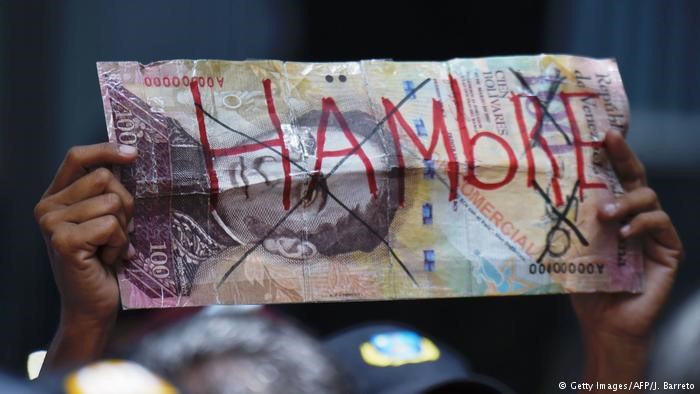
This image, from a Deutsche Welle article on Venezuela’s inflation rate—which last month reached 24,571% year-on-year—says it all.

The word drawn on the 100 bolivar note (and yes, it’s a real note, and it’s actually that big) translates to “hungry.”  In the context, it means more broadly, “a widespread, intense, and prolonged shortage of staple foods that a population suffers.”

Hungry indeed, too.  A bit over two pounds of meat cost about 2 million bolivars (or did once, daily inflation is running at 2.4%), or €16.9 or $20, against a surgeon’s monthly salary of not even 6 million bolivars.  Meat, not steak in particular.  That’s some expensive hamburger or shank cut.

And, not to put too fine a point on it, that works out to a bit over three ounces of meat per day, with nothing left over for anything else: vegetables, rent, transportation, etc.  And that’s for a relatively well off man like the surgeon.  What about the middle class, or especially the poort.

This is reminiscent of what Joseph Stalin did to the Ukrainians and White Russians when he collectivized—socialized—the Soviet Union’s kulak farms.

NLMSM and a Summit

I watched CNN‘s coverage of the President Donald Trump-Baby Kim summit, following which they signed a document wherein they agreed on four steps to carry out on the path forward, including Baby Kim’s commitment to denuclearize “the Korean Peninsula.”  That last, especially, is a Big Deal, albeit hard details like on what schedule and what Baby Kim wants in return are yet to be discussed and agreed.

Still, you’d think that would be news worth covering, worth reporting and commenting on.  So what did CNN devote its Tuesday morning programming to?  Their morning Star Anchor interviewed two ex-Federal employees, asking them about taping back together “White House” torn-up documents.  The anchor kept referring to the documents as “destroyed official documents” as she sat at her desk, leaning into the camera with her mouth hanging open in faux shock (or, as my mother used to say, drawing flies).  The interviewees kept holding up the pieces of paper they’d brought with them to illustrate the kinds of documents they’d been told to tape together and the degree of “destruction” the tearing up represented.

Now, I came on the interview in mid-stream, so I don’t know the basis of the anchor’s characterization of the documents as “official” or as “destroyed.” It wasn’t clear to me throughout the remainder of the interview that these terminated employees weren’t expressing their disgruntlement over having been terminated.  It wasn’t clear to me how these two interviewees came to have—after their termination—official documents still in their possession, or even whether what they had were documents.  They did clearly represent the size of the torn pieces to be representative of their reassembly task.  What also was clear was that those representative pieces of paper weren’t “torn-up,” official or otherwise.  They were documents that had been torn in quarters or eighths.  Thus, they could have been notes torn up to signify “done with these,” as many of us do, or they were “official” and torn in rejection, as the tearer (Trump? one of his senior staffers?) told the individual who handed them to him said, “This is trash; do it over. Bring me what I asked for.”

But what’s important about CNN‘s interview is this: the just concluded summit wasn’t important enough to cover, but taping pieces of paper together was.

It’s Time

…for Deputy Attorney General Rod Rosenstein to go.  He

threatened to “subpoena” emails, phone records and other documents from lawmakers and staff on a Republican-led House committee during a tense meeting earlier this year [January], according to emails reviewed by Fox News documenting the encounter and reflecting what aides described as a “personal attack.”

In a notification to the House Office of General Counsel about the incident, the House Intelligence Committee’s then-Senior Counsel for Counterterrorism Kash Patel (now the Committee’s National Security Advisor) wrote

The DAG [Deputy Attorney General Rosenstein] criticized the Committee for sending our requests in writing and was further critical of the Committee’s request to have DOJ/FBI do the same when responding.  Going so far as to say that if the Committee likes being litigators, then “we [DOJ] too [are] litigators, and we will subpoena your records and your emails,” referring to HPSCI [House Permanent Select Committee on Intelligence] and Congress overall.

A second staffer corroborated the complaint:

Let me just add that watching the Deputy Attorney General launch a sustained personal attack against a congressional staffer in retaliation for vigorous oversight was astonishing and disheartening. … Also, having the nation’s #1 (for these matters) law enforcement officer threaten to “subpoena your calls and emails” was downright chilling.

In response, DoJ said that Rosenstein

never threatened anyone in the room with a criminal investigation.

That’s a cynically offered strawman, and its offering confirms the need for Rosenstein to go—as well as the DoJ official who offered it.  Patel was not alleging a retaliatory criminal investigation, only protesting the threat of subpoena of Committee and Committee personnel correspondence in response to a threat of Contempt of Congress citation—itself necessary by the FBI’s and DoJ’s—Rosenstein’s—stonewalling of Committee document requests.

Further distraction, stonewalling, and now intimidation: Rosenstein, according to one of his own staffers, will

request that the House General counsel conduct an internal investigation of these Congressional staffers’ conduct.

For the heinous crime of insisting on the House’s oversight prerogative, Rosenstein is expected to extend his threats and intimidation effort.

Tom Dupree, Principal Deputy Assistant Attorney General in Bush the Younger’s administration, long out of government, still felt qualified to weigh in:

It’s hard to tell whether [Rosenstein] was sending a message to back off, or whether he was just trying to illustrate how invasive he considered the demands from Congress.

There’s no misunderstanding here.  Rosenstein plainly was trying to intimidate the Committee members and staffers into backing off.  He knows full well that Congressional oversight is, necessarily, invasive, especially given the stonewalling.

Again: Rosenstein must go.