Meanwhile

I wrote earlier about one small subset of regulatory barriers to US investment. Here’s another side.

The Australian Business Review headline pretty much tells the story, and they stand in sharp contrast with the burgeoning US regulatory environment.

Indonesian President Joko Widodo Pledges to Cut Investment Barriers

And the lede:

The new leader of the world’s fourth-largest nation promised to move aggressively to lower barriers to investment and overcome decades of unmet potential that have left Indonesia lagging behind more dynamic Asian nations.

Recognizes the man himself:

…we need investment, we need investors, to boost our economic growth….

And lowering regulatory barriers is critical to that. Because prosperity.

More Thoughts on Minimum Wage

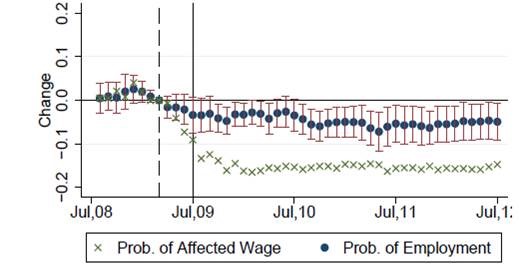
And actual data. Econbrowser pointed out a quasi-controlled study by PhD candidate Michael Wither and Professor Jeffrey Clemens that compared populations of workers in states that had minimum wage laws with higher minimum requirements than Federally passed wage requirements at the time the Federal legislation was enacted with populations of workers in states that did not. They also compared populations of workers starting out with wages higher than the new mandates with populations of workers with wages lower than the new mandates (workers with wages less than $7.50/hr and workers with wages between $7.50 and $10.00 at the time of a then-newly Federally mandated minimum wage of $7.25) over the three years following the Federal mandate.

This figure is from Econbrowser‘s summary of the study:ProbabilityOfEmployment

Dynamic estimates of the effects of minimum wage on low-skilled workers. Green x’s denote difference in probability of having a low-wage job between states with low minimum wages and those with high minimum wages. Blue dots indicate difference in probability of being employed between states with low minimum wages and those with high minimum wages, with accompanying 95% confidence intervals. Source: Clemens and Wither (2014).

In other words, a low-skilled worker in a low minimum wage state was more likely to have a job at all than was his counterpart in a high minimum wage state. Moreover, while jobs in high minimum wage states got raises as a result of the Federal minimum wage mandate, workers were less likely to be hired into those jobs.

As Clemens and Wither put it,

Over the late 2000s, the average effective minimum wage rose by 30% across the United States. We estimate that these minimum wage increases reduced the national employment-to-population ratio by 0.7 percentage point.

Clemens and Wither also had this:

We also present evidence of the minimum wage’s effects on low-skilled workers’ economic mobility. We find that binding minimum wage increases significantly reduced the likelihood that low-skilled workers rose to what we characterize as lower middle class earnings. This curtailment of transitions into lower middle class earnings began to emerge roughly one year following initial declines in low wage employment. Reductions in upward mobility thus appear to follow reductions in access to opportunities for accumulating work experience.

But Progressive Democrats know better. Facts are for the little people—you and me.

Maybe That’s The Point

Banks are urging some of their largest customers in the US to take their cash elsewhere or be slapped with fees, citing new regulations that make it onerous for them to hold certain deposits.

The banks, including JP Morgan Chase & Co, Citigroup Inc, HSBC Holdings PLC, Deutsche Bank AG, and Bank of America Corp, have spoken privately with clients in recent months to tell them that the new regulations are making some deposits less profitable

And

The change upends one of the cornerstones of banking, in which deposits have been seen as one of the industry’s most attractive forms of funding….

“Loanable funds.” That’s what those deposits are called in economist circles. The funding in question is a major source of the monies that banks lend on to other customers for the latters’ investment goals—investment in things like capital plant improvement (new factories, new equipment to put in existing or new factories, computers for a company’s IT infrastructure or for employee productivity improvements), R&D, even short term to make payroll until payments for booked sales arrive.

The regulations in question here are intended to make our banking system “safer,” but this is a holdover from the government’s (read: regulators and remaining politicians) stinking…panic…over the Panic of 2008.

And as is usually the case with (especially big) government intrusions into our marketplace, there are unintended consequences.

Or maybe these aren’t so unintended. Recall that, for all the cover “panic” provides for suboptimal behavior, these are extremely intelligent men and women. It’s hard to believe they couldn’t predict these consequences: it’s Econ 101 that if you raise the price of something, you’ll get fewer buyers for it.

Also, keep in mind that the private sector competes with government in the marketplace.

Finally, keep in mind that fundamental tenet of the Democratic Party, the dominant party in American politics during the era when this sort of regulation was proselytized and expanded: Americans are stupid, and it’s OK to lie to us. For our greater good at the hands of our Betters. A step in this is to bring our financial system, beginning with our banks, to heel.

Who’s the Rape Victim in the “Jackie” Story?

University of Virginia President Teresa Sullivan suspended until January the entire fraternity system at UVA. She did it on the basis of a newspaper story whose author—Sabrina Rubin Erdely—and which paper’s editor—Will Dana—consciously and openly stated that they had done nothing to fact check the claims made by this “Jackie” person and which Erdely published.

On the heels of that, we get Zerlina Maxwell writing in another newspaper article headlined

we should generally believe rape claims

That headline, incidentally, originally appeared in the online edition as automatically rather than generally, but apparently The Washington Post thought it better to weasel-word things a tad. What Maxwell said in the body of her article, though, remains unaltered:

We should believe, as a matter of default, what an accuser says. … Even if Jackie fabricated her account, U-Va. should have taken her word for it….

Which UVA did: not only the allegedly involved frat was suspended, all of them were. As far as I can tell, as of my writing of this the fraternities remain suspended, even with the “Jackie” story exposed as false. I’ll be happy to update this article if someone can show me that Sullivan has lifted her suspension prior to 9 Jan 15.

As a result, particularly of Sullivan’s actions, but actively aided and abetted by Maxwell and triggered by Erdely’s now known to be false story, an entire institution and every member of it has been irretrievably smeared. These young men have had their reputations trashed, or alternatively will no longer be able to claim affiliation with their fraternity or any part of the Greek system.

Worse, the victims of real rape now have an additional hurdle—credibility—to overcome as a result of these three women’s…behavior. Actual rape victims are being raped a second time, in advance.

An Excuse to Stall?

In a city with a history of denying Americans their gun rights?

[Washington, DC] does not know how long it will take to process those requests [for concealed carry licenses].

“There’s no internal guideline for how long the process should take at this point,” DC police Lieutenant Sean Conboy told a Free Beacon reporter today.

Yeah. Because in the six years since DC v Heller and the four years since McDonald v Chicago and the two years since the Seventh Circuit’s Moore v Madigan gave a strong hint, it’s unreasonable for the DC cops to figure out how to assess and issue CCWs.

And there’s this:

There is still confusion about how people will complete the required 16 hours of classroom training and two hours of range training. Conboy said that the city is still working to officially license a trainer….

And there’s the matter of public firing ranges in DC: there aren’t any.

Hmm….

The 2nd Amendment is quite clear. In light of the erosion of it, it’s time to give it back its teeth. I don’t like Federal laws in general, but here’s one I could get behind: all police departments—every single one of them—must issue concealed carry licenses absent a compelling reason(s) (e.g., the applicant is a felon) for not. There must be a deadline on the application’s favorable ruling, too: if no necessarily derogatory information is turned up (that felony conviction, for instance) within a reasonable time frame—say 28 days, or 42 days—the department must issue the license.