And actual data. Econbrowser pointed out a quasi-controlled study by PhD candidate Michael Wither and Professor Jeffrey Clemens that compared populations of workers in states that had minimum wage laws with higher minimum requirements than Federally passed wage requirements at the time the Federal legislation was enacted with populations of workers in states that did not. They also compared populations of workers starting out with wages higher than the new mandates with populations of workers with wages lower than the new mandates (workers with wages less than $7.50/hr and workers with wages between $7.50 and $10.00 at the time of a then-newly Federally mandated minimum wage of $7.25) over the three years following the Federal mandate.
This figure is from Econbrowser‘s summary of the study: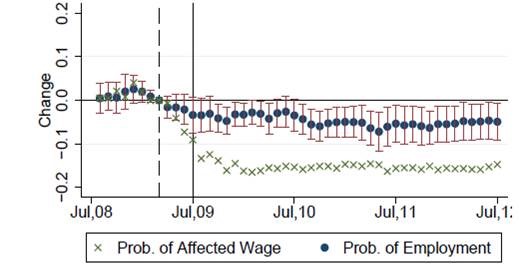
Dynamic estimates of the effects of minimum wage on low-skilled workers. Green x’s denote difference in probability of having a low-wage job between states with low minimum wages and those with high minimum wages. Blue dots indicate difference in probability of being employed between states with low minimum wages and those with high minimum wages, with accompanying 95% confidence intervals. Source: Clemens and Wither (2014).
In other words, a low-skilled worker in a low minimum wage state was more likely to have a job at all than was his counterpart in a high minimum wage state. Moreover, while jobs in high minimum wage states got raises as a result of the Federal minimum wage mandate, workers were less likely to be hired into those jobs.
As Clemens and Wither put it,
Over the late 2000s, the average effective minimum wage rose by 30% across the United States. We estimate that these minimum wage increases reduced the national employment-to-population ratio by 0.7 percentage point.
Clemens and Wither also had this:
We also present evidence of the minimum wage’s effects on low-skilled workers’ economic mobility. We find that binding minimum wage increases significantly reduced the likelihood that low-skilled workers rose to what we characterize as lower middle class earnings. This curtailment of transitions into lower middle class earnings began to emerge roughly one year following initial declines in low wage employment. Reductions in upward mobility thus appear to follow reductions in access to opportunities for accumulating work experience.
But Progressive Democrats know better. Facts are for the little people—you and me.
