
A(nother) Thought on Climate…Change

Watts Up With That has a summary article and graph on this; the basic article is on the other side of a link in the summary. It’s typically academic in its language, but it’s well worth a layman’s time in slogging through. Here’s the graph (which is a construction of Watts’; it’s not in the linked-to article):TreeRingSummary
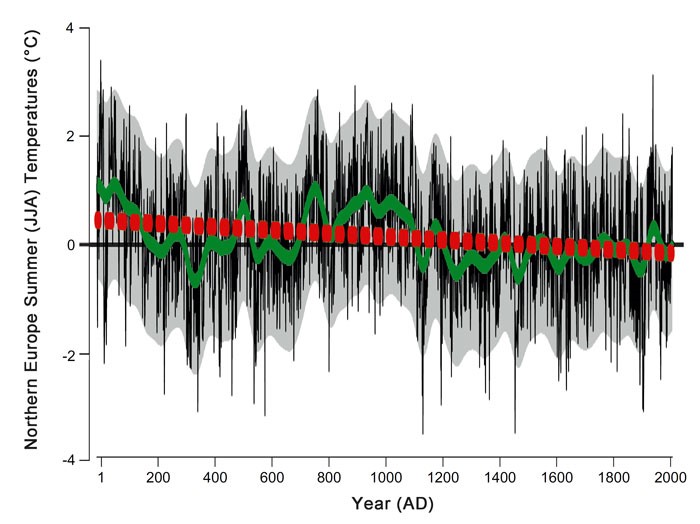
Northern Europe summer (June, July, August) temperature reconstruction. Data shown in °C with respect to the 1961-1990 mean. Adapted from Esper et al. (2014).

The black lines are individual data points, and the grey shading smoothes the data. The green line represents the center of the grey shading, and the red line approximates a regression line showing the long-term rate of cooling over these 2,000 years. All the representations show the same thing: it was warmer in northern Europe 2,000 years ago, during the time of the Roman Empire, than it is today.

The take away for me, though, is what’s represented by the black lines and the grey shading. Compare those to the alleged warming trend of the last 100 years—and its stagnation over the last 20 years (fully a fifth of those 100 years).

Now show that that recent “trend” is distinguishable from the noise level apparent in the data and their first smoothing, the grey shade.

Obama and Economics

In the question and answer period following President Barack Obama’s end-of-year Friday press conference, Obama offered this regarding the Keystone XL pipeline, gas prices in the US, and global markets [emphasis added]:

So there’s no—I won’t say ‘no’—there is very little impact, nominal impact, on US gas prices—what the average American consumer cares about—by having this pipeline come through. And sometimes the way this gets sold is, let’s get this oil and it’s going to come here. And the implication is, is that’s going to lower gas prices here in the United States. It’s not. There’s a global oil market. It’s very good for Canadian oil companies, and it’s good for the Canadian oil industry, but it’s not going to be a huge benefit to US consumers. It’s not even going to be a nominal benefit to US consumers.

Pick one, Mr Obama. It’s either a global market or a Canadian one. If it’s global—which includes US consumers buying gas—the large increase in supply, especially if it’s more cheaply delivered to the global market via Keystone and Gulf Coast ports than via truck and train to British Columbia ports, most assuredly will have a salubrious effect on the prices US consumers pay for our gas.

And that ignores the fact that a lot of that Canadian oil going to the Gulf Coast via Keystone will be sent to US refineries there, and a lot of the refined product will be sold in the US—a prompt and nearby increase in supply.