Economic Gains

President [Barack] Obama used Labor Day to tout the country’s economic gains under his leadership….

Let’s look at those gains.

  • he’s increased the national debt in his six years by 70%—it stood at $10 trillion at the end of 2008; it’s now over $17 trillion
  • median income has fallen—it stands now at $53,900 compared with $56,700 in December 2007 at the start of the current economic dislocation
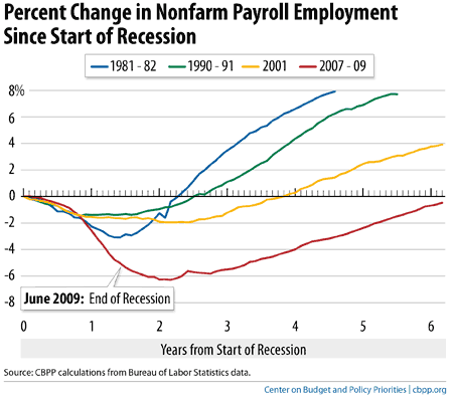
  • job creation is only just back to pre-Panic levels, 6 years into his administration, compared with normal economic recovery needing only 2-3 years to get to this point
  • unemployment rate now stands at 6.2%, dropping 1.1 points over the past year—still 20% above full employment, and again years behind schedule
  • labor force participation rate is at an historic low
  • GDP growth remains anemic at 1.5%-2.5% year on year (with this year’s growth rate projected to be in the 2.5% range) compared to a normal economic recovery growth rate in the 4.5%-6.5% range.

And this graph sums it all up:RecoveryComparison_Cox

Obama, in the same appearance, also claimed that “higher wages and other progress for workers can only be achieved through a Democrat-controlled Congress.”

Really? Can our country afford more of this Progressive progress?

In Which I Side with the “Liberal” Judges

Regarding the NSA’s broad (much too broad, IMNSHO) surveillance of American citizens, the three judges hearing an appeal to the 2nd Circuit Appellate Court (Democrat appointees, all) expressed concern about that breadth. A Federal District Court had ruled the surveillance constitutional, and the ACLU is leading the appeal (and so I’m siding with that crowd, too, on this matter).

In an oral argument that was set for less than 30 minutes and lasted nearly two hours, three judges on a panel hearing the case at the Second US Circuit Court of Appeals in Manhattan probed claims by the ACLU that the federal government’s collection of data relating to “every phone call made or received by residents of the United States” is illegal and unconstitutional.

Indeed,

[Judge Gerard] Lynch asked how well briefed members of Congress were before voting, and questioned how much they understood about the program. At one point, [Judge Robert] Sack chimed in, “We don’t know what we don’t know” about NSA operations.

Lynch and [Judge Vernon] Broderick both questioned why the government’s justification for the bulk phone data collection program would not also extend to bank records, credit card transactions, and other personal data. Lynch asked if the government’s argument would not also entitle it to access “every American’s everything.”

It’s a fine line between the legitimate security needs of the Federal government if it’s to do the job for which we hired it—to protect us from foreign threats and from each other—on the one hand, and our individual liberty and responsibility on the other. Ben Franklin was right.

It’s necessary, also, to keep in mind that without our individual liberty and responsibility, we have no security. It matters not a whit whether we’d be enslaved by our own government or by a foreign power—we’d still be slaves.

Our Constitution has drawn that line: judge-issued warrants, on a showing of probable cause, are necessary to the legitimacy of the collection. These warrants also must be particular to the person and his property, and they also must be particular to the things being sought out. Fishing expeditions are not allowed.

True, “warrants” are sought in advance via a FISA court. But the FISA court is a secret court, a Star Chamber, no matter its currently good intentions. “Warrants” issued by it similarly are secret, which is to say, they don’t exist: they’re not public, and the person being “searched” under them has neither the ability to contest the warrant in court prior to its execution nor the ability to quash at trial the data discovered and/or seized. Nor can there be any guarantee that, given an ultimate victory, whether over an individual warrant that was discovered or over the process (the DC Circuit is hearing a similar appeal, and the thing is likely to find itself in front of the Supreme Court in the next session), the collected data actually will be expunged.

The 2nd Circuit’s case can be followed as American Civil Liberties Union v Clapper, 14-42, US Court of Appeals for the Second Circuit.

What Does Europe Owe Ukraine?

The crisis in Eastern Europe…is now entering its 10th month. What began with the collapse of an association agreement between the European Union and Ukraine can now be called a war.

Emphasis added.

All Ukraine wanted was to be free. Free from Russia; free to chart its own course; free to begin to escape its own history of governmental corruption; free to align itself with, learn from the association, and perhaps to prosper in its freedom. The EU implied, with that agreed association, that it would help Ukraine work toward those goals, using that association and EU’s vasty trade market.

When the collapse of the agreement occurred, the Ukrainian people tossed the mendacious government that had collapsed it—and those people—in favor of returning to the Russian sphere; in retaliation against the Ukrainians’ making their wishes, their demands, their very sovereignty over government known, Russia invaded Ukraine. First, the Russians occupied Crimea and then partitioned Ukraine, incorporating Crimea into itself. Then the Russians invaded eastern Ukraine, initially by supplying arms and ammunition to Russian “separatists” already present in the region, then by supplying Russian soldiers “on holiday,” and now openly, driving a Russian held corridor through southern Ukraine stretching along Ukraine’s erstwhile Sea of Azov coast from Russia to Crimea.

What is Europe doing about this? They’re talking. German Chancellor Angela Merkel has telephoned Russian President Vladimir Putin 25-35 times, to engage in idle chit-chat. The EU has applied pinprick “economic sanctions.” They do not supply arms and ammunition. The openly say they will not supply troops—which Ukraine already has said they do not want, but still….

What is the value of Europe’s agreements when they dishonor the implications of an association agreement? Even the one that was signed by the government which the Ukrainian people put in place a couple short months ago?

Wave Election

There are wave elections, and there are wave elections. In 1894, for instance, the Republicans gained 130 seats in the House out of a total of 357 seats up for election. In 1932, the Democrats gained 97 seats out of 435. In 2010, the Republicans picked up 63 seats.

But all politics is local.

In Alabama’s 2nd District, for instance, the Republican won by 5,000 votes out of 216,000 cast in 2010, a margin of 2%. In Texas’ 23rd District, the Republican won by 7,000 votes out of 151,000 cast, and in the 27th District, the Republican won by 700 votes out of 105,000. In South Dakota, the Republican won by 7,000 votes out of 319,000. In Minnesota’s 8th District, the Republican won by 4,000 out of 277,000 cast.

So it went throughout the country, and so it went in all the wave elections. Waves occur from the aggregation of local politics, local elections, and a very large number of those local elections are not blowouts at all (though many are; some elections look like the losing candidate was just taking up space on the ballot).

In the coming 2014 mid-terms, the races in both the House and the Senate are similarly extremely tight, especially in the so-called battleground States. Indeed, even in wave elections, potsful of seats are locked up tight by the incumbent. See, for instance, the map presented here, showing gains and holds from the 2010 wave.

If the 2014 close races all break the Republicans’ way in the Senate, they could pick up 12 of the 6 seats they need to take control. If those races go the Democrats’ way, though, so would the wave go their way: they’d have 67 seats (counting the Independent and the Socialist who caucus with the Democrats) instead of their current 55.

Local politics.

Good, and Bad

The 6th Circuit, in a case involving an assault on an Amish man by various members of his community because he didn’t conform to their standards, came to the right answer, but then it did the wrong thing with its answer.

The assaulters were convicted of their assault, with the crime and the conviction treated by the prosecutor and the trial court as a hate crime. The Circuit Court ruled, though,

Personal conflict, not religion, was the driving motive behind beard- and hair-cutting attacks targeting Amish, an appeals court panel ruled Wednesday in overturning the hate-crime convictions of 16 men and women.

This is good, because our crimes don’t need to be gussied up with froo-froo, and adding “hate” to the definition of a crime in order to create a new crime is such froo-froo. When we criminalize hate, we criminalize the contents of a man’s mind—and that’s no thing a government should be involved with. Full stop. All that needs criminalization—if anything—is the actual deed done. Our thoughts must be beyond government’s reach, no matter the good intentions in trying to go that far.

But the ruling is bad because it overturned the convictions altogether, rather than remanding the case for resentencing. That the men were convicted of a crime with a motivation means the men were convicted of a crime.

Now the victims must consider reliving those events in a new trial, and that’s also bad.

The 6th Circuit’s opinion can be read here.