
The Supreme Court and Rule By Law

Steven Hayward, at Power Line, wonders whether the Supreme Court could take a mulligan on the Patient Protection and Affordable Care Act case before them.  The background for his question is this:

What people forget is that Citizens United was reargued, because the Justice Department also could not give a coherent answer to a killer question, this time from Justice Alito, as to whether the campaign finance laws that prohibited the distribution of Hillary, the Movie wouldn’t also allow the Federal Election Commission to regulate the distribution of books near election day.  Then-solicitor general Donald Stewart answered Yes, notwithstanding that pesky little First Amendment thingie.

Alarmed, the Court ordered the case reargued, specifically expanding its scope to ask whether certain previous cases that provided the basis for Stewart’s answer had been erroneously decided and should be overruled.  During the second oral argument, a new solicitor general—Elena Kagan—was asked the same killer question, and answered: “No [we can’t regulate books]; the government’s position has changed.”

Stop and dwell on that one phrase for a moment: “The government’s position has changed.”  That says about all you need to know about the rule of law in the liberal wonderland of today’s administrative state.

The question in the Court’s present PPACA case that raised Hayward’s concern was Justice Kennedy’s “Can you create commerce in order to regulate it?”

The question I have, though, concerns the Court’s position on the rule of law vs rule by law.  Why did the Court need to wait on the Executive’s instruction to it of the distinction between one form of free speech and another form of the same speech?  Surely it knows that there is no distinction, and it can rule on its own initiative.  Surely, it could have recognized on its own judgment that a proper ruling in Citizens (i.e., that speech really is a matter of freedom) would require acceptance that it had decided erroneously on earlier cases, and that those opinions would have to be overruled.  How many times was Brown argued on the recognition that Plessy would have to be overruled?

Surely the Court knows that when commerce does not exist, there is nothing to regulate, and by extension, government cannot create commerce out of the æther in order to have something to do.

That this Court needs these answers makes me wonder about its own attitude toward rule of law.  It got Citizens right, but it shouldn’t have needed additional (and in the event both erroneous and irrelevant) instruction from the Executive in order to do so.  It shouldn’t need additional instruction here, either.
He Just Doesn’t Get It, Treasury Precinct

Eric Morath, of The Wall Street Journal, describes Secretary Treasury Timothy Geithner’s speech this week before the Economic Club of Chicago.  Geithner said,

The challenges facing the American economy today…are about the barriers to economic opportunity and economic security for many Americans and the political constraints that now stand in the way of better economic outcomes[.]

So far, so good.  But then, Geithner claims that the deficit- and debt-exploding “stimulus” spending this administration and its predecessor inflicted on our economy in 2008 and 2009 helped avoid a much deeper depression.  (As an aside, it’s interesting to note that, just as everyone else in this administration who’s made this claim has done, Geithner declined to offer any evidence whatsoever to support his claim.)  He also insists that government needs to do yet more to stimulate our economy.

Then he argued, in all seriousness, that cutting spending and taxes won’t stimulate the economy.  Here’s the Treasury Secretary insisting that leaving more of our money in our hands to spend—or save—according to our needs isn’t stimulative.

Additionally, here’s that same Treasury Secretary arguing the old, failed Keynesian thought that government spending, of its nature, is stimulative.  The thing with government spending, though, is that it crowds out private spending, it doesn’t add to it.  With the government buying, there’s less need for individuals or businesses to buy: government will, and give it to us.  Look at health care.  Look at food stamps (which I pick on due, among other things, to the impact of farm price supports and the government-mandated ethanol program on food prices).

And

There is no economic or financial case for using the fear of future deficits to cut as deeply into core functions of the government, to weaken the safety net or fundamentally alter Medicare benefits[.]

No, of course not.  He’ll just have more money printed up to cover those costs.  Never mind that all that inflowing printed currency is just inflation, either today or tomorrow, which will only erode the value of the money coming from that Federal spending—and the value of what money we still have after taxes.  The government can print money to keep up with its inflation.  We cannot.

No, Mr Geithner, the political constraints challenging our economy today consists entirely of too much Federal government interference in our economy.  The most important thing that government needs to do more of right now, to help our economy, to stimulate our economy, is to sit down and put its collective hands in its collective pockets.  Do more nothing

Recovery, and Recovery, and Recovery

…creeps in this petty pace.*  Here are some statistics, courtesy of Edward Lazear, writing for The Wall Street Journal.

  • In the three years [after the Great Depression of 1930-33], the economy rebounded with growth rates of 11%, 9%, and 13%, respectively.
  • The current recovery, beginning in 2009, has had growth rates of in 3% and 1.7% in 2010 and 2011, respectively.  The [2012] growth rate looks to be about 2%.
  • From post-WWII to the current recession (1947-2007), the US’ average annual growth rate was 3.4%.
  • Since the ’80s, we’ve had somewhat slower growth, but even here, the average growth rate was 3%.
  • During our current “recovery,” our economy has grown at 2.4%—below both that long-term trend, and the intermediate, nearby trend.
  • Today our economy is 12% smaller than it would have been had we matched our growth trend since 2007.
  • Today our economy is 4 per centage points further off trend line than it was 1Q09 when President Obama’s nearly trillion-dollar “stimulus” effort started.

Historically, the deeper the recession, the stronger the subsequent recovery.  The present “recovery” isn’t robust by any measure.  It’s not even catching up.

Whose policies have been in effect throughout this creeping, petty “recovery?”  Not those of Bush the Younger.

*With apologies to the Thane, Macbeth.

Taxes, Revenue, and Growth

Do Federal revenues come from taxes or from economic growth?  (I’ll elide, for this post, a discussion of whether the Federal government needs the revenue it wants to collect.)  A couple of better men than me offer up some thoughts:

There is a point at which in peace times high rates of income and profits taxes destroy energy, remove the incentive to new enterprise, encourage extravagant expenditures and produce industrial stagnation with consequent unemployment and other attendant evils.

and more loquaciously,

Our true choice is not between tax reduction, on the one hand, and the avoidance of large Federal deficits on the other. It is increasingly clear that no matter what party is in power, so long as our national security needs keep rising, an economy hampered by restrictive tax rates will never produce enough revenue to balance our budget just as it will never produce enough jobs or enough profits.  Surely the lesson of the last decade is that budget deficits are not caused by wild-eyed spenders but by slow economic growth and periodic recessions, and any new recession would break all deficit records.

In short, it is a paradoxical truth that tax rates are too high today and tax revenues are too low and the soundest way to raise the revenues in the long run is to cut the rates now…. The purpose of cutting taxes now is not to incur a budget deficit, but to achieve the more prosperous, expanding economy which can bring a budget surplus.

Who said these things?  Those old and venerated, in some circles, Democrats: Woodrow Wilson in the first case, in his 1919 message to Congress, and John Fitzgerald Kennedy in the second, in his 1962 speech to the Economic Club of New York.

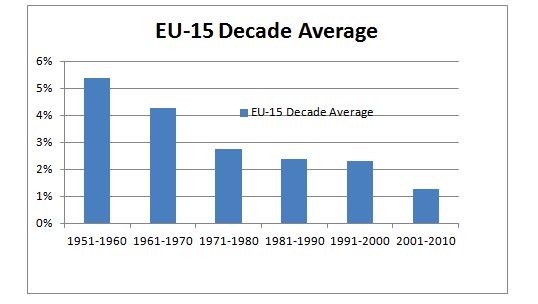
Here’s a graph from our current Progressives’ favorite exemplar, Europe, courtesy of Dan Mitchell at the International Liberty blog:

EU-15 refers to the 15 nations which comprise the 15 members of the pre-May 2004 European Union: Austria, Belgium, Denmark, Finland, France, Germany, Greece, Ireland, Italy, Luxembourg, the Netherlands, Portugal, Spain, Sweden and the United Kingdom—e.g., western Europe, less Norway and Switzerland.

The graph shows, decade by decade, the steady reduction in economic growth of those 15 EU nations as their governments, individually, and the EU “government” generally, expanded their size and control over their nations’ economies and their citizens’ abilities to make their own decisions.

As an aside, how do we get an economy to generate revenue?  Not this way:

Shall we create more jobs by aping Europe, which since 1990 has averaged 9.16% unemployment while ours was 5.95%?

[L]ike the leaders of the bankrupt states of Europe, President Obama believes that the key to prosperity is to regulate, engineer, and direct the economy; to raise taxes; to augment the powers of government; to substitute collective largess for family cohesion; to spend money that does not exist…to paraphrase Macbeth, to borrow, to borrow, and to borrow.

Hmm….

Sure, Why Not?

Congressman James Clyburn (D, SC) is advising President Obama to run against the Supreme Court if the Court is so wrong-headed as to strike down the Patient Protection and Affordable Care Act.

Clyburn says,

In terms of the Congress, I believe that it would be off-base for us to do that, but for the president, I don’t think it is.  I think the president ought to take a look at what happened in years before—we’ve seen presidents run against Congress….

He may be onto something here.  Obama can’t run, Truman-like, against a Do-Nothing Congress—those Do-Nothings are actually his own Democratic Party-controlled Senate, which has actively refused even to pass a budget for three years.  Nor can Obama run on his record.  His policies have led to national security-threatening national debt and spending deficits, historically high and prolonged unemployment, rising energy costs, and are suppressing an economic recovery that may or may not be in progress, finally.  His red herring ad hominem attacks aren’t finding traction, either.

So, sure—run against the Supreme Court.  Argue that upholding the Constitution is somehow judicial activism.

Yeah, that’s the ticket.