A Border Crisis Stop-Gap Immigration Bill

Late Friday, the House passed this—along party lines, because the Democrats in the House wanted no part of it. The bill provides roughly $700 million, less than a quarter of President Barack Obama’s original $3.7 billion do deal with the situation. What it does is this:

  • increases funding, to $70 million, for the relevant States’ National Guards, with the funding to go directly to those States, bypassing the Federal government. This alone is anathema to Democrats
  • provides $400 million for border security
  • provides $200 million for housing and “humanitarian assistance”
  • adds more immigration judges and detention spaces
  • alters a 2008 anti-trafficking law to permit Central American kids to be sent back home without deportation hearings

Yet the Democrat-controlled Senate has gone on vacation, refusing even to consider the bill. Apparently their time off is more important than their duty. But then, this Reid satrapy has been on vacation since 2010, with some 350 House-passed bills, including more than 40 directly related to putting out-of-work Americans back to work and others related to immigration reform, simply moldering on the Democrats’ collective desks—as they refuse even to allow debate on the bills, much less actually vote on them.

Further, Obama has vowed to veto the lately passed House bill were it to make it to his desk. No surprise there; it’s a largely Republican bill, and that alone makes it unacceptable to him.

The Second Amendment and a Judge’s Misunderstanding

And a State’s misunderstanding. Fortunately, the Ninth Circuit, that bastion of conservatism, corrected the State’s misapprehension and struck its law regarding a man’s right to carry a firearm outside his home. The Ninth’s dissenter, though, is illuminating, and worrisome.

The situation is this. California is a “may issue” state, meaning that local authorities are allowed to use their discretion in deciding whether to issue a concealed carry permit or license that would authorize a California citizen to carry a firearm outside his home. California is even more restrictive in that “may issue” bit, though; it requires its citizens to satisfy those local authorities that the supplicant applicant has “good cause” for being permitted. That’s the State’s misunderstanding, corrected by the Ninth.

San Diego County residents, including the six plaintiffs in this case, were forced to sue for their licenses because the sheriff’s department, the “local authority” here, routinely—universally—denied licenses because the sheriff could never be satisfied that “good cause” existed. The case made its way to the Ninth with the above victory for the plaintiffs. The majority opinion held, in part, that

One of Heller’s most important lessons is that the Second Amendment “codif[ies] a pre-existing right….”

…a law that destroys (rather than merely burdens) a right central to the Second Amendment must be struck down.

And [citations generally omitted, emphasis in the original]:

We thus disagree with those courts—including the district court in this case—that have taken the view that it is not necessary (and, thus, necessary not) to decide whether carrying a gun in public for the lawful purpose of self-defense is a constitutionally protected activity. Understanding the scope of the right is not just necessary, it is key to our analysis. For if self-defense outside the home is part of the core right to “bear arms” and the California regulatory scheme prohibits the exercise of that right, no amount of interest-balancing under a heightened form of means-ends scrutiny can justify San Diego County’s policy. See Heller (“The very enumeration of the right takes out of the hands of government—even the Third Branch of Government—the power to decide on a case-by-case basis whether the right is really worth insisting upon.”).

And [citation omitted, emphasis in the original]:

But the fact that a small group of people [e.g., retired cops, and others suggested in the opinion] have the ability to exercise their right to bear arms does not end our inquiry. Because the Second Amendment “confer[s] an individual right to keep and bear arms,” we must assess whether the California scheme deprives any individual of his constitutional rights. Thus, the question is not whether the California scheme (in light of San Diego County’s policy) allows some people to bear arms outside the home in some places at some times; instead, the question is whether it allows the typical responsible, law-abiding citizen to bear arms in public for the lawful purpose of self-defense. The answer to the latter question is a resounding “no.”

Certainly, reasonable men can disagree about the degree of burden that’s appropriate (demonstrating a reasonable proficiency with firearms, akin to demonstrating a reasonable proficiency with cars as a prerequisite to being issued a driver’s license, for instance; at the other end of the scale, four states have no licensing requirements at all), but clearly that burden cannot become a barrier, as the appellate court acknowledged.

This is where the dissenter’s misunderstanding comes in. Judge Sidney Thomas argued this:

The Supreme Court has instructed that the core of the Second Amendment is “the right of law-abiding, responsible citizens to use arms in defense of hearth and home.” Heller…. Carrying concealed weapons in public by definition does not inherently involve defense of hearth and home, so the core of the Second Amendment is not implicated.

But this is a misreading of the Supremes’ opinion as well as of the 2nd Amendment itself. What the Supreme Court said, more fully, in that cite is this:

And whatever else it [the 2nd Amendment] leaves to future evaluation, it surely elevates above all other interests the right of law-abiding, responsible citizens to use arms in defense of hearth and home.

Plainly, “defense of hearth and home” was offered as an example of what is protected by the 2nd, not an enumeration of the total reach of it. Beyond that, this is the 2nd Amendment:

A well regulated Militia, being necessary to the security of a free State, the right of the people to keep and bear Arms, shall not be infringed.

Not only is “defense of hearth and home” not numbered here, it cannot be: limiting the security of a free State to defense of points of property prevents on its face the ability to see to the security of the State: those arms must be borne where the threats exist (including preemptively)—by the citizens acting individually, as is the duty of every citizen in a free State, as well as collectively through a militia (or today’s professional armed forces)—for when the threat reaches a domicile’s doorstep, the State’s security already is lost.

But the right to “keep and bear Arms” is an individual right, as well as the collective right of the individuals’ militia, as the Supreme Court also has acknowledged, and for much the same reason. If the individual citizen cannot “keep and bear Arms” nearly anywhere he may choose to go, then he cannot see to his own security (not only his own defense). And if the individual is not secure, then the aggregation of them that is a “free State” cannot be secure.

But the matter goes beyond even that. What is “security?” It’s far more than merely self-defense. Pedantically, the first definition of “security” in Johnson’s Dictionary, contemporaneous with the writing and ratification—by the people of the United States—of our Constitution, is “freedom from fear.” We have to go all the way to the third definition (of five) to get to “Protection; defence [sic].”

And it is exactly that. Any infringement of this right, any limit a Court might presume to place on this Amendment, can only reduce that freedom from fear. Fear comes from many sources, not only from an immediate attack on one’s person. Fear also comes from limitations on individual responsibilities, it also comes from limitations on individual liberty, it also comes from sources only tenuously, if at all, related to politics or general society.

This makes the permissible purposes for carrying firearms very broad, indeed, deliberately vaguely put in the Amendment, and beyond the ability of government to prescribe; they are not limited to “hunting,” or to “personal defense,” or to…. For a government—any branch of it—to determine what permissible purposes may be is to enumerate what can only be a subset of the 2nd Amendment’s range of purposes, and that is a very dangerous determination.

Unfortunately, the Ninth’s majority judges also seem to misunderstand the reach of the 2nd Amendment, focusing as they do on the “purpose” of self-defense, but they got to the correct immediate decision, at least.

The Ninth’s decision can be read here. The Supreme Court’s Heller decision can be read here.

Paul Ryan’s Expanding Opportunity in America

House Budget Committee Chairman Paul Ryan’s “Expanding Opportunity in America” proposal can be seen in full here. I’ll only comment on parts of it in this post.

On the 50th anniversary of the War on Poverty, then, we should reexamine the federal government’s role. For too long, the federal government has tried to supplant, and not to support, the people fighting poverty on the front lines—families, neighborhoods, community groups. In the fight against poverty, the people ultimately are the vanguard, and government is the rearguard. Government protects the supply lines. But it is the people themselves who take to the front lines.

A major part of his proposal is his Opportunity Grant Pilot-Project

[T]his proposal [The Opportunity Grant Pilot-Project] would create a new pilot project in a select number of states. In participating states, the federal government would consolidate a number of means-tested programs into a new Opportunity Grant (OG) program. The largest contributions would come from SNAP, TANF, child-care, and housing-assistance programs, and the funding would be deficit-neutral relative to current law.

It is important to note that this is not a budget-cutting exercise—this is a reform proposal. This consolidation does not make judgments about an optimal level of spending. Instead, this proposal is concerned with our ability to use resources effectively and to find out what works. It allows the federal government to leverage its strengths—vast resources—while also allowing states, localities, and communities to leverage theirs—deep knowledge of their population and the unique challenges they face. Therefore, this proposal seeks to create the space and flexibility necessary for local, state, and federal government to add value without making judgments about the right level of spending.

OG Funding Stream

  • Consolidates several means-tested programs into a new Opportunity Grant program.

  • Each participating state gets the same amount of funding they receive from the programs listed in Appendix I.

  • The proposal is deficit-neutral relative to current law.

  • Within the Opportunity Grant, states would have flexibility in accommodating housing-aid recipients, the elderly, and the disabled—either by maintaining the current programs or dedicating the same amount of resources to them in the new program.

He offers, though, few ideas on how this program would eliminate the welfare tax cliff he mentions and that’s also described here. “Sign a contract:”

Providers must be held accountable, and so should recipients. Each beneficiary will sign a contract with consequences for failing to meet the agreed-upon benchmarks. At the same time, there should also be incentives for people to go to work. Under each life plan, if the individual meets the benchmarks ahead of schedule, then he or she could be rewarded. For example, if the goal of an individual’s plan is to find a job within six months, and he or she starts working within three months, he or she could receive a bonus. Bonuses could take a number of creative forms, such as a savings bond.

He offers no examples of how this might work; he relies solely on the hope that State experimentation will suffice. This isn’t all bad, if only for the admission that the Federal government has no solutions—and that’s the point of his entire proposal. It’s also not a forlorn hope: State experimentation is necessary; it’s there that the answers will be developed.

Of course the Progressives in government will not like this plan: it encourages people to see to their own ends, it enables them to become responsible, independent, contributing citizens, and it will end their dependency on the welfare handouts of Progressives—it will reduce the need for those whose jobs, political or bureaucratic, depend on being able to provide welfare handouts.

Regarding Ryan’s Earned Income Tax Credit expansion, I confess to misgivings here, too, although Ryan’s proposal makes sense as a first cut. I’ve never been enamored of this; it’s hard to see how the welfare cliff from losing the credit in return for advancing in work isn’t a discouragement from finding advancement in work. However,

The consensus among independent economists is that in most cases the EITC makes low-income families more likely to work by increasing work’s rewards. CBO also finds that it encourages households to enter the labor force.
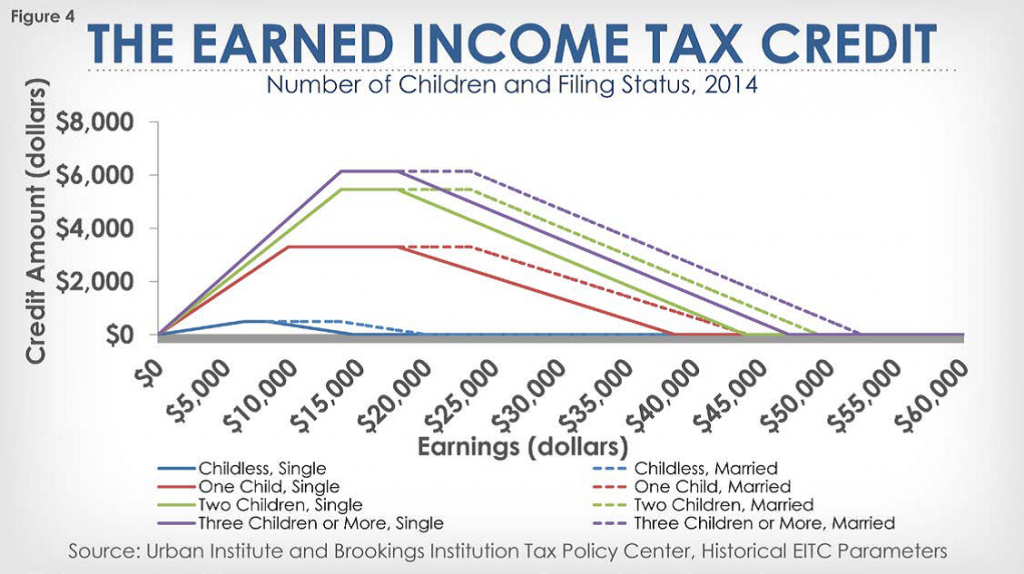
EITCGraphRyan’s proposal is simply to expand EITC eligibility to younger workers and to childless single and married parents (not to raise the upper income bound for eligibility), and to pay for that expansion with spending cuts—real cuts—elsewhere in the budget.

Running the numbers seems to mitigate the other part of this: that discouragement from advancement through the reduction in EITC subsidy that results. A married couple, one child family, for instance, making $25,000/yr gets roughly $3,500 in EITC for total income of $28,500. Were that family gets a wage increase to $30k, EITC falls to a rough $3k for total income of $33k. Thus, the family would keep $4.5k of that total income increase; the drop in EITC would constitute only a 10% “tax” on that raise.

Federal criminal justice system

Ryan’s proposal here centers on sentencing and prison reform, and this is good. A couple things are lacking, though, regarding sentencing. One specific sentencing reform that would be valuable—and that would dovetail nicely with his jobs training proposal—regards nonviolent criminal sentencing. This should center on community service, but not just any service: the criminal’s time here should be in a service that also teaches the man a marketable skill, so that when he’s finished paying his debt for his crime, he’s not only a free man again, he has the means with which to earn his way through life, rather than (be forced to) resume stealing it.

The other reform here will be much harder to achieve, and in truth it’s outside the scope of a budget proposal. We have too many Federal laws on the books, and in particular, we have too many Federal criminal laws. These need to be culled.

In the end, there’s much not to like in Ryan’s proposal—it’s deficit neutral, for instance; it by design leaves spending and taxing alone—but there’s also much to like. Progressives in government won’t like it, either. It reduces the Federal government’s role in our economy and in our individual lives, and from that it reduces those Progressives’ raison d’être.

The largest likability, and this alone is a deal maker, is that it’s a net improvement over the existing welfare régime: it takes control over welfare away from the Federal government, which for all its good intentions is too remote and too slow to respond to changing conditions, and puts welfare in the hands of those closest to the particular welfare needs: the State governments and local agencies.

Ryan’s proposal does this—another strong likability—by reallocating existing spending into consolidated block grants and shipping those to the States. The strings attached to these grants—and I’m of mixed minds regarding any Federal stringing—are minimal and centered on satisfying a Federal agency (primarily HHS and Education) that a State’s plans for the grants are suitable to the task.

****

Finally, we also must be mindful of two things: the first is that better is the enemy of good enough. This plan is good enough, for today. This plan is good enough as a first step.

The other thing is a direct follow-on to the first: welfare reform—nothing in politics—is a once and done affair. Most discussions of welfare reform, tax reform, spending reform, what-have-you reform only look at a specific proposal as though it’s entire in itself and nothing more need be done, or rejected. It’s not good enough now, so toss it and start over.

This plan is not fully grown or perfect, either. But it’s good enough for now. It’s good enough (since passage in 2014 is unlikely) for next year, and that year’s status as the first year of the 114th Congress. Pass it, knowing that the work isn’t done and knowing that the work can be improved. Then come back the following year, the second year of that Congress and correct the defects that will have become apparent by then, and add to the plan additional, de novo, changes as the experimental results come in, as experience suggests new ideas. Then in each of the sessions of the 115th Congress, do it again. And again in the 116th. And so on.

False Tax Premises

Edward Kleinbard, a USC law professor, had some thoughts on tax inversions, the process whereby a domestic company merges into a foreign company and moves its headquarters to that foreign company’s domicile in order to avoid high domestic taxes. The subject has come up in the last few weeks in the context of US companies doing the inversions. Dr Kleinbard, though, is proceeding from some false premises.

He argues, for instance,

Firms that invert argue that the deals are…harmless to US tax-revenue collection, and a necessary response to our anticompetitive world-wide corporate tax system. [“Harmless” is] demonstrably false…..

If allowed to continue, inversions will eviscerate the US domestic corporate tax base, because making a foreign company the parent of a US firm opens up new tax-avoidance possibilities.

The false premise is this. It isn’t the government’s money; it’s the money of the corporation’s owners. It simply isn’t possible for the government to be harmed by not receiving that which doesn’t belong to it.

Moreover, there shouldn’t be a “US domestic corporate tax base” in the first place. The corporation really doesn’t pay much of those taxes; the corporation’s customers do in the form of higher prices—which ultimately makes the American citizens doubly taxed.

Another of Kleinbard’s false premises is this:

Corporate tax reform will not be able to undo the damage done to the US tax base.

Part of this second error is simply a restatement of the first: no damage can be done to the government’s tax base by not receiving that which doesn’t belong to the government.

The larger question here, though, is the predicted failure of corporate tax reform. With American corporate tax rates lower than anywhere else in the world (their complete removal, say I) the US will be far more attractive to all companies, foreign and domestic. Including to those inverted companies, still inverted, or with the inversions undone as the more attractive alternative for the putative new senior partner company.

Besides, in the end, as always, the government doesn’t need the money; it needs to reduce spending.

The Wrong Question

Jim Angle, of Fox News, usually does better than this.

“Right now the savings that was projected to pay for all this spending [on Obamacare] is not being collected as originally projected,” said Charles Blahous, of the Mercatus Center. He estimated the law will eventually cost $200 billion a year by 2020.

And

“There was about $100 billion that was supposed to come in over the next 10 years from penalties on individuals, if they did not carry health insurance, penalties on employers, if they do not offer health insurance, and to date, those penalties have not been enforced,” Blahous said.

The law also counted on more than $700 billion in cuts to Medicare, including up to $150 billion in cuts to Medicare Advantage, but the president set those aside at the behest of Senate Democrats who feared angering seniors in an election year.

It’s gotten so bad that the CBO will no longer do estimates on Obamacare’s costs, Angle cites American Enterprise Institute’s Joe Antos as saying.

But then Angle goes astray:

The changes, and the overall uncertainty regarding the price tag, are raising concerns about whether the law even has enough revenue coming in to pay for the program.

This is the wrong question. The delays and alterations illustrated above show the essential capriciousness of any government effort—not just the present administration’s effort; this one is only the most active—at emulating a private business arrangement. This law shouldn’t have any revenue coming in to pay for it. This should be a private enterprise matter, with private enterprise raising the money for its private enterprise endeavor—or the endeavor fails, because the free market—American citizen participants—don’t want it. The law shouldn’t exist.