
The Left Misunderstands

Iran has a uranium enrichment facility at Fordo, a bunkered facility that Iran had built years ago in violation of its then international agreements and UN resolutions. It was only discovered in 2009, after it had been in operation for years.

The present nuclear weapons deal being “negotiated” with Iran would allow enrichment to continue at Fordo, under…inspection…, but with only several hundred centrifuges spinning.

Both Democrats and Republicans in Congress are objecting to this “deal” coming out of Lausanne, Switzerland, insisting that we’re giving away too much to Iran’s weapons program and getting too little in return, especially in the way of assurances—real block, not just “rules” and “agreements” and “protocols”—that the remaining facilities won’t, in fact, be turned to production of highly enriched uranium and the fission bombs that can be built from it.

Daryl Kimball, Executive Director of the Arms Control Association in Washington, though, thinks this is a good deal.

I think Senator Graham and Senator Menendez [leaders of the objections in the Senate] need to take a step back and put this development in a broader context. The key to Fordo is that we do not want this to be a facility with industrial-scale uranium enrichment and this report suggests they are moving in that direction.

And therein lies a bright, clear illustration of the Left’s lack of understanding of what’s happening. The key to Fordo is that it should not exist at all: its construction and operation are a demonstration that Iran cannot be trusted with any deal regarding its nuclear enrichment “program.”

Any such deal must include shutting down Iranian centrifuges—every single one of them—confiscating all uranium enriched above 5% (above that is not needed for power generating nuclear reactors), and requiring Iran to import its nuclear reactor fuel (as so many other nuclear power generating nations around the world do). Any such deal must have stern verification measures in place, also: an international inspecting presence permanently in place, able to go where it will, able to go there on no notice at all, and able to confiscate the produce of any violation. Severe sanctions to punish such violations also must be in place and triggered automatically on discovery of violation.

Full stop.
A Reason

…to decertify public “service” unions. And to terminate for cause the government’s “negotiators” for agreeing to such a thing.

Under the 1978 Civil Service Reform Act, “official time” was named, and it allows public service union members to use company time—that is, time they’re formally working for the government in a government job as a government employee—to do union administrative things. Doing union-specific work on the government’s clock also means they’re being paid by the government—by us taxpayers—to do union, and not government, work.

The thinking behind this little fillip was the premise that the union bargains in the name of all government employees, whether they’re union members or not, and this was a way to compensate the union for those alleged extra costs.

Like all sweetheart deals, this one has gotten out of hand.

According to the Office of Personnel Management, in 2012 (the most recent year there are statistics for) federal workers spent 3.4 million man-hours on union issues and not the work they were hired for. OPM estimates the cost to taxpayers was more than $157 million.

What’s more, at two government agencies that would seem least able to afford a loss of manpower—the Veterans Affairs Department and IRS—hundreds of workers spent 100% of their time doing union work. At the VA, 259 employees worked solely on union issues. At the IRS—which only disclosed their statistics when the National Review sent them a Freedom of Information Act request—the number was 201.

But wait—there’s more:

According to the Bureau of Labor Statistics, 939,000 federal workers belonged to a union in 2014. Another 139,000 were covered by collective bargaining agreements, but weren’t in a union. That brings the total number of employees covered by the unions to 31.6% of the total federal workforce.

However, there’s no requirement for any union to bargain for non-union employees, nor is there any requirement for any employer—even the government—to apply union contract terms to non-union members. Indeed, there’s no requirement for non-union employees to accept union contract terms as their own employment terms.

And so there are no costs for bargaining for the benefit of non-union employees. There never has been, requirement or cost; those are just fictions peddled by self-serving union leadership in order to get more money for union coffers.

Hence my call for decertification and termination.

All the more Reason

…to speed reform of the way in which our economy produces medical care services and in which we pay for them.

[A] 66-year-old couple retiring this year with average Social Security benefits can expect medical costs to consume 67% of the Social Security they will receive in retirement.

A 55-year-old couple who plan to retire in 10 years can expect to devote about 90% of their lifetime Social Security benefits to healthcare costs.

There’s more:

Social Security benefits typically grow by approximately 2% a year—the overall rate of inflation. But medical costs in general tend to rise by more, 5% to 7% a year[.]

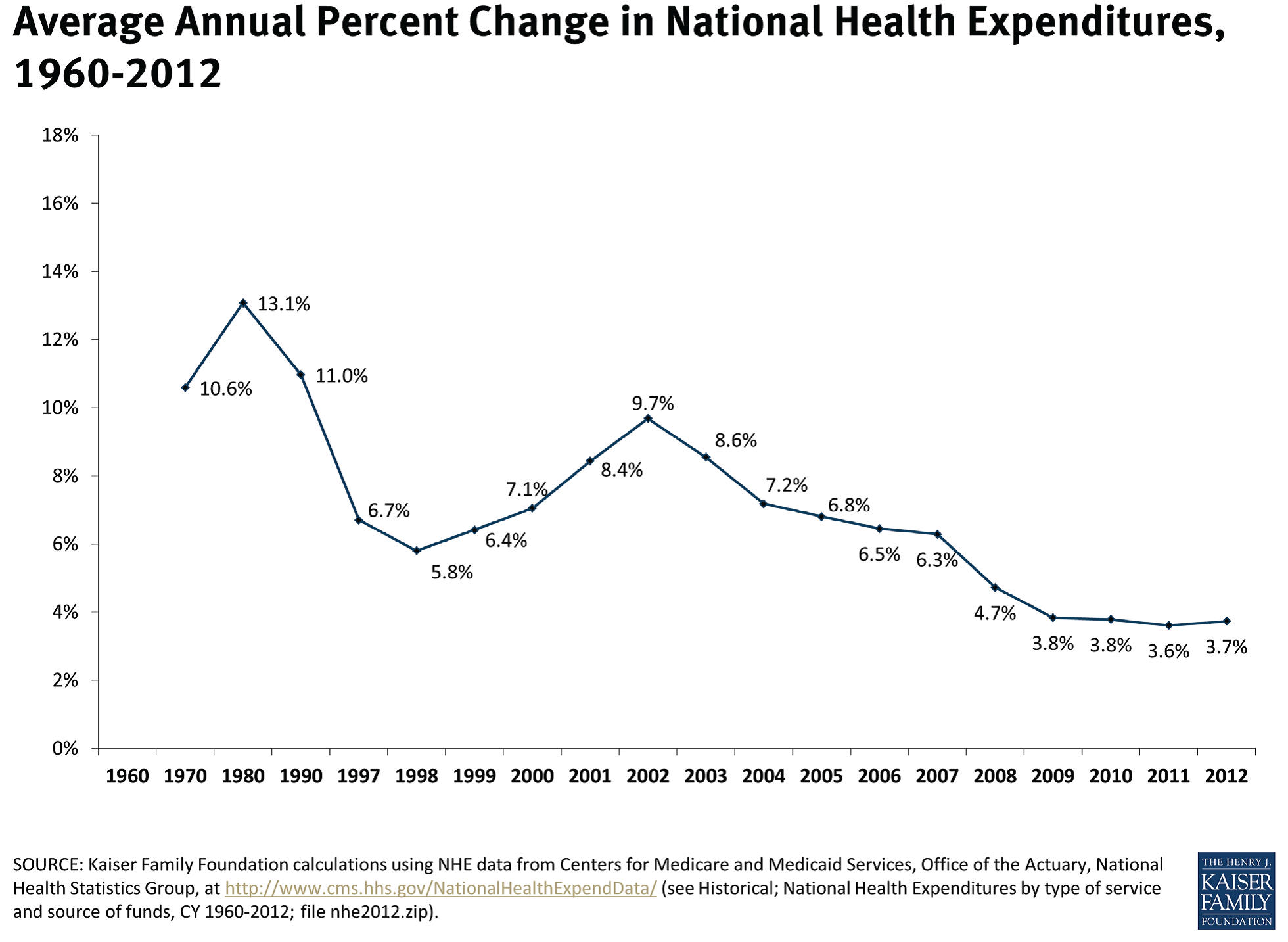
There’s this graph, too, that illustrate cost change trends since 1960:HealthCostTrends

Since Obamacare was enacted and has started to take effect (since 2010), the then-eight-year-old trend of decreasing costs has been completely stopped. That’s the effect of government intervention into a free market.

If we’re to correct this, if we’re actually to hold down, not just the rise in costs, but the actual costs themselves, we need to get government out of the way and use free market solutions: get rid of the health welfare that is Obamacare, allow insurance companies—which would sell true insurance policies—to charge premiums based on the actual risk transferred from customer to company, and allow insurance policies to be sold across state lines—that is nationwide.

All government intervention succeeds in doing is preventing competition and market forces from reducing and then holding down costs. Which hits hardest the very people these government programs are claimed to help.

Shameful

President Barack Obama has yet to meet with the new head of the North Atlantic Treaty Organization, and won’t see Secretary General Jens Stoltenberg this week, even though he is in Washington for three days. Stoltenberg’s office requested a meeting with Obama well in advance of the visit, but never heard anything from the White House….

Stoltenberg has met with most of the other NATO member heads of state, including Canada’s Prime Minister on the same trip that brought him to DC to be snubbed by our President.

It’s not like Obama was too busy to meet with the NATO head; although, Obama doesn’t have any golf scheduled, either, so….

In the end, this is a major step toward giving Russian President Vladimir Putin something of what he wants: the irrelevance, if not the outright dissolution, of NATO.

Justice Kennedy Testified

Justice Anthony Kennedy testified a little bit ago before the House Appropriations Subcommittee on Financial Services and General Government regarding the Supreme Court’s budget request. In the course of that, Congressman Ander Crenshaw (R, FL), the subcommittee’s chairman, asked Kennedy about Congressional gridlock. Kennedy answered,

And we think an efficient, responsive legislation and executive branch in the political system will alleviate some of that pressure. We routinely decide cases involving federal statutes and we say, well, if this is wrong the Congress will fix it.

But then we hear that Congress can’t pass a bill one way or the other. That there is gridlock.

Some people say that should affect the way we interpret the statutes. That seems to me a wrong proposition. We have to assume that we have three fully functioning branches of the government, government that are committed to proceed in good faith and with good will toward one another to resolve the problems of this republic.

I think, though, that Kennedy is missing part of the point (keeping in mind that the C-SPAN clip is an excerpt, but this particular answer is presented in its entirety). Federal statutes, under our Constitution, are political matters to be determined solely by We the People through our elected representatives in the Congress (with veto or signing input from our elected President). The Judiciary, that third fully functioning branch of the government under our Constitution, can only decide the legitimacy—the Constitutionality—of a Federal statute and, on finding it legitimate, can only apply that statute as it is written.

There is nothing in our Constitution that authorizes the Judiciary to do any part of law making in the event of gridlock. Gridlock is a political matter, not a judicial one, it’s an occasional outcome of the checks and balances built into our government by our Constitution, and it’s there on purpose: that would be the “check” part. The courts are in no way authorized to fill that void with their own view of what the law (or a law) ought to be. There is, in fact, no void to be filled.

It would have been good had Kennedy given a more complete answer.