
A Misunderstanding

Or a non sequitur. A recent Wall Street Journal editorial was headlined thusly: Should There Be a Tax on Soda and Other Sugary Drinks? The subhead had this: Supporters say it is an effective way to cut obesity. Critics say the health benefits are far less than claimed.

The piece then proceeded to a debate between Kelly Brownell, Dean and Robert L Flowers Professor of Public Policy at Duke University’s Sanford School of Public Policy, and William Shughart II, J Fish Smith Professor in Public Choice at Utah State University’s Jon M Huntsman School of Business, among other titles.

Both entirely missed fundamental point. The answer to the headline question can only be a resounding “No.” The debate was a waste of bandwidth and of newsprint and ink because it doesn’t matter whether taxing sodas is an effective way of curbing obesity.

As James Madison once said in the Third Congress about a related subject,

Mr Madison wished to relieve the sufferers, but was afraid of establishing a dangerous precedent, which might hereafter be perverted to the countenance of purposes very different from those of charity. He acknowledged, for his own part, that he could not undertake to lay his finger on that article in the Federal Constitution which granted a right of Congress of expending, on objects of benevolence, the money of their constituents.

Charity of one sort, or charity of another sort, or simply the Federal government presuming to pressure us toward government’s definition of society, it’s all the same. And so it is with taxing as well as spending. Our tax code, in no way shape or form, should be used to conduct social engineering. Full stop.
Irrelevant Indeed

The spokesman for the Saudi-led coalition targeting Yemen’s Shiite rebels in airstrikes since March says the coalition is not bound by a new truce deal.

Saudi Brig Gen Ahmed Asiri’s comments, posted Saturday on the website of the semi-official Saudi newspaper al-Riyadh, cast doubt over the fragile truce that begin at midnight Friday.

Well, it is, after all, a UN-declared “truce.” It’s not like all the combatants were even consulted. Like the Houthis, or the Saudis, or many of (any of?) their coalition partners.

Some Economics Numbers

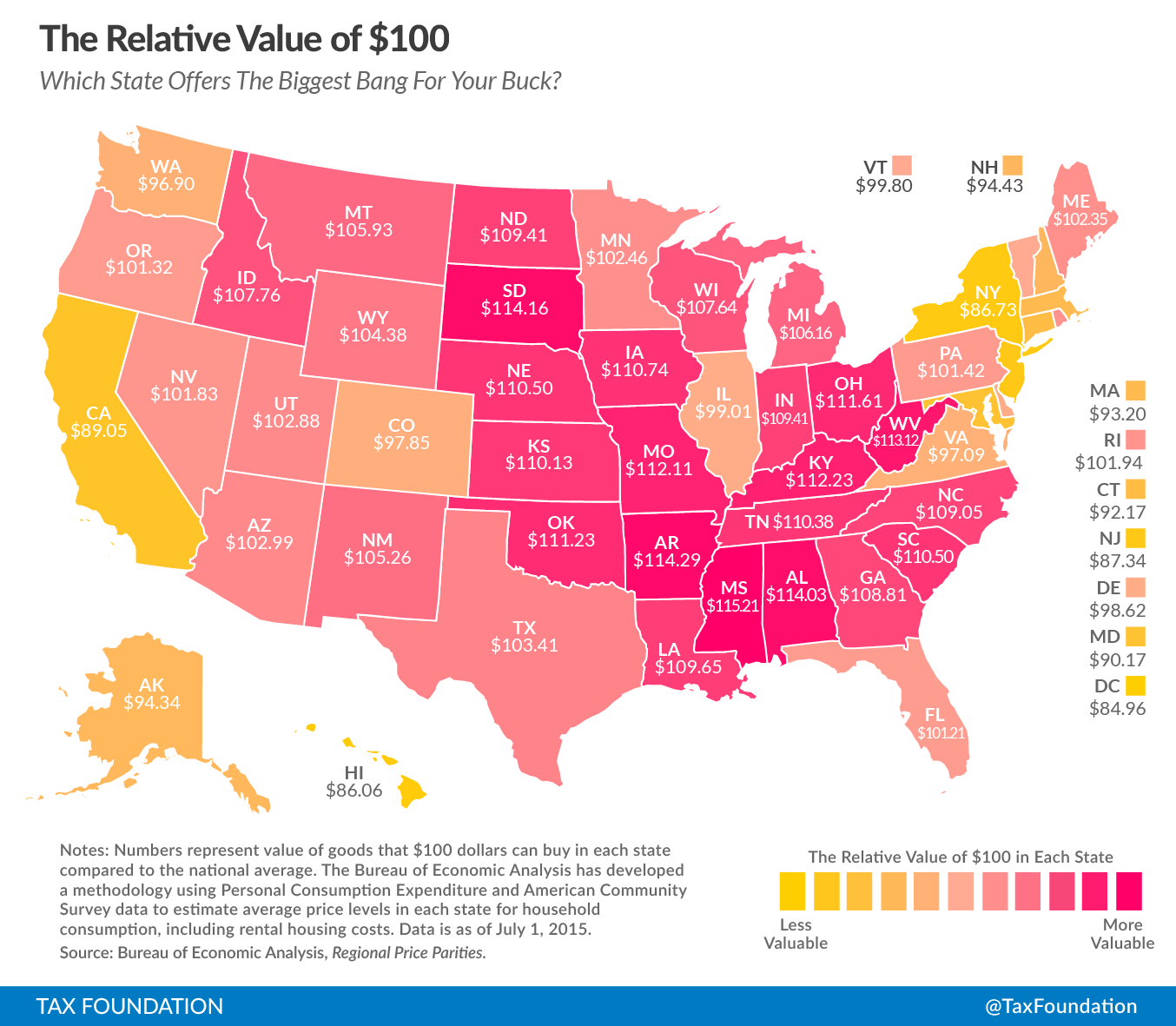
…from the Tax Foundation, via AEIdeas. First this graph (right-click on it to get a bigger, more readable version):TaxMap_100-Map

The figures are regional price parities of $100 for each of the 50 states, where the national average price is taken as 100. In other words, whereas on average across the whole country, $100 would buy $100 worth of goods, in California those $100 would buy only $89 and change, in Arkansas those $100 would buy a bit over $114 worth of the same goods. The bulk of the differences across the US was driven by relative housing costs: California’s housing, for instance, costs one-third more than the national average while Arkansas’ housing is one-third cheaper.

Mark Perry expanded on these data in his article at the AEIdeas link above, and adjusted per-capita personal income for differences in personal taxes and those price levels. California, based solely on income, ranked 12th in the nation at $48.5k per person. After adjusting for California’s tax bite and pricing, though, the value of a California’s average citizen fell to just $34.8k, dropping California to 37th in the nation the value of that nominal income.

Arkansas, on the other hand, started out 43rd in unadjusted income, with a citizen getting $36.7k. After tax and price level adjustment, though, the state rose to 31st, with that income becoming $35.5k.

There’s something to be said for cost of living and taxes in determining where actual prosperity resides.

An Accelerating Nuclear Program?

Iran keeps threatening to greatly accelerate its nuclear weapons program if the current “negotiations” break down.

While US-led world powers hold talks with Iran in Vienna to curb Tehran’s illicit nuclear weapons program, the Islamic Republic’s spies have been seeking atomic and missile technology in neighboring Germany as recently as last month, according to German intelligence sources.

Iran’s illegal activities have continued since talks between Iran and the P5+1 [now carefully relabeled “EU + 3”]…began with a Joint Plan of Action in 2013, according to German intelligence sources. The JPOA was intended to stop Iran’s work on a nuclear weapon until a comprehensive agreement is reached.

It seems they already are—have been for some time—accelerating their nuclear weapons program.

Given this, on what basis could anyone possibly accept a deal signed by the current men of the Iranian government—beginning with Ali Khamenei?

National Security Teams

USMC General Joseph Dunford, in a Senate confirmation hearing concerning his nomination as our new Joint Chiefs of Staff Chairman, had this to say about threats to our national security.

My assessment today…is that Russia presents the greatest threat to our national security.

So if you want to talk about a nation that could pose an existential threat to the United States, I’d have to point to Russia.

In Russia we have a nuclear power. We have one that not only has the capability to violate the sovereignty of our allies and to do things that are inconsistent with our national interests, but they’re in the process of doing so.

So if you want to talk about a nation that could pose an existential threat to the United States, I’d have to point to Russia. And if you look at their behavior, it’s nothing short of alarming[.]

To which President Barack Obama responded through his Press Secretary Josh Earnest:

Certainly, General Dunford is somebody who has spent a lot of time thinking about these issues and has his own view, but I think that he would be the first to admit that that reflects his own view and doesn’t necessarily reflect the consensus analysis of the President’s national security team[.]

What an alarming thing to say about his own national security team.